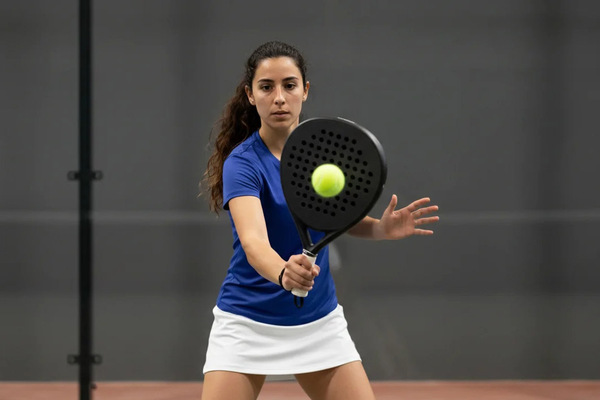
If you could fix only one thing in your padel technique, fixing your contact point would probably do more than almost anything else. Where you meet the ball, in relation to your body and your racket, decides how much control you have, how much power you can use, and whether you're rushed or comfortable. Different shots have different ideal contact points, which is why a bandeja feels nothing like a chiquita. This guide explains where to hit each shot in padel, from groundstrokes and volleys to overheads and wall balls, with a quick-reference table, drills to find your own contact point, and the mistakes to avoid.
Two Meanings of "Contact Point"
The phrase covers two ideas. The first is where the ball is relative to your body: in front, beside you, or behind you, and at what height. The second is where on the racket the ball lands. Coaches describe players who understand the basics but don't always hit the center of the racket, which costs them control. Both matter, and good contact starts with good positioning so that the ball arrives where your racket face is ready for it.
The Golden Rule: Meet the Ball in Front
Across almost every shot in padel, the best contact is in front of your body, with the racket set before the ball bounces. Padel swings are shorter than most tennis players expect, and the ball often comes quickly off the glass, so the habit that helps most is to let the ball come to you and take fewer balls behind your body. When the ball ends up beside your hip or behind you, you've been late, and the shot loses direction and power.
Note
The heights below are guides, not strict rules. Your height, grip, and the ball's pace all change the exact spot. Use them as a starting point, then find the contact that feels strongest and most controlled for you.

Where to Hit Each Shot
| Shot | Where to Make Contact |
|---|---|
| Forehand and backhand groundstrokes | In front of the body, around waist height, toward the front leg |
| Volley | In front of your body and shoulders, with the racket head above your wrist |
| Bandeja | At about forehead or eye level, slightly in front of you and to the side of your hitting shoulder |
| Flat smash | Above you and slightly in front, with the arm extended |
| Kick smash | In front of the body, brushing up and over the top of the ball |
| Chiquita | In front of the body, around knee to waist height, with the racket below the ball |
| Serve | At or below waist height, with the ball dropped close to your body |
| Wall exit | After the rebound, in front of you in a comfortable zone around waist height |
Groundstrokes: In Front, Around the Waist
Put it to the test with our free padel quiz — quick questions, instant results.
On forehand and backhand drives, aim to meet the ball in front of the body, around waist height and in line with your front leg, with your weight moving forward. On a slice forehand, the ideal contact is somewhere between hip and shoulder height. On the backhand, make contact slightly ahead of your body, out toward the lead foot, and not next to your hip or behind you.
Volleys: A Short Punch in Front
A volley is a punch, not a swing. Take only a small backswing, step into the shot, and meet the ball in front of you, with the racket head above your wrist. If the ball gets close to your hip or body, you're late, and the volley will lack direction. Keep your racket up in front of your chest so you can adjust. For low volleys, bend your knees to get down to the ball instead of dropping your racket head below the ball, which makes the shot pop up.
Overheads: Choose Your Height
Overheads have different contact points depending on the purpose of the shot. The bandeja is a control shot, hit around forehead or eye level, slightly in front of you and not at full stretch above you. Staying grounded and balanced and meeting the ball in front of the body also sets you up to recover to the net. A flat smash is hit higher, with the arm extended above and slightly in front. The kick smash is also hit in front, but with the racket brushing up and over the ball to add spin.
Soft and Defensive Shots
For the chiquita, take the ball in front of you at about knee to waist height, with the racket below the ball. If contact is too far behind you, the ball pops up and gives the net player an easy volley, and if it's too early, you risk hitting the net. Wall exits follow a different rule: wait for the ball to drop after the rebound into a comfortable zone, then step in and meet it in front of your body.
The Serve
On the serve, contact must be at or below waist height. Drop the ball close to your body, just ahead of your front foot, and give it a moment to rise before you hit through it. Contact above the waist is the most common serving fault.
Important
If you often feel rushed, check whether you're contacting the ball behind your body. Taking the ball earlier and in front, even by a few centimeters, usually fixes multiple problems at once: better control, better height, better balance, and faster recovery.

How to Find Your Contact Point
Everyone's ideal spot is slightly different, so it helps to find it by feel. Stand sideways and take slow shadow swings, noticing where your arm is naturally extended and strongest. Then have a partner feed easy balls and try to meet them at that spot. A cone or a marker placed on the court in front of your lead foot can give you a physical target for where contact should happen. Filming a few swings from the side shows whether you're making contact beside you or behind you.
Drills for Better Contact
Cone Contact Drill
Place a cone just in front of your lead foot. Hit easy feeds and aim for contact at about that spot, so you build a consistent reference.
Shadow Swings With a Mirror
Practice slow swings in front of a mirror or a camera, and check the position of your arm and racket at the moment of contact.
Center of the Racket Drill
Rally gently with a partner, and focus on hitting the middle of the racket on every ball. Count how many in a row feel centered.
Volley Punch Drill
A partner feeds volleys at chest height while you keep the swing tiny and meet each ball in front of you.
Overhead Height Drill
A feeder throws lobs. Hit some as bandejas at eye level, then some as flat smashes with the arm extended, to feel the difference in height.
Common Mistakes
Hitting Beside or Behind the Body
It leaves you jammed and out of control. Step in and meet the ball in front.
Dropping the Racket Below the Ball on Volleys
It pops the ball up. Keep the racket head above your wrist and bend your knees.
Contacting the Serve Above the Waist
It's the most common serving fault. Keep contact at or below waist height.
Ignoring the Racket Face
Hitting off-center costs control. Practice finding the middle of the racket.
Advice
Film yourself from the side for two minutes in your next practice. Freeze the video at the moment of contact on a forehand, a volley, and a bandeja. Seeing where the ball meets the racket relative to your body is the fastest way to find what to fix.

The right contact point depends on the shot, but the principle is the same: meet the ball in front of your body, at the height that suits the stroke, with the middle of the racket. Learn the contact point for each shot, find your own reference, and you'll gain control, power, and time without changing a single swing.