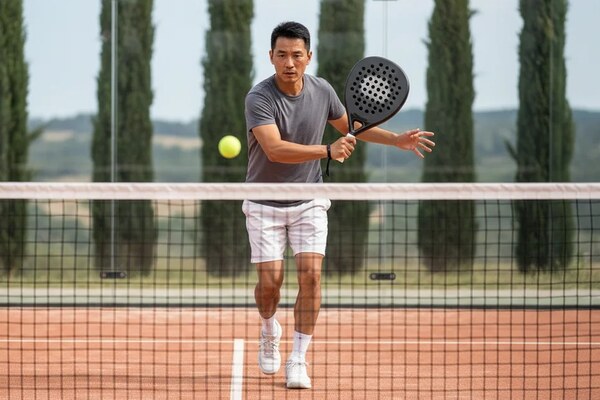
A backhand you can trust isn't the one that hits the hardest. It's the one that goes where you aim, comes back every time, and doesn't fall apart when the ball comes off the glass. That kind of control is built with targeted practice. This guide gives you ten padel backhand drills for better control, arranged as a progression from simple wall work to direction, speed changes, rebounds, and defensive shots, plus a scoring table and a four-week plan. For the basic technique, see our beginner-friendly guide to the one-handed backhand.
What Control Means on the Backhand
Control has three parts. Depth is how far the ball travels, ideally deep enough to push opponents back. Direction is where you send it, such as cross-court or through the middle. Consistency is how often you can repeat the shot under pressure. The drills below train all three, and beginners should live on control, not power.
Before You Start
- Mark targets. Use cones or marked zones on the court so you have something to aim at. Directing your backhand to a target improves accuracy and depth.
- Use good balls. Flat, worn balls make control drills frustrating.
- Warm up first. A few minutes of light movement and easy rallies before you add targets.
- Keep score. Count how many of ten shots hit your target. A number makes progress visible.
Note
Start every drill slowly. A smooth, balanced swing at half pace trains control far better than a rushed one at full speed. Add pace only when your targets are being hit consistently.

Ten Backhand Drills for Control
Drill 1: Wall Rally for Posture and Timing
If you have access to a practice wall, hit backhand after backhand against it, maintaining control and good posture. Focus on turning early, keeping the swing short, and making contact in front. Once you can keep a long rally standing still, add a small recovery step sideways after each shot, so you're moving into every ball.
Drill 2: Wall Backhand With Depth Control
On the same wall, aim to keep every rebound at a similar height and distance by controlling your pace. If the ball keeps coming back too high or too fast, you're swinging too hard. The goal is a rhythm you could keep up indefinitely.
Put it to the test with our free padel quiz — quick questions, instant results.
Drill 3: Cross-Court Series
With a partner or coach, rally backhand to backhand cross-court, focusing on hip rotation and weight transfer. Cross-court is the natural direction for your backhand because it uses the longest part of the court, which gives you more room for error.
Drill 4: Cross-Court and Down the Line
Now alternate directions: one cross-court, one down the line. Mark target zones for each, and count how many land. This builds the ability to change direction without telegraphing it.
Drill 5: Target Zone Challenge
Place cones in the deep middle, the deep corner, and a shorter zone. Call the target before each shot and try to hit it. It trains accuracy, and the calling forces you to decide before you swing.
Drill 6: Speed and Height Variation
With a partner, perform backhand series where your partner varies the pace and height of the feed. You'll learn to adjust your preparation and contact point to different balls, which is exactly what happens in a match.
Drill 7: Glass Rebound Feeds
Have a partner feed balls past you into the back glass. Practice the routine of tracking the ball, turning, and letting it drop before you hit. Repeat until it's automatic, since a backhand off the glass is one of the most common defensive shots in padel.
Drill 8: Corner Ladder
A partner feeds balls toward the corner seam where the back and side glass meet. Work through three stages: single glass, double glass, then taking the ball before the wall, with about five repetitions of each. Keep the swing short and compact.
Drill 9: Backhand Lob for Depth
From the backhand side, hit lobs aimed deep, near the back of the court. A controlled lob gives you time and takes pressure away, and practicing it with your backhand makes it a reliable escape.
Drill 10: Soft Touch Rally
Stand close to the net with a partner and rally backhands softly, avoiding power and focusing completely on feel. Short distances force you to control pace and contact, which develops the touch you need for slices and chiquitas.
Important
If your accuracy drops when you add pace, step back to the previous drill. Control that disappears under speed isn't control yet, and rushing it only builds bad habits.

How to Score the Drills
| Drill | What It Builds | How to Score It |
|---|---|---|
| Wall rally | Posture, timing, rhythm | Longest rally without a mistake |
| Cross-court series | Direction and weight transfer | Consecutive balls in play |
| Cross-court and down the line | Changing direction | Balls hitting the right zone out of 10 |
| Target zone challenge | Accuracy | Targets hit out of 10 |
| Speed and height variation | Adaptability | Balls controlled out of 10 |
| Glass rebound feeds | Defense off the wall | Controlled replies out of 10 |
| Corner ladder | Reading corners | Good contacts per stage out of 5 |
| Backhand lob | Depth under pressure | Lobs landing deep out of 10 |
A Four-Week Plan
In week one, do Drills 1 and 2 against a wall, plus Drill 3 with a partner, focusing on a short, smooth swing. In week two, add Drills 4 and 5, and start counting targets hit. In week three, introduce Drills 6 and 7 to work on varied balls and the glass. In week four, add Drills 8 and 9, then finish with Drill 10 as a cool-down.
Which Drills for Which Level?
Beginners should spend most of their time on Drills 1 to 3, building a short swing and a steady cross-court rally. Intermediate players can focus on Drills 4 to 8, where direction, varied balls, and the glass come in. More experienced players can use Drills 9 and 10 to refine the lob and the touch shots that win points. Whatever your level, remember that control is trained at a comfortable pace and then tested under pressure.
Adding Flat and Slice to the Drills
Once the basics are steady, repeat the cross-court and target drills with both a flat backhand and a slice. Compare how the ball behaves after the bounce, and notice which one gives you more control on low balls and which keeps the ball low off the glass. Having both options makes it much easier to adjust to different situations during a match.
Common Mistakes
Hitting Too Hard Too Soon
Power makes accuracy harder. Build control at a comfortable pace.
Practicing Without Targets
If you don't aim at anything, you can't measure control. Always mark a target.
Skipping the Wall and Glass Work
Many backhands in padel are played off the glass, so train rebounds as well as clean balls.
Forgetting to Recover
A good backhand followed by standing still leaves you out of position. Add a recovery step to every drill.
Track Your Control
Choose two measures, such as targets hit out of ten and your longest rally, and record them weekly. A steady rise over a month shows your backhand is becoming more controlled, even if individual sessions feel uneven.
Advice
Film a short clip of your backhand each week from the side. Check three things: early turn, contact in front, and recovery. Seeing yourself is the fastest way to find the habit that's costing you control.

Padel backhand drills for better control come down to targets, a comfortable pace, and a progression from the wall to cross-court, down the line, the glass, and finally game-like feeds. Count your results, stay patient with speed, and your backhand will become a shot you can rely on when it matters.