Reading the wall and deciding to let the ball bounce are only half of back wall play. The other half is the stroke itself: how you set up, where you make contact, and what you hit once the ball comes off the glass. Done well, a ball that looked threatening becomes a controlled drive, a reset lob, or even an attack. This guide focuses on the mechanics of the shot played after the rebound, and complements our guides on defending the back wall and on letting the ball bounce off the wall.
When You Play Off the Back Wall
Back wall shots are defensive shots played from the back of the court. A useful rule of thumb is that when the ball bounces on the baseline or deeper, you should play it after it rebounds off the wall rather than trying to take it early. These shots are essential for responding to deep attacks and getting back into the point, and they're a core skill for any player who wants to stop feeling trapped at the back.
Note
The Spanish name for this shot is "salida de pared," or wall exit. Some players also call it "contrapared," meaning "against the wall." Different coaches use the terms slightly differently, but the idea is the same.

Phase 1: Prepare Before the Ball Arrives
Preparation starts when you read your opponent's shot. Work out where the ball is likely to go after it hits the wall, and consider whether it's travelling straight or across the court, how hard it's hit, and whether it carries spin. Take the racket back early and adjust its height to the height of the ball, so you aren't scrambling to set up after the rebound.
Phase 2: Let It Pass and Get Between the Wall and the Ball
Let the ball pass you and hit the wall. When it rebounds, position yourself between the wall and the ball, so that the ball comes toward you and you can hit it in front of your body. If you're moving back with the ball toward the wall and then forward after it rebounds, you can take a fuller swing with more control than if you were jammed against the glass. Standing flat against the wall leaves no room to swing and forces a cramped shot.
Phase 3: Contact
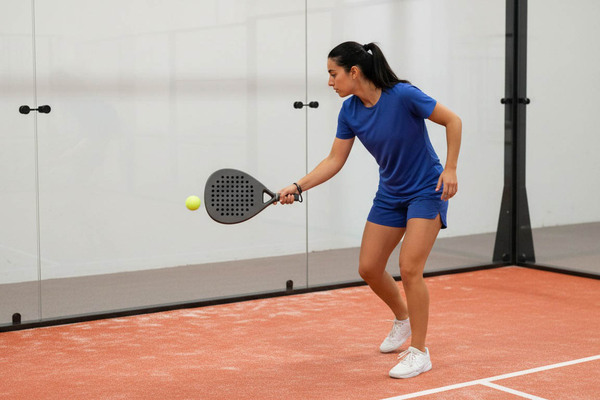
Aim to hit the ball in front of your body, and try to make contact when the ball is at the highest point of its flight after rebounding. Stepping forward into the shot gives you stability and control, and a compact swing keeps the stroke reliable, especially when the ball arrives with pace. The point is to meet the ball, not to chase it from behind.
Put it to the test with our free padel quiz — quick questions, instant results.
Important
Move back with the ball as it travels toward the wall, but once it has rebounded, resist the urge to keep retreating. Counter-intuitively, staying put or moving into the ball improves your timing, while backing away makes you hit the ball late and from behind.

Phase 4: Follow Through and Recover
On the forehand, finish with your racket across your body, roughly in line with the opposite shoulder, as if you were wearing a scarf. Then recover your position, because the shot is rarely the end of the point. If your reply is deep and has put opponents on the back foot, move forward and take the net back together with your partner.
Forehand and Backhand Wall Shots
The principles are the same on both sides. On the backhand, make a point of showing your shoulder to the net, take the racket back with the tip pointing toward the back wall, and make contact a little ahead of your hip, always staying between the wall and the ball. On either side, the key is to decide early what you plan to hit, rather than hoping to improvise once the ball arrives.
What to Hit After the Rebound
| Situation | Good Choice |
|---|---|
| Under pressure, ball arrives fast | Controlled drive cross-court or through the middle |
| Need time to reset | High, deep lob over the net players |
| Clean, higher single-wall rebound | Bajada: step in and drive through it low |
| Low, skidding ball | Get behind it, play higher cross-court |
| Opponents crowd the net | Lob deep to the corner, then advance |
The Bajada: Attacking Off the Back Wall
The bajada, Spanish for "descent," is an attacking shot played after a ball rebounds off the back glass. Step in early, meet the ball at a higher contact point, and hit through it with a flat or slightly sliced stroke, keeping it low and direct over the net. It's best saved for clean, single-wall rebounds, and most coaches suggest learning the basic wall exit first, since the bajada is a more advanced shot.
Corners and Double-Wall Balls
Balls that hit two walls are trickier because the rebound is less predictable. Use a compact swing and avoid a big backswing that could collide with the side wall. The best moment to hit a double-wall ball is after it has completed its full rebound and begins to rise slightly, since that's when it's most predictable and controllable. Open the racket face, turn your shoulders, and let the ball complete its path before you step into the shot.
Drills to Build the Shot
Drop-Feed Wall Exit
Stand roughly a racket length from the back glass, drop-feed a ball, let it bounce and rebound, then step forward and drive it cross-court.
Deep Lob Feeds
Have a partner feed deep lobs to the back corner and play a wall exit on each one, aiming for height and depth.
Exit and Advance
Play a wall exit, then take two steps forward with your partner to practice the transition from defense to attack.
Mixed Responses
Have a coach call "drive," "lob," or "bajada" as the ball bounces, so you practice choosing and executing a response quickly.
Tracking Your Progress
Choose a simple measure during practice, such as how many of ten deep balls fed off the back wall you return deep and under control without feeling jammed. Add a second measure for decision-making, such as how often you chose a sensible reply for the situation. A rising score over a few weeks is a clear sign your preparation, spacing, and contact are improving, even when individual shots still feel awkward.
Common Mistakes
Standing Flat Against the Wall
It jams your swing. Give yourself room.
Backing Away From the Ball
Stepping back makes you late. Move between the wall and the ball and step in.
Swinging Too Big
A long backswing is hard to time and can hit the side wall. Shorten it.
Turning Your Back on the Court
Losing sight of the court makes it harder to choose a target. Keep your shoulders turned but your eyes up.
Advice
Learn the basic wall exit first and make it reliable before adding the bajada. A solid, controlled reply from the back is worth much more in matches than an occasional spectacular attack.

Playing well off the back wall comes down to four phases: prepare early, get between the wall and the ball, make a compact, forward contact, and recover. Master those, then add the choices that turn defense into offense, and the back glass stops being the part of the court you fear and becomes the part you use.