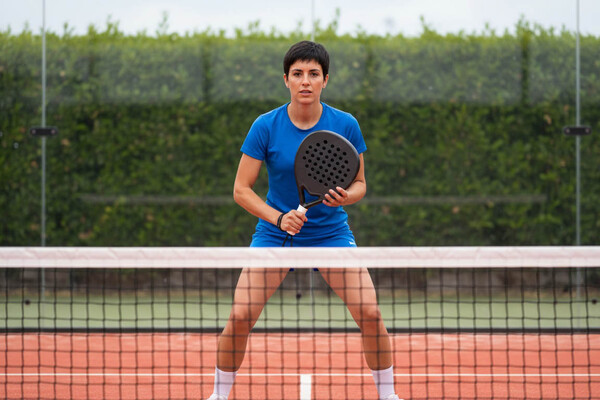
The net is where most padel points are decided, and how you move there decides how often you get to use it. Good net footwork is small, quick, and balanced: it keeps you ready for a fast volley, lets you cover the middle, and gives you time to handle a lob. Most players spend far more time practicing strokes than movement, even though poor footwork is behind many volley errors. This guide breaks down net movement into a handful of habits you can practice: distance, stance, the split step, adjustment steps, lateral movement, advancing, covering the lob, and recovery.
Why Net Movement Is Different
At the net, exchanges are fast and the distances are short, so there's rarely time for a big step or a long run. At the same time, the lob can send you backward in an instant. That combination means net movement is mostly about being ready, adjusting with small steps, and choosing a position that gives you options in both directions.
Start With the Right Distance
A common mistake is standing too close to the net. A good net position is roughly two to two and a half meters back, noticeably further than most beginners stand. From there you can still volley down into your opponents' feet, but you can also cover a decent lob with two or three backward steps instead of a desperate sprint. Standing within touching distance of the net leaves you exposed to every lob and gives you little space to put your body weight into a volley.
Note
Commit to your position. Either get all the way to the net or get all the way back, because hovering halfway leaves you vulnerable at your feet.

The Ready Stance
Stay light on the balls of your feet, with your knees slightly bent and your weight balanced, and keep your racket up in front of you around waist height or higher. Turn slightly side-on to the net so you can push backward for a deep ball without a full stop-and-turn. A flat-footed, upright stance makes every direction slower.
The Split Step
The split step is a small hop made just as your opponent hits the ball. It loads your legs so you can push off in any direction, whether that means forward to a short ball, sideways to a volley, or backward to a lob. The key is timing: land just as your opponent makes contact, and treat it as a stop, not a lunge. If you jump too early you'll still be in the air when you need to move, and if you drift forward while splitting, you'll arrive late and off balance. Do it before every opponent shot until it becomes automatic.
Small Adjustment Steps
Put it to the test with our free padel quiz — quick questions, instant results.
The last steps before a volley should be short and quick. Fine-tune your position with small adjustment steps rather than one big lunge, because short steps keep you balanced and make it easier to meet the ball in front of your body. Avoid overstepping the best distance from the ball. Long steps make it harder to control the racket and slow you down when you need to recover.
Important
If you find yourself lunging for most volleys, your first step is probably too late. Work on the split step and on starting your movement earlier, rather than trying to reach further.

Lateral Movement and Covering the Middle
At the net, most of your movement is sideways. Use short side shuffles for small distances and a crossover step when you need to cover more ground. Shift in the same direction as your partner so the middle stays covered, and remember that recovery doesn't have to be purely sideways: moving diagonally to your next position is often quicker.
Moving Forward to the Net in Stages
Approaching the net isn't a single sprint. Hit your approach shot, take two or three quick steps forward, then split step as your opponent starts their swing. If their reply is weak, keep going. If they lob, you're balanced enough to turn and retreat. Arriving at the net in the middle of a stride leaves you unable to react in any direction.
Covering the Lob
Lobs are the main way to dislodge a net player, so your footwork needs a backward option. When an opponent sets up early under a high ball, a lob is coming, so take a half-step back before they swing. Stay side-on and take two or three quick backward steps, keeping your eyes on the ball, before turning fully if you need to chase it. If a lob beats your partner, drop back with them rather than staying forward alone.
Recovering After Every Volley
Every volley should be followed by a recovery. After you hit, move back to a balanced, central position, ready to split step again. One of the most common mistakes is standing still after a good volley, admiring the shot, and being caught flat-footed when the ball comes back. Hit, recover, split, repeat.
| Situation | Footwork |
|---|---|
| Opponent about to hit | Split step, landing at contact |
| Ball close to your body | Small adjustment steps |
| Ball wide | Side shuffle or crossover, partner shifts too |
| Lob coming | Half-step back, stay side-on, quick backward steps |
| After a volley | Recover to a balanced, central position |
Footwear and Court Conditions
Good footwork depends on being able to push and stop confidently. Padel shoes with good lateral support and grip help you move sideways safely, and a quick check of the court surface before play makes it easier to anticipate how much you'll slide.
Drills for Net Movement
Split Step Reaction
A partner feeds balls from the other side while you split step before each one and then move to volley. Focus on landing as the feeder makes contact.
Shadow Shuffle With Calls
With a partner at your side, shuffle sideways together as a coach calls "left," "right," or "lob." This trains side movement, covering the middle, and the backward step.
Volley and Recover
Hit a volley, then immediately recover to the ready position and split step before the next feed. The emphasis is on the recovery, not the volley.
Lob Cover
Have a feeder alternate volleys and lobs so you have to read each one and decide whether to stay forward or step back.
Tracking Your Progress
Movement is easier to improve when you can see it. Ask a partner or coach to watch whether you split step before most opponent shots, or film a short rally from behind and count how often you recover after a volley. A rising count over a few weeks is a clear sign the habits are taking hold, even when the individual shots still feel the same.
Common Mistakes
Standing Too Close to the Net
It limits your reaction time and leaves you vulnerable to lobs. Give yourself some space.
Skipping the Split Step
Without it you start from a standstill and react late. Make it a habit.
Lunging Instead of Stepping
Big lunges throw you off balance. Use small adjustment steps.
Standing Still After the Shot
Recover straight away so you're ready for the next ball.
Advice
Start with one habit, such as adding a split step before every opponent shot, and practice it for a few sessions before adding the next. Small, consistent improvements in net footwork make a big difference.

Moving well at the net comes down to a sensible distance, a light and ready stance, a well-timed split step, short adjustment steps, and a quick recovery after every shot. Practice those habits and the net stops feeling like a place where things happen too fast and starts feeling like the place where you control the point.