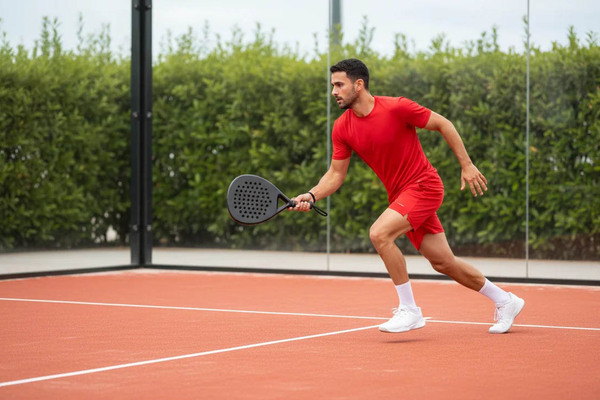
Many players try to improve at padel by hitting more balls, yet the fastest gains often come from moving better. Padel is a positioning sport: the walls bring the ball back so rallies keep going, and even good technique falls apart when your feet are in the wrong place. This guide gives you a complete picture of court movement, from the three zones you move between to the five basic footwork patterns, and a simple routine to build them. It's an overview, and it points you toward more detailed guides on net movement and moving as a pair.
Padel Is a Positioning Sport
Because the glass keeps the ball in play, the player who is in the right place has more time and more options than the player who is simply faster. Better positioning also means running less, since you're already where the ball is going. That's why improving how you move often feels like improving everything else at once: your decisions get better, your balance improves, and your shots become easier to hit.
The Three Zones of the Court
It helps to think of the court in three functional zones based on your distance from the net. The defensive zone runs from the back glass to roughly two meters forward, the transition zone covers the middle of the court between the service line and the back glass, and the net zone runs from the net to about three meters back. Most points involve moving between these zones, and the main challenge is knowing when to stay and when to pass through.
| Zone | Main Goal | Movement Priority |
|---|---|---|
| Defensive (back glass) | Stay in the point, choose safety before pace | Use the glass for time, move back then forward |
| Transition (middle) | Pass through quickly | Don't stop, move with your partner |
| Net | Apply pressure | Small steps, split step, cover the middle |
The Five Building Blocks of Padel Footwork
The Split Step
A small hop made just as your opponent hits the ball, so your legs are loaded to push off in any direction. It's the foundation of reaction speed, and it should happen before almost every opponent shot.
Adjustment Steps
Short, quick steps used to fine-tune your position before hitting. They keep you balanced and let you meet the ball at the right distance, instead of lunging or reaching.
The Side Shuffle
Put it to the test with our free padel quiz — quick questions, instant results.
A sideways step used for short distances, keeping you facing forward and ready. It's the basic way to cover small gaps at the net or the back.
The Crossover Step
A faster step for covering longer distances, such as moving back toward the glass or across the court. Use it when a shuffle won't get you there in time.
The Recovery Step
After each shot, return quickly toward the center and a balanced position so you're ready for the next ball. In padel, recovery is constant, and good recovery reduces effort while bad recovery creates panic.
Note
These aren't separate skills to master one by one. In a rally you'll use all five in sequence: split, step, shuffle or cross, hit, recover.

Move Efficiently: Diagonals and Fewer Steps
Wasted movement is tiring and slows you down. One simple habit is to move diagonally rather than only sideways or straight back, since diagonal paths often get you to the next position faster. Taking fewer, more purposeful steps and avoiding unnecessary running also saves energy over a long match.
Moving Around the Back Glass
The back glass is one of the trickiest parts of padel movement. The glass gives you extra time, but only if you use it instead of rushing through it. Retreat toward the glass in a controlled way, let the ball come to you, play deep and cross-court, and choose safety before pace. Standing too close to the wall leaves no space to play the rebound, so give yourself room to step into the shot.
Moving Forward and Backward: Commit
When moving forward to the net, advance in stages: hit your shot, take a few quick steps, then split step as your opponent swings. If you can't get all the way to the net, it's often better to stay back with your partner than to stop halfway in the transition zone. A common mistake is moving to the net without a strong ball and getting passed easily.
Move With Your Partner
In padel you're almost always either up at the net with your partner or both towards the back defending, and the best teams move around the court together to cover space and leave fewer options for opponents. Staying connected, covering the middle, and communicating are covered in more detail in our guides on moving as a pair, and net-specific footwork is covered in our guide to moving at the net.
Looking After Your Body While You Move
Padel involves quick starts, stops, and turns, which can be hard on the knees and ankles, particularly if you move inefficiently. A good warm-up, regular balance and strength work, and sensible progression in how often you play all help. If you have pain or an injury, talk to a doctor or physiotherapist rather than pushing through.
Footwear and Court Surface
Padel shoes are designed for stability, support, and grip on the court surface, which lets you change direction safely. Check your soles regularly and clean them, since a worn or dirty sole reduces traction and makes every movement less secure.
A Simple Weekly Movement Routine
Spend ten to fifteen minutes at the start of a session on movement. Begin with a few minutes of dynamic warm-up, then practice split steps and side shuffles without a ball, and finish with a few minutes of shadow movement where you move to imaginary shots and recover each time. Adding this to two sessions a week is usually enough to see a noticeable difference after a few weeks.
Signs Your Movement Needs Work
A few patterns suggest movement is the real problem rather than technique: you often hit the ball off balance or at full stretch, you're regularly late to balls that look easy, you feel out of breath chasing balls you could have anticipated, or your partner keeps ending up in the same spot as you. Spotting these signs helps you decide whether to spend your next practice on strokes or on footwork.
Common Mistakes
Skipping the Split Step
Starting from a standstill makes every reaction slower. Make the split step automatic.
Standing Still After Hitting
Failing to recover leaves you out of position for the next ball. Hit, then recover.
Rushing the Back Glass
Hurrying a ball off the wall wastes the time the glass gives you. Let it come to you.
Stopping in the Middle
Hovering in the transition zone leaves you exposed. Commit to the net or retreat together.
Important
Movement training isn't about getting faster at all costs. Controlled, balanced movement beats frantic speed, and it's also easier on your joints.

Advice
Pick one movement habit each week, such as split-stepping before every opponent shot, and focus only on that. Layering habits gradually works far better than trying to change everything at once.

Moving better on a padel court comes down to knowing the zones, using the five basic footwork patterns, moving efficiently, using the glass wisely, and staying connected with your partner. Build those habits one at a time, and your shots, your decisions, and your stamina will all improve without changing a single stroke.