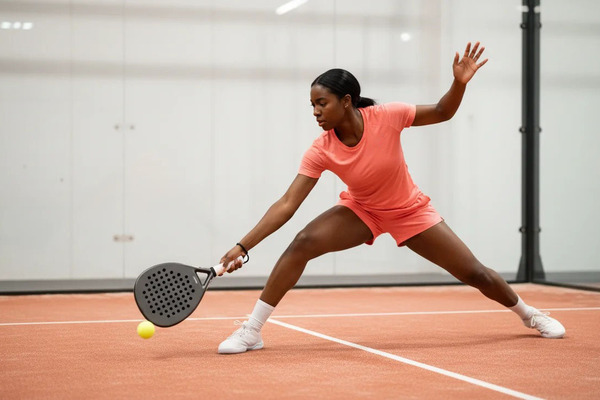
The chiquita is a soft, low shot that just clears the net and drops toward your opponents' feet. It's one of the most useful tools for breaking net pressure, since it takes away your opponents' pace and forces them to hit upward, which gives you a chance to move forward and take the net yourself. This guide focuses on how to actually execute a chiquita: when to use it, the technique step by step, where to aim, and how to avoid the habits that make it float.
What the Chiquita Is
A chiquita is a controlled, slow shot played low over the net. The goal isn't to win the point outright but to make your opponents' next shot difficult. A good chiquita lands near their feet, so they can't volley it down and must lift the ball instead. A bad one floats up to racket height, which hands them an easy attack.
When to Use a Chiquita
The chiquita works best in a few specific situations. The classic one is when your opponents are at the net and you're stuck at the back with a low ball you can't drive. It's also a common choice on the return of serve, particularly against an easy serve when the server isn't yet close to the net. Finally, it can be used as a counterattack when opponents are comfortable volleying and you want to pull them out of that rhythm.
Note
A chiquita is a way to change the pattern of a rally. Think of it as a low-speed problem for your opponents, not as a winner.

Step-by-Step Technique
Step 1: Read the Ball and Decide Early
Look at the ball you've been given before choosing the shot. A chiquita needs a ball you can reach comfortably and control. If you're rushed or off balance, another shot will usually be safer. Making the decision early gives you time to set up properly.
Step 2: Get Low and Keep the Swing Compact
Put it to the test with our free padel quiz — quick questions, instant results.
Bend your knees so you meet the ball at a low contact point rather than reaching down with your arm. Keep the backswing short, since you're not trying to generate pace. A relaxed, slightly softer grip helps you absorb the ball's speed.
Step 3: Make Soft Contact
Let the ball come to you and meet it with a stable racket face, cushioning the pace rather than driving through. The type of spin matters less than the height and speed of the ball as it crosses the net. You want it to clear the tape by a small margin and then drop.
Step 4: Aim at the Feet or a Gap
Aim for the ball to land near your opponents' feet or in a gap between them. A flat, controlled trajectory that dips quickly is more uncomfortable to deal with than a high one.
Step 5: Move Forward Immediately
As soon as the ball leaves your racket, move forward in the direction of your shot toward the attacking area. Waiting to see how the opponent responds wastes the initiative the chiquita gave you. The shot only pays off if you follow it forward.
Important
A chiquita without a follow-up step forward rarely achieves anything. Opponents who see you stay back simply reset and attack the next ball.

Where to Aim
The most reliable target is the feet of the player closest to the net, since a ball dipping toward their shoelaces is hard to volley with authority. Aiming at the gap between opponents can also work, because it creates indecision about who should take the ball. Choose a target before you swing rather than just trying to get the ball over softly.
The Chiquita on the Return of Serve
On the return, a chiquita aimed at the server's feet is a popular option, because the server has a larger gap in front of them than their partner and may still be moving forward. The main objective of any return is to keep yourself in the point, so only use a chiquita when it's within your capability, typically on an easier serve and when the opponents aren't already close to the net. If the serve is difficult or the server charges in, a high lob is often the safer choice.
Forehand and Backhand Chiquitas
You can hit a chiquita off either wing, and most players find one side more natural than the other. The principles stay the same: low contact, soft hands, a clear target near the net, and a forward step afterward. Practicing both sides evenly matters, because opponents will quickly notice if you only use the chiquita from your stronger wing and start to anticipate it.
Reading Your Opponents Before You Hit
A quick glance at where your opponents are standing tells you whether a chiquita is a good idea. If they're tight to the net and comfortable, a low ball at their feet makes sense. If they're sitting back, a chiquita may simply let them step in and take control, and a deeper shot or a lob could be a better way to keep them away from the net. Adjusting to what you see, rather than hitting the same shot automatically, is what turns the chiquita from a trick into a tactic.
When Not to Hit a Chiquita
Skip the chiquita if you're close to your back wall and can't realistically reach the attacking area afterward, because opponents have plenty of time to read it and it becomes ineffective. Also avoid it when you're badly off balance or the ball is too high to play a controlled low shot.
| Situation | Better Choice |
|---|---|
| Low ball, opponents at the net, you're balanced | Chiquita to their feet |
| Easy serve, server still moving forward | Chiquita return at the server's feet |
| Hard serve or server rushing the net | High lob |
| You're stuck near the back wall | Lob or a safe deep shot |
| Ball above shoulder height | Attack with a volley or smash instead |
Common Chiquita Mistakes
Hitting It Too High
If the ball clears the net with a lot of room to spare, it arrives at opponents' racket height and gets volleyed away. Aim for just over the tape and let the ball drop quickly.
Swinging Too Hard
The chiquita works because it's slow. A big swing adds pace, which makes the ball easier to attack and harder to control.
Forgetting to Follow It Forward
Staying at the baseline after a chiquita gives opponents time to recover and counterattack. Move forward as soon as you've hit it.
Using It Every Time
Opponents who see the same shot repeatedly will anticipate it and attack. Mix in lobs and deeper balls so the chiquita stays effective.
Advice
Practice the chiquita with a partner volleying at the net so you get real feedback. If they can easily put the ball away, yours is too high or too fast.

A Simple Practice Progression
Start by hitting slow, fed balls from the baseline toward a marked target area just past the net, focusing only on soft contact and low trajectory. Next, add a partner at the net who tries to volley what you hit, so you learn to land the ball at their feet. Finally, play short live points where you must follow every chiquita with a step forward.
The chiquita is less about technique than about touch and decision-making: soft hands, a clear target, and the discipline to move forward afterward. Used at the right moments, it turns a difficult low ball into a chance to take the net.
Give it time. Touch shots feel unreliable at first, and many players abandon them after a few missed attempts. A few weeks of patient, low-pressure practice is usually enough to make the chiquita a dependable part of your game.