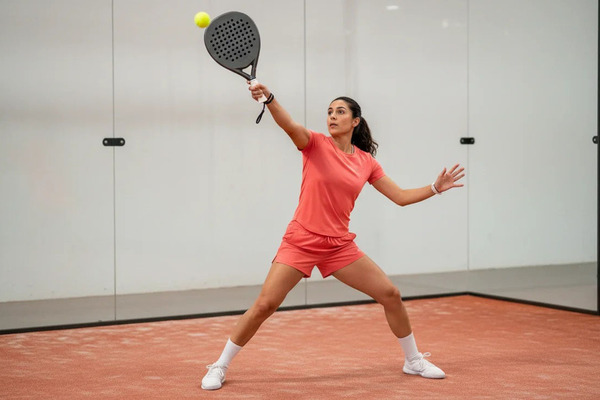
The vibora, Spanish for "viper," is an aggressive overhead hit with sidespin. It sits between the controlled bandeja and the all-out smash: more attacking than the first, safer than the second, and designed to keep you at the net while putting your opponents under pressure. It's a technically demanding shot that usually clicks once you understand the contact point and the swing path. This guide breaks it down step by step, from when to choose it to how to practice it.
What the Vibora Does
A vibora is struck on the outside of the ball with a rotational swing, which produces sidespin and a ball that dips and kicks awkwardly off the court and the glass. The bandeja, by contrast, is hit from underneath the ball. Because of the spin, a good vibora is difficult to attack even when it isn't a winner, and it keeps you in an offensive posture at the net.
Note
The vibora is generally considered a medium-to-high level shot. If your bandeja isn't consistent yet, build that first and add the vibora later.

When to Use a Vibora
Choose the vibora when the lob is short enough that you can step into it and put opponents on their heels, but not short enough to hit a clean flat smash. A lob that falls short in the middle of the court is a typical cue. It's also a sensible choice when balls have gone soft and no longer bounce well, since that makes finishing with a flat smash harder. If the ball is deep and you'd have to retreat, a bandeja or a lob is usually the better option.
Step-by-Step Technique
Step 1: Read the Ball and Take an Extra Step Back
As soon as you see the lob, turn sideways and move so that you're behind the ball. An extra step back helps you get in position without drifting too far from the net.
Step 2: Use a Continental Grip and Prepare Early
Hold the racket with a continental grip and take it back early. Pointing at the ball with your non-hitting hand helps you track it and judge where it will fall.
Step 3: Extend and Meet the Ball Around Face Height
Put it to the test with our free padel quiz — quick questions, instant results.
As the ball drops, extend your arm and aim to make contact in front of you, around face or head height. Contact that's too high turns the shot into a flat smash and you lose the sidespin, while contact that's too low makes it hard to get over the net with control.
Step 4: Strike the Outside of the Ball
Instead of hitting underneath the ball as in a bandeja, swing around the outside of it. Slightly tilting the racket face helps create the sidespin. Commit to the contact, because the spin is what keeps the ball in play.
Step 5: Finish High and Recover
Let the racket finish high, over your shoulder. A low finish across your stomach is the sign of a smash, not a vibora. Then step back toward the net immediately, since the point of the shot is to stay offensive.
Important
Don't drift backward after you hit. The whole point of the vibora is to keep you at the net, so recover forward as soon as the ball has left your racket.

Low Contact and High Contact Versions
There are two broad versions. A low-contact vibora is hit around head height, and the ball tends to stay low in the corner after it bounces, which makes it hard to attack. A high-contact vibora is struck a little above head height and comes off a bit faster, sometimes almost hitting the side fence. The low-contact version is generally the more reliable one, since it stays down and lets you step back toward the net more easily.
Where to Aim
A common target is the corner, hit aggressively with slice, so the ball stays low and kicks away from your opponent. Keeping opponents pinned in the corner gives you an easier ball to volley next. Aim for control over power: a slightly slower vibora with the right spin can be just as effective as a hard one, because your opponents still have to lift the ball.
| Aspect | Bandeja | Vibora |
|---|---|---|
| Contact | Underneath the ball | Outside of the ball |
| Spin | Light slice | Pronounced sidespin |
| Intent | Hold the net and stay safe | Attack while staying in control |
| Typical lob | Deeper | Short enough to step into |
| Finish | Controlled | High over the shoulder |
Vibora, Bandeja, or Smash: Quick Decision Cues
A simple way to choose is by the depth and height of the lob. A short, high ball that lets you strike above your shoulder while moving forward suits a smash. A ball that lands a little short in the middle of the court, and that you can step into, suits a vibora. A deep ball that pushes you back suits a bandeja or a lob. Deciding early, before the ball is on you, lets you commit to the swing rather than hesitating halfway through it.
Following the Vibora With Pressure at the Net
A vibora is rarely the end of the point on its own. Its job is to keep opponents off balance so that their reply is weak. After you hit it, move forward and be ready to volley, because if your opponents can return it at all, it usually won't be with an attacking shot. Treat the vibora and the volley that follows as a single sequence rather than two separate shots.
Drills to Build Your Vibora
Shadow Swings
Practice the turn, the extra backstep, and the around-the-ball swing without a ball. Check that your finish is high and your recovery step is quick.
Fed Balls to the Corner
Have a partner feed medium-height lobs while you aim for the corner with sidespin. Track how many land where you intended and stay low after the bounce.
Wall Sidespin Practice
Practice hitting sidespin against a wall to get used to the sensation of brushing around the ball before adding movement and decisions.
Bandeja and Vibora Pairing
Have a partner feed a mix of lobs so you must choose between a bandeja and a vibora on each ball, building the decision-making you need in matches.
Common Vibora Mistakes
Hitting Too Hard
A vibora doesn't need to be a winner. Overhitting reduces control and often sends the ball long or into the net.
Contact Too High
If the ball is above your head, you've effectively hit a flat smash and lost the sidespin. Aim for face or head height.
Drifting Backward
Retreating after the shot gives up the net. Recover forward immediately.
Using It on the Wrong Ball
A deep lob that forces you to retreat is a poor candidate. A bandeja or lob is a better answer.
Advice
Film your vibora from the side and check two things: whether you contact the ball in front of you at around head height, and whether your finish is high rather than low across your body.

A reliable vibora comes from a clear contact point, an around-the-ball swing, and the discipline to recover forward. It rewards patience in practice and sound shot selection in matches.
Don't expect it to feel natural immediately. Give yourself several sessions of focused repetition, and keep the bandeja as your safe option for the balls where the vibora doesn't fit.