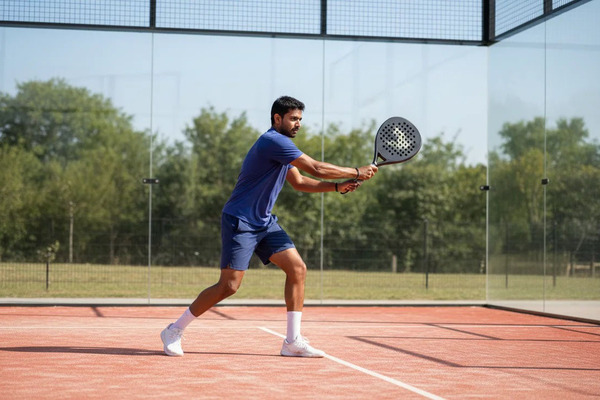
The two-handed backhand is a familiar shot for anyone who comes to padel from tennis, and it can feel far more natural than hitting a backhand with one hand. It isn't the standard in padel, though, and it has real limits on a court with walls. This guide covers when a two-handed backhand makes sense, how to hit it step by step, where it works well, and how many players combine it with a one-handed version so they're never stuck.
One Hand or Two? The Honest Picture
Coaches generally teach complete beginners with no racket-sport background to hit the backhand with one hand, because it adapts better to the demands of padel. Players with a tennis history often keep their two-handed habit, and neither approach is wrong. The trade-off is that a two-handed backhand makes some shots harder, so it's worth knowing exactly what you gain and what you give up before building your game around it.
Note
Padel rackets are shorter than tennis rackets and have a shorter handle, so a two-handed grip can feel cramped. Some rackets are built with a longer handle, which makes two-handed hitting easier.

Who Should Consider a Two-Handed Backhand
It tends to suit players who already hit a two-handed backhand in tennis and want to keep a stroke they trust, particularly for returns and for balls they have time to set up for. If you're brand new to racket sports, a one-handed backhand is usually the better long-term foundation, because it works across more situations on a padel court.
Grip and Setup
Hold the racket with your dominant hand in a continental grip, as you would for most padel shots, and place your non-dominant hand above it. Your waiting position is the same as for a one-handed backhand: knees slightly bent, racket in front of you, ready to turn. Keeping one consistent base grip means you don't have to change your hold mid-rally.
Step-by-Step Technique
Step 1: Turn Sideways Early
As soon as you see the ball is going to your backhand side, turn your shoulders and hips so your shoulder faces the net. Early preparation matters even more with two hands, because the shot has less reach to fall back on.
Put it to the test with our free padel quiz — quick questions, instant results.
Step 2: Take the Racket Back Compactly
Draw the racket back with both hands in place, keeping the backswing short. A long swing is hard to control on a small court and gives you less time to recover.
Step 3: Set Your Feet and Space the Ball
Use small adjustment steps to get the right distance from the ball. Because the contact point with two hands sits a little further back than with one hand, give yourself enough room so the ball doesn't crowd you.
Step 4: Swing Through Together
Drive forward with both hands working together, using your legs and core rather than just your arms. Keep the racket face stable through contact and aim to meet the ball in front of your body, remembering the contact point is a touch behind where you'd hit a one-handed shot.
Step 5: Finish and Recover
Complete the swing across your body and reset to a balanced position. If you're playing from the back of the court, your next priority is usually getting ready for the following ball rather than admiring the shot.
Important
With both hands on the racket you can't create the backspin or slice that many defensive padel backhands rely on. If a ball demands slice, that's a sign to release to one hand.

Where It Works and Where It Struggles
| Situation | Two-Handed Backhand |
|---|---|
| Return of serve | Works well, especially for tennis converts |
| Ball that sits up and gives you time | Good: stable and controlled |
| Low balls | Harder, you need to adjust your position |
| Reaching wide or stretched | Limited reach, release to one hand |
| Balls off the back wall | Often better played one-handed, frequently with slice |
| Defensive shots needing slice | Not possible with both hands |
The Hybrid Approach
A practical middle ground that many players settle on is to hit with two hands when you have time and the ball sits up, and release to one hand when you're reaching or playing off the back wall. This keeps the stability and familiarity of the two-handed shot where it helps, without leaving you exposed on the situations padel throws at you most often. Practicing the transition between the two is worth dedicated time, since fumbling it mid-rally is a common source of errors.
Adapting Your Tennis Habits
Players arriving from tennis often carry habits that don't translate directly. A big, looping backswing, a heavy reliance on topspin, and a contact point suited to a longer racket can all cause trouble on a padel court, where time is tighter and the ball often comes back off the walls. Shortening the swing, accepting a flatter or more controlled shot, and spending time practicing balls that rebound off the glass are the adjustments that make the biggest difference.
Is It Worth Keeping Long-Term?
Many players keep a two-handed backhand for years without a problem, particularly at recreational level. The question is whether it limits you as you improve. If you find yourself regularly caught out by low balls, wide balls, or balls off the back wall, adding a reliable one-handed shot, or shifting to it more often, will usually pay off. If your results are solid and you're comfortable switching when needed, there's no reason to abandon a shot that works.
Drills to Build It
Shadow Swings
Practice the turn, compact backswing, and swing path without a ball, concentrating on a steady rhythm and keeping both hands working together.
Cross-Court Backhand Rallies
Rally backhand to backhand with a partner, aiming for consistency rather than power. Keep track of how many shots you can string together.
Mixed Feeds
Have a partner feed a mix of comfortable balls, low balls, and wide balls so you practice choosing between two hands and one hand. Include some balls that come off the back wall.
Common Mistakes
Hitting With Two Hands on Every Ball
Insisting on two hands when you're stretched or the ball has come off the glass usually produces weak or late contact. Be willing to release.
Crowding the Ball
Because the contact point is a bit further back, standing too close leaves you cramped. Create space with small adjustment steps.
Ignoring Low Balls
Low balls force you to adjust your position, and it's easy to reach down with your arms instead of bending your knees. Get low with your legs.
Neglecting the One-Handed Shot
Players who only practice the two-handed version often find themselves without a reliable answer when a ball demands slice or reach. Keep a one-handed option in your toolkit.
Advice
If you're deciding whether to keep your two-handed backhand, try a few sessions where you deliberately play one-handed on balls off the wall and low balls. The comparison shows quickly which situations your current shot handles and which it doesn't.

A two-handed backhand can be a sound, stable shot in padel as long as you know its limits. Use it where it shines, on returns and balls you have time to set up for, and keep a one-handed option ready for reach, slice, and play off the walls.
Whichever you choose, the fundamentals stay the same: an early turn, a compact backswing, good spacing, and a balanced finish. Build those habits and the backhand stops being the shot you avoid and starts being one you can rely on.