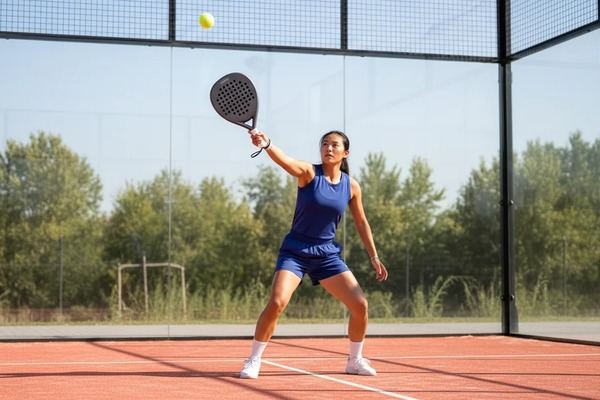
The topspin smash, often called the kick smash, trades raw speed for spin and control. Instead of driving the ball flat, you brush up and over it so it kicks high after it bounces and comes off the glass in a way that's awkward for opponents to deal with. It's less about brute power and more about technique, which makes it a valuable tool for players who can't generate a flat winner every time. This guide covers when to use it, how to hit it step by step, where to aim, and how to practice it without developing bad habits.
What the Topspin Smash Does
A flat smash tries to beat opponents with speed and an angle. A topspin smash uses spin to make the ball jump high after it lands, often bouncing up off the court and then off the back or side glass. When it works, opponents are pushed back or forced to hit the ball from an uncomfortable height, and the ball is far harder to attack than a flat shot that stays low. It can also be played so that the ball returns to your side of the court rather than ending the point outright.
Note
The topspin smash is a risk. If it isn't hit well enough, it can float up and give opponents an easy ball to attack. That's why it needs practice before it goes into match play.

When to Use a Topspin Smash
Use it when you get a high lob and have time to get underneath the ball and load the shot. A lob that's decent but not short enough for a flat winner is a typical situation, since the spin gives you a margin of safety while still putting pressure on your opponents. If a lob pushes you backward and the contact point drops, a bandeja, a vibora, or a lob is usually a better choice. Recreational players often start with the topspin smash on easy balls close to the net.
Step-by-Step Technique
Step 1: Read the Lob and Get Into Position Early
As with any overhead, start with a split step as your opponent hits the lob, then turn sideways and move back with crossover steps. Getting underneath the ball in time is what makes the shot possible at all.
Step 2: Prepare Like a Second Serve
The motion is often compared to an exaggerated tennis second serve. Raise the racket high, point at the ball with your free hand, and let your body load, using your legs as well as your arm.
Put it to the test with our free padel quiz — quick questions, instant results.
Step 3: Brush Up and Over the Ball
Instead of hitting through the back of the ball, brush over the top of it by throwing the racket upward and across. The racket face slides across the ball rather than striking it flat, which is what creates the spin. Many coaches describe making contact slightly higher and a little further back than for a flat smash, so there's room to roll over the ball.
Step 4: Use the Forearm and Pronate
Topspin comes from the way your arm and forearm move through contact. Rotating the forearm through the ball, known as pronation, sends the ball down with more kick.
Step 5: Finish and Recover Quickly
After contact, get back into position as soon as possible. Because the ball is designed to come back to your side or stay in play, you need to be ready for the next shot.
Important
Don't try to hit a topspin smash from a poor position, such as when you've been pushed far back and the ball is dropping low. In those situations the shot loses its margin and a safer overhead is better.

Where to Aim
Where you aim depends on where you're hitting from. Close to the net, you don't need to hit the ball very deep. You want it to bounce, kick high into the glass, and come back toward your side, which makes it difficult for opponents to attack. From farther back, aim deeper so the ball travels toward the back wall. A diagonal topspin smash toward the fence is another effective option, because the fence produces unpredictable bounces and is hard to defend. Aim close to the fence, using a little topspin and medium to fast speed.
| Aspect | Flat Smash | Topspin Smash |
|---|---|---|
| Main idea | Speed and angle | Spin, kick, and margin |
| Contact | Flat racket face | Brushing up and over the ball |
| Risk | Comes back if it doesn't clear the glass | Floats up if not struck well |
| Best used | Short, high lobs | High lobs when you have time to load |
| Result | Can end the point outright | Pushes opponents back or sets up the next ball |
Topspin Smash and the Wall Shots
The same brushing motion underpins the wall-based smashes, where the ball is hit so it bounces in the opponent's court and then leaves the court over the glass or fence. Practicing the topspin smash to the fence is a good way to get comfortable with the action, since the preparation is the same. Don't rush into the extreme wall smashes until the basic brushing motion feels natural.
Topspin Smash or Bandeja?
A useful way to decide is to ask whether you can get above and underneath the ball with time to spare. If you can, the topspin smash gives you a chance to apply real pressure. If the ball is around shoulder height or you're already stretched, the bandeja keeps you at the net with far less risk. Calling your intended shot out loud, even quietly to yourself, before contact helps you commit to a decision instead of drifting into a half-hearted swing.
Drills to Build It
Shadow Swings
Practice the throwing-up, brushing motion without a ball, focusing on the high preparation and the forearm rotation. The movement should feel smooth rather than forced.
Fed Balls to a Target
Have a partner feed high lobs while you hit topspin smashes toward a marked area near the net and the glass. Track how many land where you intended and how high they kick.
Mixed Feeds
Vary the feeds so you must decide between a flat smash, a topspin smash, and a bandeja. Repeating the same smash from the same feed over and over is a common training mistake, since it doesn't build the decision-making you need in matches.
Common Topspin Smash Mistakes
Hitting Flat and Calling It Topspin
If the racket goes straight through the ball, you lose the spin. Focus on brushing across the top.
Poor Footwork
Failing to get underneath the ball makes it impossible to load the shot properly. Move early and use crossover steps.
Using It From the Wrong Position
Trying a kick smash when you're pushed back and the ball is low usually gives opponents an easy reply.
Forgetting to Recover
Because the ball often comes back or stays in play, you need to reset quickly rather than watching the result.
Advice
Get a coach or a partner to check your contact point and recovery on live feeds. Video from the side also makes it easier to see whether you're truly brushing over the ball.

A good topspin smash is built on early preparation, a brushing swing, and sound shot selection rather than pure power. Learn the motion in stages, use it when you have time to get under the ball, and it becomes a reliable way to pressure opponents without relying on a flat winner.
Be patient with the learning curve. The brushing action can feel unnatural at first, especially for players used to hitting through the ball, but regular, structured practice is usually enough to make it automatic.