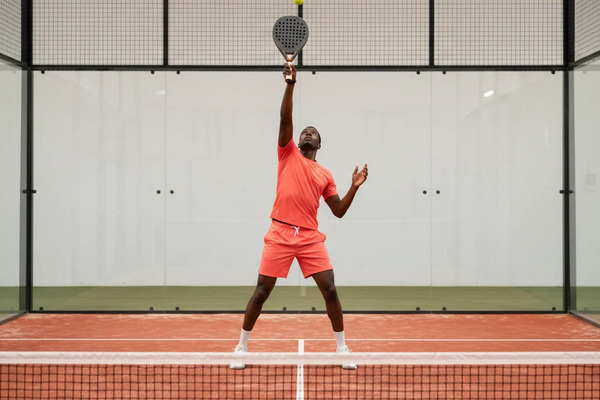
The flat smash is padel's most decisive overhead, but it's also one of its most error-prone shots. Many players, especially those coming from tennis, simply swing as hard as possible and hope. A reliable flat smash is built from a sequence of small steps: early preparation, footwork, a high contact point, a flat racket face, and a controlled pace. This guide walks through that sequence and gives you a progression of drills to build it, rather than repeating the basic rules covered in our introductory smash guide.
When a Flat Smash Is the Right Shot
A good rule of thumb is to smash when the lob is short enough that you can hit the ball above your shoulder while moving forward. If you have to retreat a long way or the ball is dropping deep, a bandeja is usually the smarter choice. Choosing the smash too often is one of the most common mistakes in padel, because opponents who realize you'll always go for it can simply let the ball bounce off the glass and take the point back.
Note
The smash isn't the most-used shot in padel, it's the most decisive. Hitting fewer of them, and choosing the right ones, usually wins more points than smashing everything.

Step-by-Step Technique
Step 1: Split Step and Read the Lob
A smash starts before the lob is even hit. Time a small split step to the moment your opponent's racket meets the ball, then react to how high and deep it's traveling. Standing flat-footed is one of the most common reasons players arrive late to the ball.
Step 2: Turn and Move Back With Crossover Steps
Turn your body sideways and move back using crossover steps rather than backpedaling. Crossover steps keep you balanced and let you get underneath the ball more quickly, while backpedaling tends to leave you off balance and reaching.
Step 3: Racket Up and Point at the Ball
Raise your racket early, with the head up and behind you, and use your non-hitting arm to point toward the ball. This keeps your body orientated to the ball and helps you judge its height and timing.
Step 4: Contact Above and Slightly in Front
Make contact with your arm extended, above your head and slightly in front of your body. Hitting the ball behind you sends it into the net or leaves it floating, while hitting it too far in front usually sends it long. Aim to strike the ball as it begins to drop, rather than at its absolute peak.
Put it to the test with our free padel quiz — quick questions, instant results.
Step 5: Flat Face, Snap Forward
Keep the racket face flat through the ball and snap your wrist forward as you make contact. Power comes from the whole body, legs and core included, not just the arm. A flat contact sends the ball down and forward without spin, which is what gives the shot its punch.
Step 6: Follow Through and Recover
Finish the swing across your body, then reset immediately to a balanced, ready position near the net. If the smash doesn't end the point, you want to be in position for the next ball.
Important
A flat smash that doesn't clear the back glass comes back into play. Hitting at roughly 70 percent pace with good placement often beats a 100 percent swing that catches the tape or lands short.

Power Versus Control
Raw power is rarely what wins smash points in padel. A shot struck at around 70 percent of your maximum offers the best balance of speed and control for most players, and it keeps you balanced for the recovery. If your smashes keep landing short or hitting the net, the cure is usually better timing and contact height, not more force.
Where to Aim a Flat Smash
Place the ball to give yourself the largest margin of error. Common targets are the open space on the court, the feet of the opponent nearest you, or a corner where the ball will rebound awkwardly. From close to the net with a short lob, a flat smash can even send the ball out of the court after one bounce for a clean winner, though that takes practice and a clear read of the angles. When you're farther from the net, prioritize clearing the net and landing deep rather than going for the extreme angle.
| Phase | What to Focus On |
|---|---|
| Preparation | Split step, early turn, racket up |
| Movement | Crossover steps, get underneath the ball |
| Contact | Arm extended, above and slightly in front |
| Finish | Flat face, wrist snap, controlled pace |
| Recovery | Return to a balanced position at the net |
Building the Physical Foundation
Much of the smash's power comes from the legs and core rather than the arm. Simple exercises like squats, lunges, and jumping drills build the explosive strength that feeds into the swing, and a stable core helps you stay balanced as you extend toward the ball. You don't need a heavy gym program, but a few weeks of consistent lower-body and core work often improves smash consistency noticeably.
What to Do When the Ball Comes Back
Even a well-hit smash isn't guaranteed to end the point. Opponents may let the ball bounce off the glass and send it back, or a shot that lands too short may be returned. Treat the smash as the start of a sequence, not the end: recover to a balanced position, keep your racket ready, and be prepared to play a controlled volley or a second overhead if the ball returns.
A Progression of Drills
Stage 1: Shadow Swings
Practice the footwork and swing without a ball. Focus on the split step, turn, and the point-and-extend motion until the sequence feels fluid.
Stage 2: Fed Smashes Down the Middle
Have a partner feed easy, high lobs while you hit smashes down the middle of the court. Concentrate on contact height and keeping the pace controlled rather than hitting as hard as possible.
Stage 3: Add Targets
Place targets in the corners or near the feet of a stand-in opponent and track how many of ten smashes find them. Gradually vary the height and depth of the lob.
Stage 4: Add Movement and Decisions
Have your partner mix short and deep lobs so you have to decide in real time whether to smash or switch to a bandeja. Finish with live points that begin with a lob.
Common Flat Smash Mistakes
Standing Flat-Footed
Failing to split step and move early leaves you reaching for the ball with poor balance. Start moving as soon as you read the lob.
Hitting Behind Your Body
Letting the ball drop behind you destroys the forward drive of the shot. Get underneath the ball and meet it in front.
Smashing Everything
Using the smash on deep lobs or from poor positions hands points to opponents. Be willing to choose a bandeja instead.
Overhitting
Swinging at maximum power reduces accuracy and often sends the ball into the net or straight back to the glass.
Advice
Count your smashes in a match. If more than a few are landing short or hitting the net, scale back the pace and focus on contact height before adding speed.

A dependable flat smash comes from consistent mechanics rather than force: read the lob early, move with crossover steps, meet the ball above and in front, and finish with a flat, controlled swing. Build it in stages, and choose your moments carefully, and it becomes one of the most reliable ways to end a point.
Give the shot a few weeks of structured practice before judging it. Overhead timing improves slowly, and players who rush to add power before the mechanics are stable often develop habits that are hard to undo later.