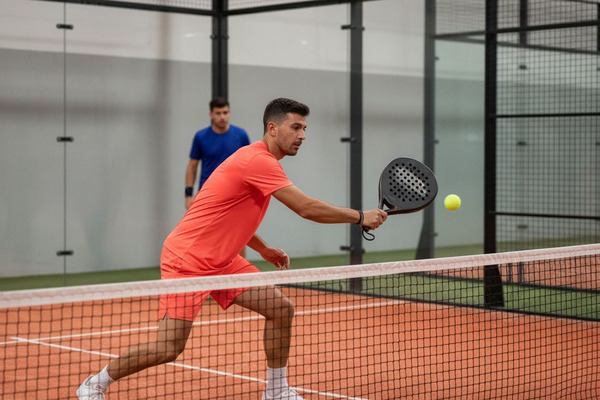
Not sure what it actually means to attack at the net?
Attacking in padel is less about hitting the ball as hard as possible and more about taking and holding a strong position at the net, where you can pressure opponents into mistakes. For beginners, learning to recognize when to move forward and how to play simple, controlled shots from that position matters far more than trying to end every point with a powerful smash. This guide covers the basics of attacking play and how to start using it in your own games.

What Does "Attacking" Mean in Padel?
In padel, attacking usually refers to controlling the net position rather than simply hitting the ball hard. A pair at the net can cut off angles, volley the ball before it bounces, and put opponents under constant pressure, while a pair stuck at the back is mostly reacting and defending. Attacking play is about earning and holding that net position, then using controlled, well-placed shots from there rather than forcing risky winners from deep in the court.
Why Net Position Is the Foundation of Attacking Play
Padel's smaller court makes the net an especially powerful position, since opponents have very little time to react to a volley hit from close range. Once you're at the net, even a moderately paced shot becomes difficult to handle, simply because there's so little space and time for the other side to respond. That's why attacking in padel starts with positioning, not power: get to the net first, and the pressure follows almost automatically.
This is also why stronger pairs so rarely stay content at the baseline once an opportunity to move forward appears. Every extra second spent deciding whether to advance gives opponents time to recover and reset the point, so treating net position as something to actively pursue, rather than something that occasionally happens, is a mindset shift worth making early.
Note
You don't need to hit a winner to attack effectively. A controlled volley that keeps your opponents on the back foot is doing its job even if the point continues for another shot or two.

Recognizing an Attacking Opportunity
The clearest sign it's time to attack is a short, weak ball from your opponents, one that lands well inside the court rather than deep near the baseline. That kind of ball gives you time to move forward and take it early, rather than being stuck defending from the back. A high, short lob is another common cue, since it invites a controlled overhead that can either end the point or force opponents into a defensive lob of their own.
Put it to the test with our free padel quiz — quick questions, instant results.
Basic Attacking Shots for Beginners
The Approach Volley
When you spot a short ball, move forward and take it in the air before it bounces, using a short, controlled swing rather than a big one. The goal at this stage isn't a winner, it's landing the ball deep or at an angle that keeps you moving forward into a stronger net position for the next shot.
A Simple Overhead on an Easy Ball
A high, short lob that gives you time to set up is a good, low-risk opportunity to hit a controlled overhead. Beginners don't need to swing for maximum power here, aiming for a moderate, well-placed shot toward an opponent's feet or an open space is far more reliable than trying to smash every overhead as hard as possible.
Angled Volleys to Open Space
Once you're comfortable with straightforward volleys, adding a slight angle toward open court, rather than always hitting straight back, makes your net play noticeably harder to defend. Even a small angle change forces an opponent to cover more ground, which is often enough to force an error or a weak reply.
Important
Don't rush to attack on a difficult, well-placed ball. Attacking works best on the specific opportunities described above, not as a default response to every shot that comes your way.

Reading Your Opponents' Position
Beyond the height and depth of the ball itself, watch where your opponents are standing. If one player is out of position, pulled wide or still recovering from their last shot, that's often a better attacking signal than the ball alone. A short ball hit toward an opponent who's set and ready is a much weaker opportunity than the same ball hit toward someone scrambling to get back into place.
When Not to Attack
Not every short-looking ball is a genuine invitation forward. A ball that's short but low, sitting well below net height, is often safer to handle with a controlled shot from where you are rather than rushing in and volleying it awkwardly on the rise. Learning to tell the difference between a short high ball, a clear opportunity, and a short low one, a trickier proposition, takes some repetition, but it prevents a lot of unnecessary errors from beginners who treat every short ball the same way.
Moving as a Pair When Attacking
Padel is a doubles game, so attacking effectively means moving forward together, not just one player rushing the net alone. If your partner sees an opportunity and moves in, following that movement rather than staying back keeps your team's shape solid and avoids leaving a large gap between you that opponents can exploit with a well-placed shot down the middle or into open space.
| Aspect | Defensive Position | Attacking Position |
|---|---|---|
| Court Position | Near the baseline | Near the net |
| Shot Type | Groundstrokes, lobs | Volleys, controlled overheads |
| Main Goal | Keep the ball in play, buy time | Apply pressure, force errors |
| Risk Level | Lower | Higher if rushed, lower if timed well |
Common Mistakes Beginners Make When Attacking
Swinging for a Winner Too Early
Free tournament generator — Americano, Mexicano and more. Set it up in minutes.
Trying to end the point immediately, even on a moderate opportunity, leads to more unforced errors than patient, controlled net play. Building pressure over a shot or two is usually more effective than forcing a low-percentage winner right away.
Moving to the Net Without a Reason
Rushing forward on a deep, well-placed ball from your opponents leaves you exposed to a lob or a passing shot you're not ready to handle. Attack on genuine opportunities, not out of habit or impatience.
Leaving Your Partner Behind
One player attacking while the other stays back creates a large gap in the middle of the court that opponents will find quickly. Move forward together whenever possible.
Advice
Practice recognizing short balls before working on the shots themselves. Knowing when to attack is a skill on its own, and it's often the harder half of learning to play effectively at the net.

Drills to Practice Basic Attacking Play
Have a partner or coach feed a mix of deep and short balls while you practice recognizing which ones are attacking opportunities and moving forward only on the short ones. Once that recognition feels natural, add a live point after each fed ball so you get used to finishing the point from the net rather than just hitting one clean approach shot and stopping. Practicing this decision-making, not just the shots themselves, is what actually transfers to real matches.
Attacking in padel starts with position, not power. Learning to recognize a genuine opportunity, move forward with your partner, and play a controlled shot from the net will do far more for your game as a beginner than chasing powerful winners from the back of the court.
As your comfort at the net grows, the same principles scale up naturally into more advanced attacking shots, sharper angles, disguised placement, and eventually shots like the bandeja. None of that is worth rushing into, though, until the basics covered here, recognizing opportunities, holding position as a pair, and playing controlled volleys, feel genuinely automatic.