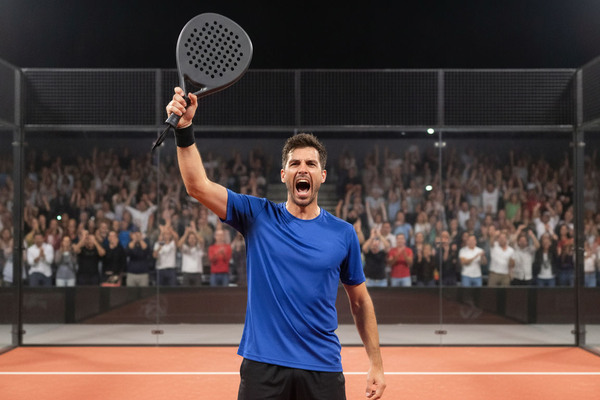
Confused by Majors, P1s and P2s on the pro tour?
Professional padel tournaments run on a tiered system, Major, P1, and P2 events, that determine how many ranking points and how much prize money are on the line each week. Understanding that structure explains why some tournaments draw the entire top of the sport while others serve as stepping stones for players still building their ranking. This guide breaks down how the professional circuit is organized, from ranking points to qualifying rounds to the season-ending finals.

Premier Padel: The Sport's Top Professional Circuit
Premier Padel is the main global professional tour, organized by the International Padel Federation and financially backed by Qatar Sports Investments, the group led by Paris Saint-Germain owner Nasser Al-Khelaifi. Launched in 2022, the circuit runs an annual season that now spans roughly 24 to 26 tournaments across around 17 countries, running from February through December.
A Short History: From World Padel Tour to Premier Padel
Before Premier Padel, the sport's main professional tour was the World Padel Tour, owned by a subsidiary of the Spanish brewing company Damm. Tensions between the WPT and top players, along with a competing circuit backed by Qatar Sports Investments, eventually led QSI to acquire the World Padel Tour outright. The WPT ceased operations after eleven seasons, and Premier Padel became the sport's sole main circuit starting with its 2024 season.
Note
Tournament counts, prize money, and even category names shift slightly from season to season as the tour continues to grow. Always check the current season's official calendar for exact, up-to-date figures.

The Three Tournament Tiers: Major, P1, and P2
Premier Padel organizes its calendar into three tiers of decreasing prestige and prize money. Majors sit at the top, four events a season held in major global cities, offering the largest prize pools and the most ranking points. P1 tournaments form the second tier, roughly ten to twelve events with strong prize money and serious ranking implications. P2 tournaments are the most accessible tier, giving emerging and established pairs alike a chance to earn points and prize money on the main professional circuit.
Put it to the test with our free padel quiz — quick questions, instant results.
| Tier | Points for Winner | Points for Runner-Up |
|---|---|---|
| Major | 2,000 | 1,200 |
| P1 | 1,000 | 600 |
| P2 | 500-600 | 300-360 |
| Tour Finals | 1,500 | 900 |
How Ranking Points Actually Work
Every pair on tour accumulates FIP ranking points based on how deep they go in each tournament they enter, not just whether they win. Losing in an early round still earns a small number of points, while reaching the quarterfinals, semifinals, or final adds progressively larger totals. These points, calculated over a rolling period, determine a pair's overall ranking, which in turn decides their seeding and seating in the draw for future events.
Important
A single Major title is worth roughly double the points of a P1 win. That gap is exactly why the season's biggest storylines tend to hinge on Major results rather than a pair's overall win count across smaller events.

Draw Sizes and Qualifying Rounds
Not every pair that enters a tournament goes straight into the main draw. Majors typically feature a men's main draw of around 48 pairs and a women's draw of about 40, each preceded by a separate qualifying tournament for pairs trying to earn one of the remaining main draw spots. P1 and P2 events run smaller main draws and qualifying rounds, scaled down from the Major format but following the same basic principle: win your way through qualifying, and you're in the tournament that actually counts for ranking points and prize money.
Prize Money Across the Tiers
Prize money scales with a tournament's category in roughly the same proportion as ranking points. Major events have historically offered prize pools in the region of half a million euros, while P1 tournaments run at roughly half that figure, and P2 events offer smaller purses aimed at giving developing pairs meaningful financial incentive to compete regularly rather than only chasing the biggest events. Exact figures shift from season to season as the tour negotiates new sponsorships and broadcast deals.
Seeding: How Rankings Shape the Draw
A pair's current ranking determines their seed in each tournament's draw, which in turn decides who they're likely to face and how far into the event they can go before meeting another top seed. Higher-ranked pairs are spread out through the draw specifically to avoid facing each other in early rounds, a structure that rewards consistent ranking performance with an easier path deeper into later, more lucrative rounds.
The Season-Ending Tour Finals
At the end of each season, the top 16 ranked pairs in both the men's and women's divisions qualify for the Premier Padel Finals, an invitation-only event that functions as the sport's equivalent of a championship playoff. Qualification comes almost entirely from performance across the season's Majors, P1s, and P2s, so a strong showing at any tier throughout the year can still book a place at the finale, even without a marquee title to show for it.
How a Typical Tournament Week Unfolds
A professional padel tournament usually opens with qualifying rounds over the first day or two, as pairs outside the direct main draw compete for the last available spots. The main draw then plays out over several days, moving from the round of 32 or round of 16 through the quarterfinals, semifinals, and final, with later rounds typically drawing the largest crowds and broadcast attention as the pairing predictions narrow toward a champion.
Free tournament generator — Americano, Mexicano and more. Set it up in minutes.
Matches themselves follow the same rules recreational players use, best-of-three sets with a golden point on deuce in most professional formats, though the intensity, pace, and shot quality on display bear little resemblance to a casual weekend game. Broadcast coverage has grown substantially as the tour has expanded, with most Major and P1 matches now streamed live for fans following from outside the venue.
The Four Majors: Padel's Biggest Stages
The four Major tournaments anchor the Premier Padel calendar in Doha, Rome, Paris, and Acapulco, giving the circuit a genuinely global footprint across the Middle East, Europe, and Latin America. Paris in particular has drawn attention for being held at Roland-Garros, the historic home of the French Open, a symbolic venue choice that signals how seriously the tennis world's infrastructure has embraced padel's rise. New markets continue to join the wider calendar too, with recent seasons adding tournaments in cities like London and Pretoria as the tour keeps expanding its reach beyond padel's traditional strongholds.
Each Major carries its own identity beyond the ranking points on offer. Doha typically opens or closes the season with the tour's biggest production values, Rome and Paris lean into Europe's deep padel fan base, and Acapulco carries a symbolic weight of its own as the birthplace of the sport, closing the calendar in the same country where padel was first invented.
Advice
If you're new to following professional padel, start by watching a Major. The stakes, ranking points, and draw quality are all at their highest, which makes it the clearest introduction to how the tour's format and pressure actually play out.

Professional padel's tournament structure rewards consistency as much as outright wins, since points accumulate across an entire season of Majors, P1s, and P2s rather than resetting after every event. Understanding that tiered system, and how points, draws, and qualifying all fit together, makes it far easier to follow why certain pairs dominate a season while others need a breakthrough run at the right tournament to climb the rankings.
There's also a national team dimension that runs alongside the individual tour. Alongside Premier Padel, the FIP organizes World Championship and continental championship events where players represent their countries rather than competing purely for individual ranking points, adding another layer to the professional calendar beyond weekly tour stops.