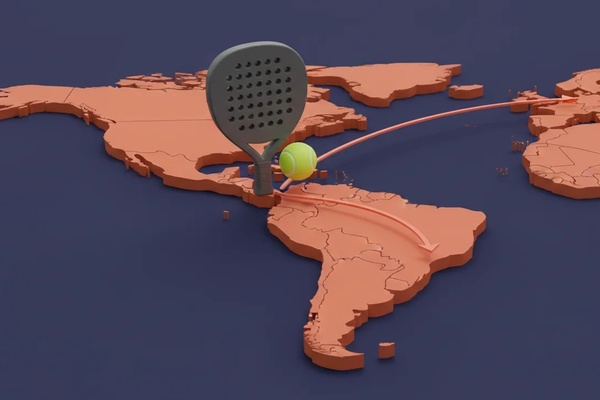
Curious how a backyard court in Mexico became a global sport?
Padel's journey from a single backyard court in Mexico to a sport played by more than 25 million people worldwide is one of the more unlikely growth stories in modern sports. It took a cramped property, a birthday gift, and a Spanish prince's summer vacation to set a chain of events in motion that eventually built a multi-billion-euro global industry. This guide traces that path, from Acapulco in 1969 to the international sport padel has become today.

A Backyard Solution in Acapulco, 1969
Padel began with a simple space problem. Enrique Corcuera, a Mexican businessman and tennis enthusiast, didn't have enough room on his property at Las Brisas in Acapulco to build a full-size tennis court. Rather than give up on the idea, he built a smaller court instead, measuring 20 by 10 meters, and enclosed it with three-meter walls, adding a tennis net across the middle. That enclosed court, built purely out of necessity, became the first padel court in history.
Viviana Corcuera's Rulebook: A Birthday Gift That Formalized a Sport
Enrique's court needed rules to actually function as a game, and that task fell to his wife, Viviana Corcuera, a former Miss Argentina. She wrote the first formal set of padel rules and presented them to her husband as a birthday gift, turning what had started as a backyard improvisation into something with a real structure. That detail, a sport's founding rulebook arriving as a present rather than a formal governing decision, captures how genuinely informal padel's origins were.
Note
The walls that define padel today weren't a deliberate design choice for strategy, they were a practical solution to keep the ball from flying off Corcuera's property into his neighbors' yards.

Crossing the Atlantic: Padel Arrives in Spain
Padel's spread beyond Mexico began with a vacation. Prince Alfonso of Hohenlohe, a Spanish aristocrat, spent his summer holidays at Corcuera's home in Acapulco during the early 1970s and tried the new sport there. He liked it enough to bring it home, building the first padel courts in Europe at the Marbella Club Hotel on Spain's Costa del Sol. Those two courts on the Andalusian coast marked padel's first step toward becoming an international sport.
Free tournament generator — Americano, Mexicano and more. Set it up in minutes.
Julio Menditeguy Brings Padel Home to Argentina
Padel's arrival in Argentina came through a similar personal connection. Julio Menditeguy, an Argentine member of Prince Alfonso's tennis club in Marbella, encountered the sport there and decided to introduce it back home. The first Argentine courts went up at clubs including Club Tortugas and the Mar del Plata Ocean Club, and the sport took off quickly in a country already deeply invested in tennis and other racket sports.
Important
Padel's early growth relied almost entirely on wealthy, well-connected individuals bringing the sport home from vacations and social clubs, not any organized marketing effort. That informal, word-of-mouth spread shaped which countries adopted padel first.

Why the Sport Took Root in These Specific Countries First
It's not a coincidence that padel's earliest growth followed a narrow social network of wealthy tennis club members rather than spreading evenly around the world. Corcuera, Hohenlohe, and Menditeguy all moved in the same overlapping circles of tennis clubs and vacation resorts, which meant the sport's first international jumps depended entirely on who happened to visit whose home or club that particular summer. That pattern explains why padel's early strongholds cluster so tightly around Spanish and Argentine high society before spreading more broadly.
The 1980s: Padel Spreads Across the Americas and Europe
Through the 1980s, padel expanded well beyond its original Mexican, Spanish, and Argentine footholds, reaching Brazil, Uruguay, Chile, France, the United States, and Canada. Argentina, in particular, embraced the sport enthusiastically enough that it became the country's second most popular sport by the early 1990s, trailing only football. In 1988, Argentina founded the Asociación Padel Argentino, the sport's first national association, and that same year hosted the first international competition between Spain and Argentina in Mar del Plata.
Formalizing the Sport: The Birth of the FIP
By 1991, padel had grown enough across multiple countries that it needed a proper international governing body. Argentina, Spain, and Uruguay came together in Madrid to establish the International Padel Federation, known as the FIP, to standardize rules and organize competition at a global level. That formal structure gave padel the foundation it needed to keep expanding into new markets with consistent rules and recognized international events, rather than each country developing its own slightly different version of the sport in isolation.
The Modern Boom: Premier Padel and Global Expansion
From the 1990s onward, padel steadily built strongholds in Italy, Sweden, Portugal, the Netherlands, and eventually the United Kingdom, with club numbers climbing in each new market. The sport's professional circuit evolved further with the launch of the World Padel Tour and, more recently, Premier Padel, backed by Qatar Sports Investments, which brought bigger prize money and broader international visibility to the professional game than the sport had ever seen before.
| Year | Milestone |
|---|---|
| 1969 | Enrique Corcuera builds the first padel court in Acapulco, Mexico |
| Early 1970s | Prince Alfonso of Hohenlohe introduces padel to Spain |
| 1975 | Julio Menditeguy brings padel to Argentina |
| 1988 | Argentina founds the sport's first national association |
| 1991 | The International Padel Federation (FIP) is founded in Madrid |
| 2020s | Premier Padel launches, accelerating global growth |
A New Wave: The United States and the Middle East
The most recent chapter of padel's spread has centered on markets that had almost no connection to the sport's original Spanish and Argentine circles. The United States, in particular, has seen rapid court construction and celebrity attention over the past several years, while Gulf states, especially Qatar, have become significant financial backers of the professional game through their investment in Premier Padel. Unlike the sport's organic, word-of-mouth beginnings, this latest wave of growth has been driven deliberately, through direct investment and marketing rather than a vacationing aristocrat trying a new game for fun.
Where Padel Stands Today
More than 55 years after Enrique Corcuera solved a simple backyard space problem, padel has grown into a sport played by an estimated 25 million people across more than 90 countries, with a global market valued at over two billion euros. The sport is now actively pursuing inclusion in the Olympic Games, with organizers targeting the 2032 Games as a realistic goal, a level of ambition that would have seemed extraordinary to anyone standing on that first court in Las Brisas.
Advice
Next time you play a match, remember that the walls you're using to keep a rally alive were originally just a way to stop the ball landing in a neighbor's garden. Padel's most distinctive feature started as a practical fix, not a strategic design choice.

Padel's global spread wasn't the result of a single company or a coordinated marketing push, it happened one personal connection at a time: a vacationing prince, an Argentine club member, a handful of national federations deciding to formalize what had already caught on. That grassroots, word-of-mouth pattern set more than fifty years ago is still recognizable in how padel keeps reaching new countries today, one enthusiastic new player and one new club at a time.
What's changed is the speed. It took padel roughly two decades to move from a single Mexican backyard to a formally governed international sport with its own federation. Today, a new market can go from almost no padel presence to dozens of clubs within just a few years, powered by the same word-of-mouth appeal Corcuera stumbled into in 1969, just moving considerably faster with the help of social media, professional investment, and a much larger global appetite for a new sport to try.