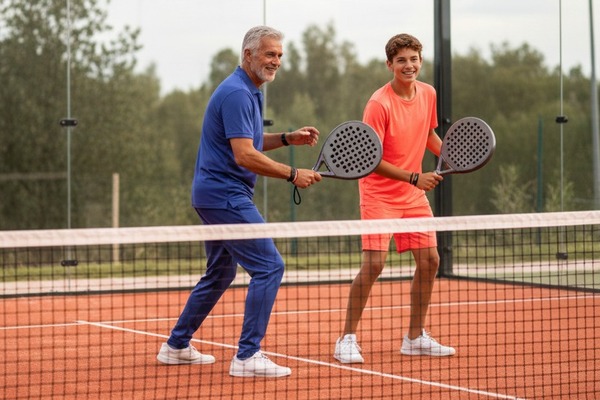
Looking for a sport the whole family can actually play together?
Padel is one of the few sports where a 75-year-old grandfather, his adult sons, and his teenage grandsons can genuinely compete against each other on the same court. In Sheffield, the Fyfe family does exactly that several times a week, three generations sharing rallies at their local club. That kind of scene isn't a rare exception in padel, it's a big part of why the sport has grown so quickly: almost nothing else about it stops people of very different ages and abilities from playing together and actually enjoying it.

Why the Small Court Levels the Playing Field
Padel is played on a court roughly a third the size of a tennis court, with two players covering each side rather than one. That smaller area means far less ground to cover, which takes away much of the advantage that pure speed and fitness usually give younger, more athletic players in other racket sports. A player with less mobility can still reach most balls, position well, and contribute meaningfully to a point.
The underarm serve helps too. Unlike tennis, where a fast overhead serve can be genuinely difficult for a beginner or an older player to return, padel's serve is hit below the waist into a generous landing zone, which keeps rallies going from the very first shot instead of ending them before they start.
Note
One UK padel enthusiast described the sport as "a great leveller," pointing out that it's easier for people of very different standards to enjoy a game together than in almost any other racket sport.

A Sport Three Generations Can Play at Once
The Fyfe family in Sheffield offers a clear example of what this looks like in practice. Richard Fyfe plays padel regularly with his 75-year-old father David, his brother Stephen, and his nephews Harri and Arvind, all at the same club. David alone had logged more than 250 matches through a padel booking app in under a year, playing nearly every day. Richard has said padel's accessibility, more than any other racket sport he's tried, is what makes it possible for people of such different standards to genuinely play together, not just take turns being patient with each other.
Free tournament generator — Americano, Mexicano and more. Set it up in minutes.
Why It's Especially Popular With Older Adults
For players in their sixties, seventies, and beyond, padel occupies a useful middle ground between the physical demands of tennis and the slower pace of golf. The reduced running, the social doubles format, and a genuine competitive element combine into something many older players describe as both a real workout and a sustainable, joint-friendly hobby they can keep up for years. It's also one of the only sports where playing a competitive match against your own grandchildren is a realistic, regular possibility rather than a nice idea that never quite happens.
Important
A forgiving format doesn't mean padel is risk-free for any age group. Proper technique, a good warm-up, and comfortable footwear still matter, especially for players managing joint issues or returning to regular exercise after time away.

Padel's Growing Appeal Among Women
The sport's social, doubles-first format has also helped it attract a notably higher share of women than most other racket sports. Roughly 30 percent of padel players are women, compared to closer to 15 percent in other racket sports, a gap that reflects how the game's emphasis on positioning, teamwork, and communication over pure power creates a more even playing field regardless of gender.
A Quick Learning Curve With a Low Injury Rate
Padel's rules are simple enough that most beginners can play an enjoyable, rally-filled game within their first session, without needing weeks of lessons before a match feels worthwhile. Combined with a lower injury rate than many other racket sports, that quick learning curve removes two of the biggest reasons people avoid trying a new sport with friends or family who are already more experienced: the fear of looking bad and the fear of getting hurt.
How Padel Compares to Other Social Sports
Golf has long been the default social sport for mixed groups, but it takes several hours and spreads players out across a course rather than keeping them together in conversation and competition. Padel compresses that same social function into a match that typically wraps up in about 90 minutes, with all four players sharing one small court the entire time. For a family or friend group looking to spend real time together rather than just occupying the same afternoon, that structural difference matters.
The Social Side: Building Friend Groups Beyond the Court
Many padel players describe their local group as something that extends well past the court itself. One recreational player in the UK described forming a regular group after just a few sessions, which grew into a standing weekly game along with dinners, drinks, and even group trips abroad specifically to play padel together. That pattern, a casual introduction to the sport turning into a genuine friend group, comes up constantly in how players talk about why they stuck with padel rather than other activities they tried once and dropped.
This kind of community effect tends to compound over time. A weekly group that starts as four people looking for a game often grows into a wider circle as friends invite friends, since the low-pressure format makes it easy to bring along someone who has never picked up a racket without worrying they'll ruin the match for everyone else.
| What Helps Bring People Together | Why It Works |
|---|---|
| Small court, doubles format | Less running, easier for mixed fitness levels to compete |
| Underarm serve | Keeps rallies going for total beginners |
| Emphasis on positioning over power | Levels the gap between different ages and genders |
| Social club culture | Turns casual games into standing friend groups |
How Clubs and Group Sessions Encourage Mixed Play
Many clubs actively design sessions around this appeal, offering family time slots and mixed-level social sessions specifically so that a wide range of players can share a court without one side dominating the whole match. These structured sessions matter, since they give newer or less confident players a low-pressure way into the sport, rather than being thrown straight into a competitive match against strangers of unknown ability.
Advice
If you're worried a big skill or age gap will make a game awkward, look for a club's family or social session rather than a fully competitive one. These are specifically designed for exactly that kind of mixed group.

What This Means If You're New to the Sport
If you've hesitated to try padel because you don't have a group of similarly skilled friends, or because your family spans a wide range of ages and fitness levels, that's actually one of the situations padel handles best. Few sports genuinely reward playing with people who are faster, slower, older, or younger than you, but padel's format was practically built for exactly that kind of mixed group.
A sport that lets a grandparent, a parent, and a teenager compete on genuinely even footing is rare, and it's a big part of why padel keeps converting one-off tries into standing weekly games. The court is small, the entry point is forgiving, and the social pull of a good group tends to do the rest.
The same qualities that make padel work for families also make it a natural fit for workplace groups and mixed-ability friend circles. Colleagues who would never share a five-a-side football pitch or a squash court together, given the gap in fitness or experience, can share a padel court without either side feeling like the game isn't worth their time. That flexibility is quietly one of the sport's biggest advantages over more physically demanding alternatives.