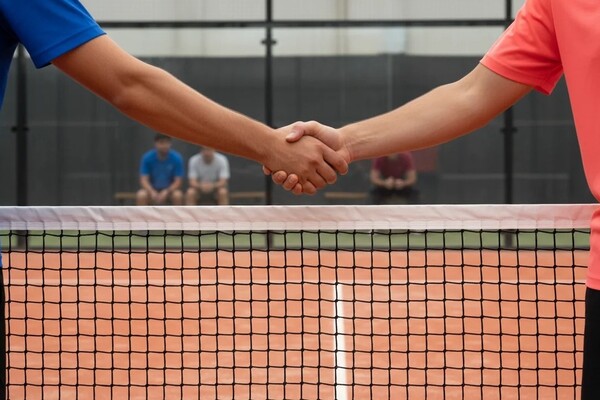
Wondering how a social tournament differs from a real one?
Social padel tournaments are built around a completely different goal than professional events: maximizing playing time and mixing players together, rather than eliminating half the field after every round. Formats like Americano and Mexicano let a group of eight, sixteen, or more players rotate through several short matches in a single afternoon, changing partners and opponents along the way. This guide explains how the most common social tournament formats actually work.

Why Social Tournaments Don't Use Bracket Elimination
A single-elimination bracket, the format most people picture when they hear "tournament," works well for professional events with a full day dedicated to one match at a time. It works poorly for a casual club gathering, since half the players go home after their first loss while the rest wait around for hours. Social formats solve this by guaranteeing everyone a full afternoon of matches regardless of how those matches go, which is why club tournaments almost never use a traditional knockout bracket.
Americano: The Classic Social Format
Americano is the most widely used social padel format. Players rotate partners round after round until everyone has played alongside, and against, every other player at least once. A variation called Team Americano keeps the same partnerships fixed for the whole event, with each team playing every other team once, closer to a traditional round robin. Either way, the appeal is the same: constant matches, no elimination, and a genuinely social atmosphere since you end up playing with almost everyone in the room.
Note
Americano tournaments work best with a number of players evenly divisible by four. Most tournament apps can still handle odd numbers, but the rotation runs more smoothly with a clean multiple of four.

Mexicano: Balanced Matches Through Rotating Partners
Mexicano takes the same rotating-partner concept as Americano but adds a competitive twist. The first round is drawn randomly, but every round after that is arranged based on the current scoreboard, pairing winners with winners and grouping players of similar current form together. The result is a tournament that stays competitive throughout, since a strong player who wins their first match ends up facing tougher opposition in the next round rather than continuing to blow out weaker players.
Free tournament generator — Americano, Mexicano and more. Set it up in minutes.
Important
In a Mexicano, your partner changes every round based on results, not personal preference. Don't expect to play the whole tournament alongside a friend you came with, that's what Team formats are for.

Mixicano and Mixed Formats
Mixicano applies the same Mexicano logic, rotating partners based on the scoreboard, while making sure every team is made up of one man and one woman each round. Mixed Americano works similarly but follows the standard Americano rotation instead, continuing until every man has partnered with every woman in the group. Both formats have become popular ways for clubs to run genuinely inclusive social events that don't split into separate men's and women's sessions.
Box Leagues and Ladder Tournaments
Not every social format finishes in a single day. Ladder tournaments run over weeks or months, with players challenging others above them on a ranked list to try to move up. Box league formats, sometimes called "beat the box," group players into small pools that play round robins among themselves, with the top finishers in each box moving up and the bottom finishers moving down for the next round of the league. These ongoing formats give a club's regular members a longer competitive structure to follow between one-off social events.
| Format | How Partners Work |
|---|---|
| Americano | Rotates until everyone has partnered with everyone |
| Team Americano | Fixed partners, every team plays every other team once |
| Mexicano | Partners rotate each round based on the scoreboard |
| Mixicano | Mexicano rotation, always one man and one woman per team |
| Ladder / Box League | Ongoing challenge or promotion-relegation structure |
How Skill Levels Are Handled
Many clubs run separate Mexicano or Americano sessions by skill band, similar to the level ratings used in padel booking apps, so beginners aren't matched against far more experienced players in the same rotation. Some formats, particularly Mexicano, also handle mixed ability within a single event reasonably well on their own, since the scoreboard-based pairing naturally starts grouping players of similar current form together after the first round or two.
What a Typical Social Tournament Day Looks Like
Most social tournaments run for two to two and a half hours, structured into short rounds rather than full best-of-three matches. A minimum number of registered players, often around eight, is usually required for the event to run at all, and courts are typically booked in a block so several matches can happen at once across the venue. Real-world club events commonly split entrants into skill bands, such as a beginner-friendly session and a more competitive intermediate or advanced one, running in parallel.
Scoring: Playing to Points Instead of Full Sets
Rather than playing full sets, social tournament matches are usually capped at a fixed number of total points, commonly 16, 21, or 24, ensuring every player serves an even, predictable number of times per match. This keeps each round short and the schedule predictable, which matters when a dozen or more short matches need to fit into a single afternoon. If the tournament runs out of time before every scheduled round finishes, the standings at that moment usually decide the final result.
Advice
Before your first social tournament, check which format is being used. An Americano means you'll play with almost everyone there; a Mexicano means your partner depends entirely on how your matches go, which changes how you might want to approach the day.

Apps That Run the Show
Dedicated tournament apps have made these formats far easier to organize than they used to be. Tools built specifically for Americano and Mexicano events automatically generate each round's pairings, track scores in real time, and display a live scoreboard that players can follow on their phones or a screen at the venue. Organizers typically just pick the format, set how many points each match is played to, and enter the players, letting the app handle the rest of the scheduling and math.
Prizes Are Usually the Point Less Than the Play
Unlike professional tournaments with serious ranking points and prize money at stake, social events usually offer little more than bragging rights, a small prize, or a round of drinks for whoever finishes on top. That lower-stakes structure is intentional, since the goal of a social tournament is participation and enjoyment across the whole group, not producing a single high-stakes champion.
What to Expect at Your First Social Tournament
Don't expect the intensity of a knockout bracket. Social tournaments are designed to keep everyone playing and mixing rather than crowning a single champion at the end of a grueling day, so the atmosphere tends to stay relaxed even when individual points get competitive. Most venues track results through a tournament app, so scores and standings are usually visible on a screen or shared link throughout the day, letting you see how the rotation is shaping up as it goes.
Social padel tournaments trade the drama of elimination for something more valuable at the club level: guaranteed playing time, constant partner variety, and matches that stay reasonably competitive from the first round to the last. Whether it's an Americano designed to mix an entire group together or a Mexicano built to keep every match close, these formats are a big part of why padel clubs feel social first and competitive second.
If you've only ever watched professional padel and pictured tournaments as best-of-three sets and single-elimination brackets, a first social event can feel refreshingly different. Show up expecting a lot of quick matches, a lot of new faces, and a schedule that keeps moving no matter how any individual game goes.