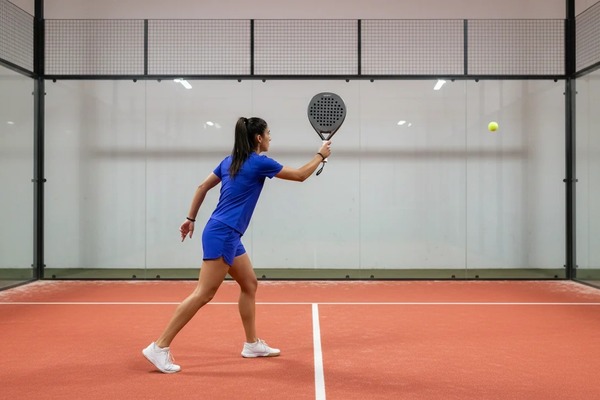
Forehands landing short and inviting your opponents forward?
Adding depth to your padel forehand means consistently landing the ball deep in your opponents' court rather than short and attackable. A deeper forehand keeps opponents pinned near the back wall, buys you time to recover position, and makes it much harder for them to step in and attack. This guide covers the technique behind a deep forehand, the most common reasons players fall short, and drills to build the skill consistently.

Why Depth Matters More Than Power on the Forehand
A hard forehand that lands short is often more dangerous to you than to your opponents, since it gives them an easy ball to step into and attack. A moderately paced forehand that lands deep, close to the back glass, does far more to control the point, since it keeps opponents on the back foot and limits their ability to move forward and take over the net. In padel specifically, depth also pushes the ball closer to the back wall, giving opponents an awkward, compressed space to work with rather than a comfortable strike zone.
The Technical Basics of a Deep Forehand
Contact Point and Timing
Making contact slightly further in front of your body, rather than letting the ball get even with or behind you, is one of the simplest ways to add depth. Contact made too late naturally sends the ball lower and shorter, since you're hitting on the way down rather than at the ideal point in the ball's bounce.
Follow-Through Direction
A follow-through that finishes up and out toward your target, rather than stopping short or wrapping around your body too early, sends more of your swing's energy into the ball's forward and upward path. Depth comes from that combination: enough upward trajectory to clear the net comfortably, paired with enough forward direction to carry the ball deep rather than dropping it in the middle of the court.
Using Topspin for Consistent Depth
A moderate amount of topspin lets you swing with real conviction while still keeping the ball inside the court, since the spin pulls the ball down after it clears the net instead of letting it sail long. This is often the missing piece for players who already swing with good pace but struggle to find consistent depth, since a flatter shot has a much smaller margin between landing deep and landing out.
Put it to the test with our free padel quiz — quick questions, instant results.
Note
Depth doesn't require maximum power. A controlled swing with the right contact point and follow-through will consistently outperform a harder swing with poor technique.

Common Reasons Your Forehand Falls Short
Most shallow forehands come down to one of a few habits: contact made too far behind the body, a flat swing with no topspin to bring the ball down safely, or simply aiming too low over the net out of fear of hitting long. That last habit is worth addressing directly, since a shot aimed with more net clearance and some topspin can actually be both safer and deeper than a flatter, lower-margin shot.
Important
Aiming higher over the net, combined with topspin, is not the same as playing it safe with a weak shot. A shot with real pace and spin that clears the net by a comfortable margin often lands deeper than a flat, low-margin shot aimed close to the tape.

Drills to Build Forehand Depth
Target Zone Drill
Mark or picture a target zone in the back third of the court, roughly a meter or two from the back glass. Have a partner feed forehands while you focus purely on landing the ball inside that zone, tracking your success rate over sets of ten to measure real progress.
Depth Ladder Drill
Divide the court into thirds, front, middle, and back, and challenge yourself to hit five consecutive forehands into the back third before allowing yourself to attempt anything more ambitious, like an angled winner. This builds the discipline of prioritizing depth as a default, rather than only reaching for it when you consciously remember to.
Off the Wall Depth Drill
Since padel's back wall plays a role in nearly every rally, practice hitting deep forehands off balls that have already rebounded from the back glass. This combines depth training with the wall-reading skill padel specifically demands, rather than practicing depth only on balls fed directly and predictably.
| Aspect | Shallow Forehand | Deep Forehand |
|---|---|---|
| Contact Point | Late, even with or behind the body | Slightly in front of the body |
| Trajectory | Flat, low net clearance | Moderate arc with topspin |
| Opponent's Position | Comfortable, can attack easily | Pushed back, limited attacking options |
| Risk Level | Higher, small margin for error | Lower, larger safety margin |
Adjusting Depth Based on the Situation
Not every forehand needs to be hit at maximum depth. When you're building a point from a neutral position, prioritizing depth keeps you in control and limits your opponents' options. Once an opportunity opens up, a short, weak ball from the other side, that's the moment to shift from depth to placement or pace, rather than defaulting to a deep shot when an attacking opportunity is actually available.
Grip Considerations for a Deeper Forehand
A semi-western grip, slightly more rotated than the continental grip used for volleys, makes it easier to generate topspin naturally through the swing, which supports depth without needing to muscle the shot. Players who stick with a continental grip on groundstrokes often find it harder to add topspin consistently, since the grip is better suited to a flatter, more direct contact than the brushing motion topspin requires.
Reading the Feed: Adjusting to Different Ball Heights
A ball bouncing above waist height gives you more room to swing up and through for topspin and depth, while a lower ball requires bending your knees to get under it rather than reaching down with just your arm. Trying to generate the same depth on a low ball with poor leg bend usually results in a flatter, shorter shot, since there's less room to create the upward swing path depth depends on.
Common Mistakes When Trying to Add Depth
Swinging Harder Instead of Adjusting Technique
Adding raw power without changing contact point or follow-through usually just makes existing technical flaws worse, sending the ball out rather than deep. Fix the technique first, then let pace follow naturally.
Aiming Too Close to the Net
Trying to keep the ball as low as possible over the net, out of fear of hitting long, often shortens the shot instead. A bit more net clearance, paired with topspin, is usually the safer and deeper option.
Ignoring Footwork and Positioning
Rushing to hit the ball from an unbalanced position makes clean, deep contact much harder to find consistently. Taking the extra half-second to set your feet properly pays off directly in shot depth.
Trying to Fix Everything at Once
Attempting to change your contact point, grip, and swing path all in the same session usually leaves you thinking too much to hit anything cleanly. Work on one adjustment at a time, giving each a real chance to become comfortable before layering on the next.
Advice
Film a practice session from the side. Seeing your actual contact point and follow-through on video often reveals exactly why your forehand is landing short, more clearly than it feels in the moment.

A deeper forehand comes down to a handful of adjustable habits: contact slightly in front of your body, a full follow-through toward your target, and enough topspin to swing with confidence while staying safely inside the court. None of it requires extra strength, just a shift in where and how you're actually making contact with the ball.
Depth is one of those improvements that pays off immediately once it clicks, since opponents who were previously stepping in to attack your forehand suddenly find themselves stuck defending from further back. Give the technique changes a few sessions to feel natural before judging whether they're working, since a new contact point or swing path almost always feels awkward before it feels automatic.