Not sure what's expected of you in a doubles match beyond the rules?
Padel is a game of four people in a small, enclosed space, so how you behave matters almost as much as how you play. Doubles etiquette is the set of habits that keeps matches fair, friendly, and fun: announcing the score, making honest calls, treating your partner well, and finishing with a handshake or racket tap. Most of it isn't written in any rulebook, but every regular player knows when it's broken. This guide covers padel etiquette for doubles matches, from before the first point to after the last, with a quick reference table and the mistakes to avoid. For the wider picture of how clubs work, see our guide to padel club culture.

Padel Etiquette in One Sentence
Padel etiquette is about preserving the spirit of the game: knowing when to cheer, when to apologise, and when to step back. If you remember only that, most situations sort themselves out.
Before the Match
- Introduce yourself. Say hello to your partner and your opponents, and mention if it's your first time or if you're returning from injury.
- Share the warm-up. The warm-up is for all four players, so let everyone hit with each other and keep it friendly.
- Agree the format. Decide on sets or a time limit, and whether deuce is decided by advantage, the Star Point, or the Golden Point.
- Greet your opponents. Padel opponent etiquette starts with a handshake before the match, but goes much further: respect their calls, applaud their winners, and thank them for the match.
Serving Manners
The server calls the score before each serve, loudly enough for everyone to hear. It prevents confusion and shows respect for the opponents. Don't rush the process, and give your opponents time to get into position to return. A deliberate, clean serve shows confidence and respect, while serving the moment someone turns away is a quick way to annoy them.
Line and Glass Calls
Put it to the test with our free padel quiz — quick questions, instant results.
Calls are where the character of a match shows. The accepted principle in padel is that if you're not sure, the ball is in, and the benefit of the doubt goes to the other side. This applies to close balls on the lines, especially in the service box.
- Call your own faults. If a ball touches your body, or you're unsure whether it bounced twice, say so immediately and give the point to your opponents.
- Be quick and clear. Make calls audibly and straight away, so everyone understands.
- Don't argue. If you keep disagreeing about a ball, restart the point with the same score. Consistent, fair calls build trust, and nobody enjoys arguing over points.
Note
In padel, the glass and the walls add extra judgment calls, such as whether a ball bounced twice or touched the mesh first. Treat them the same way as line calls: be honest, and give the benefit of the doubt.

Hitting an Opponent
In a small court, balls sometimes hit people. Hitting an opponent with the ball isn't against the rules, but doing it without an apology is bad form, a habit one etiquette guide calls "smash and dash." If you hit someone, even accidentally, raise a hand and say sorry. Avoid aiming at players' heads or faces, and think twice about hard smashes at close range when you could place the ball elsewhere.
Being a Good Partner
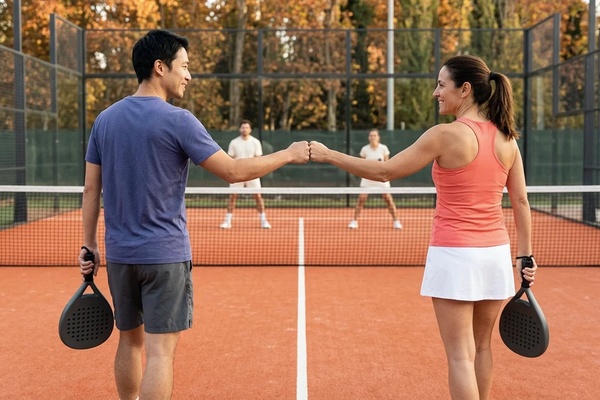
- Encourage, even after mistakes. A kind word or a fist bump goes a long way, and it helps both of you play better.
- Don't blame. Criticism in the middle of a match rarely helps. Save tactical talk for changeovers.
- Share the points. Take the balls you're best placed for, and don't hog everything or leave your partner stranded.
- Communicate. Call "mine" and "yours," and agree your signals before you start.
- Avoid the cold shoulder. Ignoring your partner after a lost point makes the next one harder.
Celebrations and Noise
Celebrate your good points, but do it in a way that respects your opponents. A fist pump or a smile is fine, taunting isn't. Avoid shouting or distracting your opponents while they're about to hit, and remember that other courts are close by. Applaud good shots from the other side too, since it builds goodwill.
Important
Throwing your racket, hitting balls in anger, or kicking the glass is unacceptable at almost every club. It can damage property and hurt people, and it spoils the match for everyone. If you feel your frustration building, take a breath during the changeover.

Doubles Etiquette at a Glance
| Situation | Good Etiquette |
|---|---|
| Before serving | Call the score clearly and give opponents time to get ready |
| A close ball | If in doubt, the ball is in, and the benefit goes to your opponents |
| Ball touches your body or bounces twice | Call it yourself immediately |
| You hit an opponent | Apologize with a raised hand |
| Your partner makes a mistake | Encourage and move on |
| A disagreement on a call | Replay the point with the same score |
| A great shot by opponents | Acknowledge it with a smile or applause |
| End of the match | Tap rackets or shake hands and say good game |
After the Match
At the end, all four players walk to the net, tap racket faces or shake hands, and say good game. It takes five seconds, and it matters. Thank your opponents, say something kind about the match whatever the result, and settle the score and any court cost cleanly. Leave the court tidy, with balls and bottles collected, so the next group can start on time.
Why It Matters
Padel is inherently social. It's almost always doubles, so your partner and your opponents are your community, and often the same people you'll play with next week. Being known as a fair, respectful player opens more doors than a powerful smash ever will, and it makes every match, win or lose, more enjoyable.
Common Mistakes
Free tournament generator — Americano, Mexicano and more. Set it up in minutes.
Serving Before the Opponents Are Ready
It feels sneaky even when it isn't meant that way. Give them a moment.
Arguing About Calls
If you can't agree, replay the point and keep going.
Hitting Opponents Without Apologising
A raised hand and a quick sorry costs nothing.
Criticizing Your Partner Mid-Rally
It adds pressure and doesn't fix anything. Wait for the changeover.
Advice
Before the match, agree one simple standard with your partner: "We give close calls to our opponents and we encourage each other." It sets the tone for the whole game.

Good doubles etiquette in padel comes down to a handful of habits: call the score, give the benefit of the doubt, own your faults, apologise when you hit someone, back your partner, celebrate with respect, and finish with a handshake or racket tap. Do those, and you'll be welcome on any court.