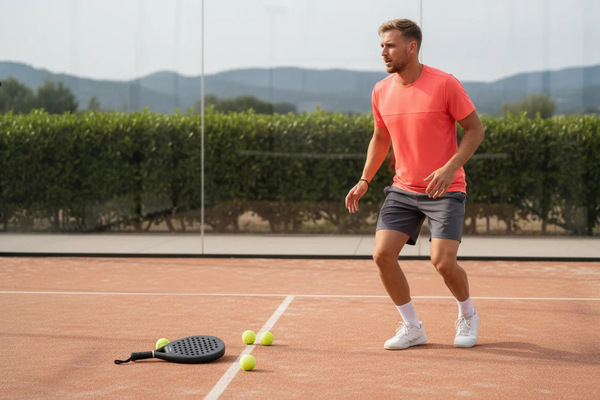
Just started padel and only ever playing matches?
Most beginners improve slowly for a simple reason: they only play matches. Matches are fun, but they don't give you enough repetitions of the basics, and they reinforce whatever habits you already have. A short, structured set of padel drills for beginners fixes that. In this guide you'll find a starter program built around three blocks, rules, control, and footwork, with eleven simple drills, a session structure, a four-week plan, and ways to measure progress. You don't need a coach, only a court, a few balls, and ideally a willing partner.

Why Drills Help Beginners
Knowing the rules is one thing. Building the skills to use them is another. Drills isolate one skill at a time, so you can repeat it until it becomes natural, and they let you practice things that rarely happen in a game, such as a clean serve or a ball off the glass. Beginners should live on control, not power, so every drill below is designed to be done at a comfortable pace.
Note
One focused 20-minute block a week, added on top of your normal matches, is enough to see steady gains. You don't need marathon sessions. Quality and repetition matter more than length.

Block 1: Rules Drills
These drills make the key rules automatic, so you stop thinking about them in matches.
Drill 1: Serve Basket
Serve ten balls into each service box, underhand, at or below waist height, with a bounce first and diagonally across the court. Count how many are legal and land in the box. Aim to get most of them in before you try anything fancier.
Drill 2: Serve and Return
One player serves to both boxes while the partner practices the return. The receiver must let the serve bounce before hitting, and aims a deep cross-court return. Swap roles every ten balls. It trains the serve, the bounce rule, and the first shot of every point.
Drill 3: Legal Ball Rally
Rally with a partner on a half court, and call "legal" or "fault" on each ball. A return must land on the opponent's floor before touching their wall or fence, and a ball that bounces twice on your side is lost. It makes the key rules about the walls and the bounce feel natural.
Block 2: Control Drills
Drill 4: Half-Court Rally
Put it to the test with our free padel quiz — quick questions, instant results.
The best way to practice is to rally on a half court with a partner, one at the net and the other at the baseline. Start slowly, keep the ball in play, and swap positions every few minutes. Because you only cover half the court, you get far more repetitions than in a full game.
Drill 5: Mini-Rallies Over the Net
Rally forehand to forehand at a slow pace, aiming for ten shots in a row without an error. When ten is easy, move to twenty, then add backhand to backhand.
Drill 6: Cross-Court Rally
Rally cross-court from the back of the court with a partner, focusing on keeping the ball in play and landing it deep. Cross-court gives you the longest distance and the most room for error.
Drill 7: Solo Wall Rally
If you have access to a wall, or you're alone on a court, stand two to three meters from the back glass and rally against it, counting the streak. When 20 feels easy, push for 50, then 100. Keep each shot at a comfortable pace and stay intentional: a count, a target, or a time goal turns hitting into practice.
Block 3: Footwork Drills
Drill 8: Ready Position and Split Step
Stand with your feet shoulder-width apart, knees slightly bent, and weight on the balls of your feet. Take a small split step every two to three seconds, landing on both feet at the same time. It costs nothing and quietly separates improving players from beginners.
Drill 9: Split Step on Feeds
A partner feeds balls alternately to your forehand and backhand. Perform a split step before every shot, landing as the feeder makes contact. It teaches you to time the split step to the opponent's hit.
Drill 10: Lateral Shuffle
Shuffle from side to side along the net, keeping your racket up and your feet moving. It trains the sideways movement you'll use constantly at the net.
Drill 11: Diagonal Retreat
Start at the net and retreat diagonally toward the back wall as if covering a lob, then recover forward. It builds the movement for both defense and the return to the net.
Important
Don't try to do all eleven drills in every session. Pick two or three that target your weakest areas and rotate through the list over a week or two. A short, focused session beats a long, unfocused one.

A Sample 60-Minute Session
| Phase | Time | What to Do |
|---|---|---|
| Warm-up | 10 minutes | Light jogging, joint mobility, dynamic stretching, easy rallies |
| Technical block | 25 minutes | One rules drill and one control drill, such as serve and return plus a cross-court rally |
| Footwork | 10 minutes | Split step on feeds and a lateral shuffle |
| Game block | 10 minutes | A short mini-game or rally to use what you practiced |
| Cool-down | 5 minutes | Gentle stretching and a quick review of what worked |
A Four-Week Beginner Plan
| Week | Focus | Drills |
|---|---|---|
| 1 | Rules and the serve | Serve basket, serve and return, legal ball rally |
| 2 | Control | Half-court rally, mini-rallies, cross-court rally |
| 3 | Footwork and the glass | Ready position, split step on feeds, solo wall rally, lateral shuffle |
| 4 | Putting it together | Diagonal retreat, serve and return, short games with partner calls |
Aim for two to four sessions a week, building from about 60 minutes. If you can only manage one, spend it on the first half of the table.
Solo or With a Partner?
Most of these drills work either way. If you're alone, use the back glass for wall rallies and the serve basket, and practice the split step, lateral shuffle, and diagonal retreat without a ball. If you have a partner, swap the solo blocks for the partner versions, such as half-court rallies and split step on feeds. The structure stays the same, and only the feed changes. Having both options means you can keep improving even when nobody else is free.
Practicing Without a Court
Footwork needs no ball and almost no space. Practice the ready position, the split step, and a few lateral shuffles in a hallway or a garden, and take slow shadow swings in front of a mirror to check your posture. A few minutes a day keeps the habits fresh between court sessions, and it makes the movement feel natural when you're back on court.
Free tournament generator — Americano, Mexicano and more. Set it up in minutes.
How to Measure Progress
Pick a few numbers and write them down: how many of ten serves are legal, your longest mini-rally without an error, your best wall streak, and how often you remember to split step. A rising number over a few weeks tells you the drills are working, even when matches still feel messy.
Common Beginner Drill Mistakes
Hitting Too Hard
Power makes control harder. Keep the pace comfortable until the numbers improve.
Practicing Without a Target
A count, a spot, or a goal turns hitting into practice. Always have one.
Skipping the Warm-Up
Cold muscles are more vulnerable. Give yourself ten minutes.
Doing Too Many Drills at Once
Trying everything makes it hard to improve anything. Choose two or three.
Advice
End every drill session with a few minutes of real play. Using what you just practiced in a game is how the skill moves from the drill into the match.

Padel drills for beginners work best when they're simple, repeated, and measured. Start with the rules, build control at a comfortable pace, add footwork and the split step, and finish each session with a little real play. A few focused hours over a month will do more for your game than months of random matches.