New to the court?
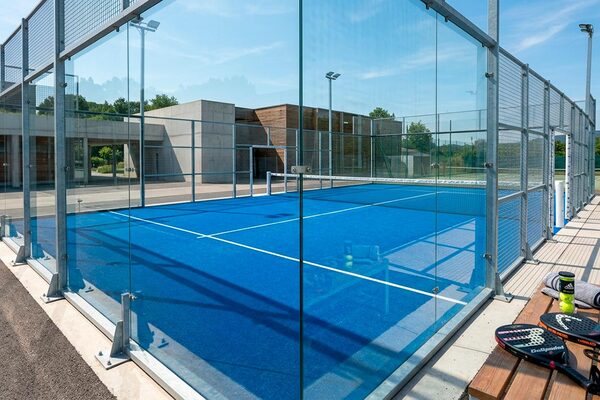
Padel court rules start with the court itself: a fully enclosed rectangle, glass on some sides, mesh fencing on others, with a net across the middle and service boxes marked on each half. Once you know what each part does, the game makes a lot more sense.
This guide breaks down padel court dimensions, the lines that matter, how the walls work, and the different zones you'll play from. It's written for anyone stepping onto a padel court for the first time.

How Big Is a Padel Court?
A standard padel court measures 20 meters long and 10 meters wide, split evenly by a net into two 10x10 meter halves. That's noticeably smaller than a tennis court, which is part of why padel feels less like a running sport and more like a positioning game.
The whole court sits inside an enclosure. Some sections are glass, others are mesh fencing, and the mix affects how the ball behaves when it bounces off them.
How Does a Padel Court Differ From a Tennis Court?
The biggest difference is the enclosure. Tennis courts are open, and a ball that leaves the boundary is simply out. Padel courts are boxed in, so the ball can bounce off walls and stay in play. The court is also smaller, there's no doubles alley like in tennis, and every padel court is built for doubles by default.
What Are the Lines on a Padel Court?
Padel court lines follow a similar layout to tennis, just scaled down. Here's what you'll see marked on the surface:
- Baseline – the back line on each side, marking the rear boundary of play.
- Service line – marks where the service boxes end, closer to the net.
- Center service line – splits each side's service area into two boxes, left and right.
- Net line – the line directly under the net, dividing the two halves of the court.
Put it to the test with our free padel quiz — quick questions, instant results.
What Is the Service Box in Padel?
The service box is the marked rectangle on each side of the court where serves must land. Each side has two service boxes, split by the center service line, and the serve must go diagonally into the correct box based on which side you're serving from. Land outside that box, and it's a fault, same as a missed serve in tennis.

Padel Baseline Basics
The baseline sits at the very back of each half, right up against the rear wall. In padel, you'll often play shots right near the baseline, since the back wall lets the ball bounce back toward you even after it seems to have gone past.
What Is the Net Height in Padel?
The net in padel sits lower than a tennis net. It's typically around 88 centimeters at the center and slightly higher, close to 92 centimeters, at the posts on either side. That small dip in the middle is intentional and mirrors tennis net design, though the overall height is lower across the board.
How Do the Walls Work in Padel?
This is the part that confuses most beginners, and it's also what makes padel fun. The court walls aren't just boundaries. They're part of how you play the ball.
Padel Glass Wall Rules
Glass panels usually make up the back wall and parts of the side walls. The rule is simple: if the ball bounces on the ground first, then hits the glass, it's still in play, and you can return it off that bounce. If the ball hits the glass before touching the ground, it's out.
Can the Ball Hit the Fence in Padel?
Yes, the same rule applies to the metal mesh fencing sections. Ground first, then fence, keeps the ball alive. Fence first, before any bounce, and the point is over.
How to Use the Back Wall in Padel
The back wall is where most beginners first notice how different padel feels from tennis. A ball heading past you doesn't mean the point is lost. Let it bounce, then use the wall's rebound to set up your return. It takes a bit of practice to judge the angle, but most players pick it up within a handful of sessions.

How to Use the Side Wall in Padel
Side walls work the same way, though angles are trickier since the ball comes across rather than straight back. Watching where the ball bounces first, rather than watching the wall itself, helps you track the rebound more accurately.
What Are the Zones on a Padel Court?
Padel doesn't have as many named zones as some sports, but understanding the general areas helps with positioning.
- Service zone – the area between the net and the service line, where serves must land.
- Baseline zone – the back third of the court, near the rear wall, where defensive shots and wall returns happen most often.
- Net zone – the area right up against the net, where volleys and quick exchanges take place.
Where Do You Stand on a Padel Court?
In doubles, one player typically holds the net zone while their partner covers the baseline zone, and you shift depending on where the rally goes. Standing too far back for too long, out of tennis habit, is one of the most common mistakes beginners make. Padel rewards moving closer to the net once you're comfortable reading the ball.

What Counts as In or Out on a Padel Court?
A quick reference for what's legal and what isn't:
| Situation | Ruling |
|---|---|
| Ball bounces inside the court, then hits glass or fence | In play |
| Ball hits glass or fence before bouncing | Out |
| Ball bounces outside the court lines | Out |
| Ball clears the top of the enclosure | Out |
| Serve lands outside the correct service box | Fault |
Keep this table in mind for your first few games, and most confusion about padel court rules clears up fast.
Padel Court Structure at a Glance
Putting it all together, a padel court is built from a few core parts:
- A 20x10 meter enclosed rectangle, split by a net around 88-92cm high.
- Baselines and service lines marking legal serve and return areas.
- Glass walls on the back and parts of the sides, allowing rebounds after a bounce.
- Mesh fencing filling in the remaining wall sections.
- A rough division into service, baseline, and net zones for positioning.
Once you've seen a court in person, all of this becomes intuitive fast. Reading the lines and walls is mostly a matter of playing a few games, not memorizing measurements. If you're ready to see it for yourself, it's worth booking a session and getting a feel for the space firsthand.