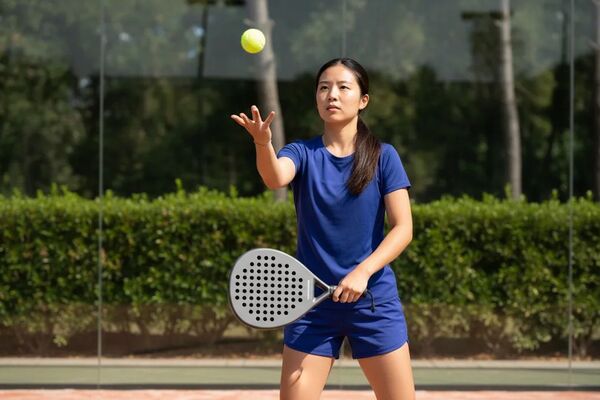
Every padel point starts the same way: a serve, a return, and a race to the net. How you handle the first two shots of a point, your serve and the volley that follows it, shapes much of what comes next. Win that sequence and you control the net; lose it and you spend the rest of the rally defending. This guide treats the serve and the first volley as one connected sequence: how to serve simply and consistently, how to move forward with your partner, and how to play the first volley without giving the point away.
The Serve Is a Setup Shot
A padel serve isn't about ending the point, it's about starting the rally on your terms and getting to the net, where most points are won. That changes how you think about it. A simple, accurate, low serve that makes the return awkward is worth far more than a fast, risky one that gives away a fault. Keep the serve simple, because the biggest error players make is overcomplicating it.
Serve Basics in a Nutshell
Stand behind the service line with both feet behind it and at least one foot on the ground, bounce the ball, and hit it underhand at or below waist height into the diagonal service box. You get two serves, and you alternate sides from point to point. If the serve clips the net, bounces in the box, and then hits a side or back wall, it's a let and you replay it, but if it hits the net, lands in the box, and then strikes the fence, it's a fault.
Serve Technique: Keep It Simple
Step 1: Drop the Ball Close
Hold the ball at roughly shoulder height and drop it close to your body, just ahead of your front foot, within easy arm's reach. Don't try to hit it the instant it bounces; give it a moment to rise.
Step 2: Racket Up, Compact Swing
Bring the racket up, pointing slightly toward the back glass, then hit through the ball at waist height with a compact, low-to-high motion. Avoid a big tennis-style windup, which adds nothing and makes the serve harder to repeat.
Step 3: Let Your Weight Move Forward
Start with your weight on your back foot and let it travel into the court as you hit, so your momentum is already moving forward. That helps you get to the net, which is the whole point of the serve.
Step 4: Finish, Then Run
Put it to the test with our free padel quiz — quick questions, instant results.
Complete your serving motion first, and then move forward. A common error is rushing toward the net during the serve itself, which makes the serve worse and doesn't actually get you there faster.
Note
Many coaches suggest adding a little slice once the basic serve is reliable. Slice keeps the ball low after the bounce, which makes an attacking return harder.

Where to Serve
Placement matters more than power. A low, accurate serve toward the seam where the floor meets the back glass is harder to attack than a faster serve into the middle of the box, and a serve that bounces off the glass buys you extra time to reach the net. You can also aim at the returner's body, which takes away their angles. Taking some pace off the serve gives you more time to move forward, and a consistent second serve matters even more than the first, since a double fault costs a point outright.
Moving to the Net Together
As soon as you've hit the serve, both you and your partner should move forward together and stop in a balanced ready position, roughly two to three meters behind the net, ahead of your opponent's return. Time your stop with a split step just as the returner hits the ball, so you can react in any direction. Avoid stopping in the middle of the court, between the service line and the net, where low balls at your feet are hard to handle.
The First Volley: Why It's Hard
The first volley is the first ball you play after serving and moving forward, usually low and often from an awkward position, because the returner is trying to hit at your feet. It's one of the hardest shots in padel precisely because you're arriving at the net while the ball is arriving at you. The aim isn't to hit a winner, it's to play a controlled ball that keeps you in the point and in position.
Important
Don't try to win the point with your first volley. A controlled, deep volley that keeps your opponents on the back foot is worth more than a risky winner that gives the net away.

First Volley Technique
Keep the racket up in front of you with a short, compact motion, and make contact in front of your body rather than letting the ball get past you. Use a firm wrist and a slightly open face to push the ball back with control, rather than swinging at it. Bend your knees for low balls instead of reaching down with your arm, so the racket head stays above your wrist.
Where to Aim the First Volley
The best volley target is low, at the feet of the player in front of you, because a ball at chest height gives them a comfortable volley. Aiming for around the opponent's service line keeps the ball deep enough to push them back without sitting up. Down the middle is another safe option, since it creates confusion about who should take the ball and reduces angles.
| Stage | What to Do |
|---|---|
| Serve | Simple, low, accurate; aim for the seam, glass, or body |
| Follow | Finish the serve, then move forward with your partner |
| Stop | Split step as the returner hits, about 2-3 m from the net |
| First volley | Compact, controlled, low and deep, or down the middle |
| After | Recover to a balanced position level with your partner |
Drills to Practice the Sequence
Serve Basket Count
Serve a full basket of balls to a target and count how many first serves land in the box. Use it to build consistency before adding spin or pace.
Serve and Follow
Serve and move forward with a partner, stopping in a balanced position as a feeder simulates the return. Focus on finishing the serve before running and on the split step.
First Volley Feed
A feeder hits low balls at your feet while you move forward from the service line, and you play compact volleys to a target near the opponent's service line.
Serve, Return, First Volley Points
Play short points that start with a serve and last no more than three shots, so you rehearse the exact sequence that starts most points.
Common Mistakes
Overcomplicating the Serve
A big windup or too much spin adds errors. Keep it simple and consistent.
Rushing to the Net
Running before you finish the serve hurts the serve and your balance. Finish, then go.
Stopping in No Man's Land
Stopping between the service line and the net leaves you exposed at your feet. Move all the way forward together.
Swinging at the First Volley
A big swing leaves no time to control the ball. Use a short, firm block.
Advice
Make a simple rule for yourself: serve, finish, move, split step. Repeating those four words in practice is a quick way to turn the sequence into a habit.

Starting a padel point well comes down to a simple, accurate serve, a forward move made together with your partner, a well-timed split step, and a compact first volley aimed low and deep. Master that sequence and you'll win the net far more often, which means you'll win more points before the rally has even begun.