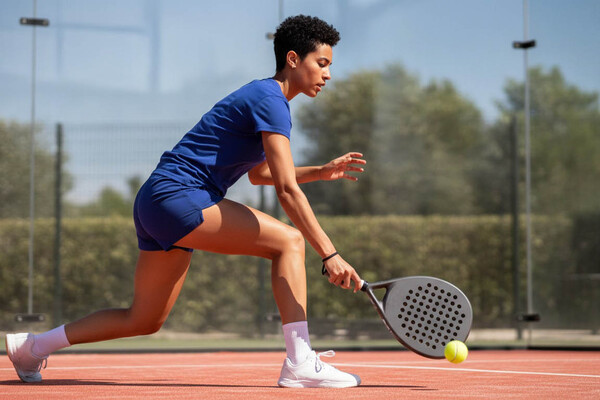
Winning fewer points at the net than you should?
The volley is one of the most important shots in padel, since most points are decided at the net, and it's also one of the most commonly misdiagnosed. Players blame slow hands when the real problem is usually a low racket, a late contact, or an over-open racket face. Rather than adding more drills at random, this guide helps you find what's actually going wrong with your volley, fix it in the right order, and then build depth and variety on top.

Start With the Ready Position
Most volley problems begin before the ball arrives. At the net, hold the racket up in front of you, roughly at chest height or in front of your head, nearly vertical, with the racket head above the handle. This position lets you react faster and make fewer mistakes, because you're already close to where contact will happen. A racket that sits low forces you to lift and then swing in a very short time, which is a recipe for mistimed, floaty volleys.
Note
Think of your racket as a shield held up and stable in front of you. From that position you can redirect the ball with control instead of swinging wildly.

The Three Variables: Path, Angle, and Speed
Every volley comes down to three things. The swing path is whether you move low to high, high to low, or flat. The angle of the racket face determines height: an open face sends the ball up, a closed face sends it down. The speed of your racket determines how hard the ball travels. When a volley goes wrong, one of these three is usually the cause, and identifying which one tells you exactly what to fix.
Diagnose Your Volley
| Symptom | Likely Cause | Fix |
|---|---|---|
| Ball flies to the back glass | Racket too open, or reacting too late | Close the face slightly, prepare earlier |
| Volley floats and sits up | Racket head dropping below the wrist | Keep the head up at contact |
| Volley goes into the net | Too closed, or late contact | Contact further in front, open slightly |
| Ball lacks control | Swing too big | Short, compact punch or block |
| You're always late | Racket low in the ready position | Hold it up in front of you |
Keep the Swing Short and Compact
Padel volleys are about timing and precision, not big swings. Use a short backswing, keep the racket head up, and step into the shot, aiming for control rather than power. A compact preparation keeps the racket close to your body so you can react late and still make clean contact, even when the ball changes direction off the glass or arrives at speed. Keep the wrist firm and the racket slightly open, and push through the ball with a compact movement.
Block, Attack, and Slice
There's more than one kind of volley. A block is a defensive, absorbing shot that sends the ball back with minimal swing, ideal when you're under pressure or the ball is fast. An attacking volley uses a little more racket speed to put the opponent under pressure. As you improve, adding slice, which puts backspin on the ball, helps it stay low and travel with depth, and a low, sliced volley that lands near the back glass is one of the hardest balls to return.
Put it to the test with our free padel quiz — quick questions, instant results.
Important
Don't add slice before the basic punch or block is reliable. Fix the ready position, contact point, and racket angle first, then layer in spin.

Depth and Where to Aim
Depth is one of the keys to an effective volley. A useful target is the service line: it's deep enough to push opponents back but not so deep that the ball sits up or rebounds high off the back glass. Against opponents at the back, aim at their feet, which forces a low, awkward half-volley, or down the middle, which creates confusion about who should take the ball. Avoid aiming for the lines. The margin for error isn't worth it, and depth and placement beat raw angle almost every time.
Footwork: Step In and Recover
Step into the volley with your opposite foot and make contact out in front of your body. After the shot, the racket follows the ball's trajectory and finishes pointing where the ball is travelling, then you return immediately to the ready position, facing the ball, knees slightly bent, racket at chest height. A volley isn't finished until you've reset for the next one.
Forehand and Backhand Volleys
A forehand volley uses your dominant side, while a backhand volley uses your non-dominant side. Most players volley the backhand with one hand because it gives more reach and a quicker, more compact punch. Whatever the side, the same principles apply: racket up, compact swing, contact in front, firm wrist.
A Practice Plan to Improve Your Volley
Control Volleys
Stand at the net with a partner at the back and exchange soft volleys, prioritizing control and direction over pace. Use this to build touch and consistency.
Moving Volleys
Have a partner feed short balls while you volley and move laterally between shots, simulating the way real net exchanges require movement.
Depth Target Volleys
Place cones or marks near the service line and aim your volleys at them, tracking how many land in the target zone.
Volley Series
Simulate approaching the net after a shot from the back and then hit several consecutive volleys, which builds both the approach and the sequence.
Volleying in Doubles
The volley doesn't exist in isolation. At the net with a partner, you also need to cover the middle, call the ball when it's down the center, and move as a unit. A volley hit well but from a poor position can still leave a gap, so combine good technique with good positioning, staying connected with your partner and adjusting together as the rally develops.
One Rule Worth Remembering
In padel you cannot volley a serve, so the receiver must let the serve bounce before returning it. Keep this in mind in practice games and warm-ups, since habits formed in drills can carry over into real play.
Tracking Your Progress
Choose one or two numbers to track over several weeks, such as how many consecutive volleys you can hit during a rally drill or how many of ten volleys land beyond the service line. Small, steady improvements show that your fixes are working far more reliably than how a single session feels.
Common Volley Mistakes
Swinging Too Much
A big swing leaves no time to react and gives up control. Shorten it.
Racket Head Dropping
Letting the racket head fall below the wrist opens the face unpredictably and floats the ball. Keep the head up.
Contact Too Late
Letting the ball get past your body makes control almost impossible. Reach out and meet it in front.
Aiming for the Lines
Chasing extreme angles produces unforced errors. Prioritize depth and placement.
Advice
Film a few volleys from the side and check three things: is your racket head up, is contact in front of your body, and do you return to ready afterward? Those three details fix most volleys.

A better volley comes from fixing fundamentals in the right order: a high ready position, a short swing, contact in front, and then depth and spin. Diagnose first, drill second, and the shot that once felt unpredictable becomes one of the most reliable parts of your game.