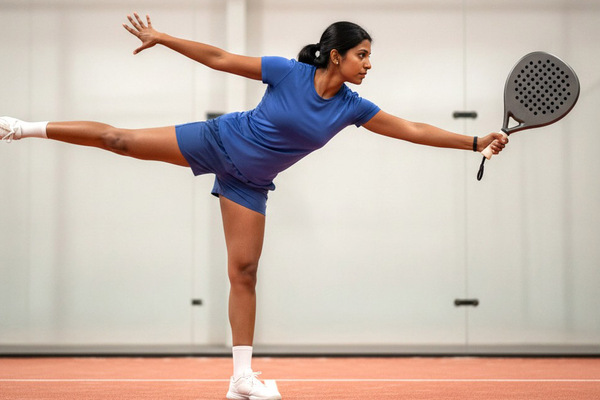
Good balance is the quiet foundation behind almost every padel shot. When you're stable at the moment of contact, your swing is more consistent, your recovery is faster, and your joints take less strain from the sudden stops, turns, and lunges the sport demands. Balance isn't a fixed trait, either: it responds well to regular, targeted training. This guide explains why balance matters in padel, which exercises build it, and how to carry it from the gym onto the court.
Note
This article offers general training information, not medical advice. If you have a current injury, balance problems, or health concerns, check with a doctor or qualified physiotherapist before starting a new exercise routine.

Why Balance Matters in Padel
Padel involves rapid changes of direction, jumps, and lunges, often while you're already reaching for a shot. Staying balanced through that movement helps you hit more accurately, recover faster for the next ball, and protect the joints that take the most punishment, particularly the ankles and knees. Ankle sprains are among the most common padel injuries, which is one reason balance and proprioception work features so heavily in injury-prevention advice.
Static and Dynamic Balance
Static balance is your ability to hold a stable position, such as standing on one leg. Dynamic balance is staying controlled while you move, changing direction, lunging, or landing. Padel leans heavily on the dynamic kind, but static exercises are a useful starting point, since they train the small stabilizing muscles around the ankle, knee, and hip that dynamic movement relies on.
The Stabilizers: Core, Hips, and Ankles
Balance comes from the whole kinetic chain. A strong core keeps your trunk steady while your arms and legs move, hip stability keeps your knees tracking properly, and strong calves and ankle muscles help absorb sudden changes of direction. Training these together, rather than isolating one area, tends to translate best to the court.
Balance Exercises for Padel Players
Single-Leg Stand
Put it to the test with our free padel quiz — quick questions, instant results.
Stand on one leg with a slight bend in the knee and hold for 20 to 30 seconds, then switch. Progress by closing your eyes, standing on a folded towel, or tossing a ball to a partner or against a wall while you hold the position.
Single-Leg Romanian Deadlift
Hold a light weight in one hand and balance on the opposite leg, hinging at the hips while extending your free leg behind you. Keep your back flat and your hips level. Start without weight until the movement feels steady.
Lateral Lunge
Take a wide step to the side, pushing your hips back as you bend one knee while keeping the other leg straight, then push back to the start. It trains the sideways stability padel movement relies on.
Plank With Alternating Limb Raises
From a plank position, lift one arm or leg at a time while keeping your hips steady. It builds core control and coordination between your upper and lower body.
Controlled Jumps and Landings
Jump and land softly on two legs, progressing to a single leg once you can do so with control. Focus on landing quietly with your knee tracking over your foot.
Unstable-Surface Work
A balance board, BOSU, or stability ball challenges your ankles and core in different ways. Use them as a progression once basic single-leg work feels easy, and keep sessions short and controlled.
| Exercise | What It Builds |
|---|---|
| Single-leg stand | Static balance, ankle stability |
| Single-leg Romanian deadlift | Hip stability, unilateral strength |
| Lateral lunge | Sideways stability and leg strength |
| Plank with limb raises | Core control and coordination |
| Controlled single-leg landings | Reactive stability and shock absorption |
A Simple Weekly Plan
A realistic target is two to three short sessions a week, around 10 to 15 minutes each, added to the end of a workout or done before playing. Alternate intensity and combine balance work with general strength and mobility rather than treating it as a separate project. Consistency matters far more than any single long session.
Important
Progress gradually. Add difficulty only when you can complete an exercise with good control. Wobbling a little is normal, but pain, sharp twinges, or loss of control are signs to stop and reassess.

Bringing Balance to the Court
Gym work only pays off if it carries over to how you move. Keep a low centre of gravity during lateral movement by bending your knees rather than standing tall, use a split step as your opponent hits so you're balanced and ready to move, and take smaller adjustment steps rather than one big lunge. After each shot, recover to a balanced, central position before the next ball arrives instead of watching where yours went.
Signs Your Balance Needs Work
A few patterns suggest balance is holding you back: you often feel off-center when you hit, you stumble or have to take extra steps to recover after reaching for a ball, your shots lose accuracy when you're stretched, or you feel your ankle roll more than it should. These signs don't diagnose anything, but they're a good cue to add regular balance and stability work to your week.
How Balance Shows Up in Specific Shots
Balance matters differently across shots. On volleys, a stable base lets you punch the ball cleanly without leaning back. On overheads like the bandeja and smash, you move backward and then need to be balanced at contact and ready to recover forward. On balls off the back wall, you move back and then step into the shot. In each case, the better your balance, the more your technique holds together under pressure, and the easier it is to move straight into your next position.
Footwear and Warm-Up
Shoes matter for balance as much as exercises. Generic running shoes are built mainly for forward motion and may lack the lateral stability padel requires, while padel-specific footwear supports sideways movement. A proper warm-up that activates the ankles, knees, and hips before play also prepares your body for the quick changes of direction ahead.
Free tournament generator — Americano, Mexicano and more. Set it up in minutes.
Common Mistakes
Only Training Static Balance
Holding a single-leg position is useful, but padel is dynamic. Add movement, lunges, and landings so the work reflects how you actually play.
Rushing the Progression
Jumping straight to unstable surfaces or heavy weights before basic balance is solid raises the risk of strain. Master the basics first.
Ignoring the Core
Balance isn't just about the legs. A weak core lets your trunk wobble, which undermines stability even if your legs are strong.
Skipping Proper Shoes
Even good balance training can be undermined by footwear that doesn't support lateral movement.
Advice
Make balance work part of your routine rather than an add-on you'll skip. Ten minutes after a session, or while watching TV, adds up to meaningful improvement over a few weeks.

Better balance in padel comes from a few simple habits: regular single-leg and core work, dynamic movements like lateral lunges, careful progression, and the on-court discipline of staying low and recovering after every shot. None of it requires special equipment, and the payoff shows up as more consistent shots and a body that holds up for the long term.