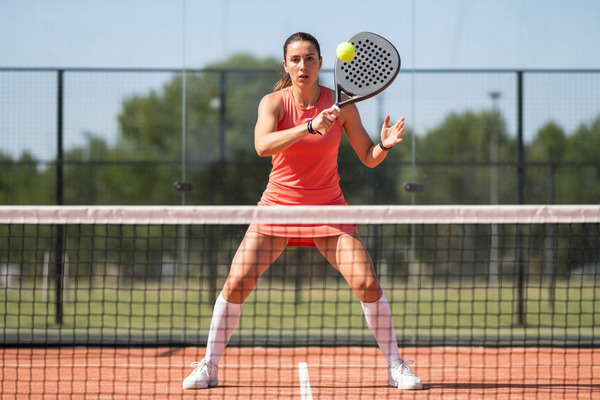
Always a split second late on fast volleys at the net?
Quick reflexes at the net feel like a gift some players are born with, but they're largely trainable. In padel, the volley is a fast, close-range exchange where you often have only a fraction of a second to react, so the players who look fastest are usually the ones who prepare best and read the play earliest. This guide explains what reflexes really mean on a padel court and gives you drills you can use to sharpen them, both on court and away from it.

What "Reflexes" Really Mean at the Net
At the net, quick hands come from three things working together: reaction speed, anticipation, and preparation. Pure reaction is how fast you respond once the ball is hit. Anticipation is reading what's likely to happen before it does, from your opponent's racket, body, and position. Preparation is having your racket up, your feet balanced, and your swing short enough that you can use the time you have. Training all three is far more effective than trying to simply "be faster."
Note
Most players improve volley speed more by shortening their swing and preparing earlier than by reacting faster. Fix the setup first, then add reaction drills.

Start With the Ready Position
Reflexes are wasted if your body isn't ready to use them. Stand with your knees slightly bent, weight on the balls of your feet, and your racket up in front of you rather than at your side. Time a small split step to the moment your opponent hits the ball so you land balanced and ready to push in either direction. A firm wrist and a short, compact swing then let you volley with whatever time you have, instead of taking a big swing you can't finish.
Anticipation: Read Before the Ball Arrives
Watching the opponent's racket preparation, shoulders, and position often tells you where the ball is going before it's struck. Good net players also anticipate patterns, such as which side an opponent prefers to hit to under pressure. Practicing concentration and reading your opponent during drills, rather than just reacting to the ball, makes your reaction look instantaneous.
Reflex Drills You Can Use
Rapid-Fire Volleys
Put it to the test with our free padel quiz — quick questions, instant results.
Stand about a meter from the net while a partner hits quick volleys at you, and alternate between forehand and backhand. The goal is to improve both reaction time and how quickly you reset between shots. Start slowly and speed up as your control improves.
Feeds at Varied Heights and Speeds
Have a partner or coach throw or hit balls at different heights and speeds so you can't predict what's coming. Mixing fast and slow balls forces you to adjust quickly and avoids settling into a rhythm.
Reduced Court Play
Play mini-games in a smaller area so exchanges come faster and decisions have to be made sooner. The smaller space forces quick reactions and sharpens your peripheral vision.
Smash Simulation
Have a partner simulate different overheads so you have to decide whether to volley, block, or let the ball go. This trains the decision-making part of reflexes, not just the physical speed.
Volley Point Game
Play a mini-game in which points can only be won with a volley. It builds quick decision-making and confidence at key moments, and it keeps the intensity close to match level.
Important
Close-range drills involve fast balls hitting areas near your face and body. Wear protective eyewear if you can, warm up properly, and agree with your partner on where they'll aim.

Off-Court Reaction Training
You can sharpen reaction speed without a court. A reaction ball or any ball that bounces unpredictably, thrown by a partner, trains hand-eye coordination. A simple ball-drop drill, where a partner randomly drops a ball and you catch it, helps you react with your legs first rather than bending at the back. Shadow play with rapid direction changes and lateral jumps over a line can also build movement quickness that supports your net reactions.
| Drill | What It Trains |
|---|---|
| Rapid-fire volleys | Reaction speed and quick reset |
| Varied height and speed feeds | Adaptability, unpredictability |
| Reduced court play | Fast decisions, peripheral vision |
| Smash simulation | Decision-making at the net |
| Volley point game | Match-level volley confidence |
| Reaction ball / ball drop | Hand-eye coordination, legs-first reaction |
A Sample 20-Minute Reflex Session
Begin with five minutes of warm-up and shadow footwork. Spend about five minutes on rapid-fire volleys at a controlled pace, then five minutes on feeds at varied heights and speeds. Finish with five minutes of a volley point game so the skills are tested under match-like pressure. Keep rest short between blocks but stop if your quality falls off noticeably, since sloppy repetition teaches the wrong habits.
Staying Relaxed Under Pressure
Tension is the enemy of fast hands. A tight grip and tense shoulders slow your reaction and make your volleys stiff. Keep a relaxed grip until contact, breathe normally, and let your racket do the work. Many players notice their reflexes improve almost immediately once they stop gripping the handle as if their life depended on it.
Reflexes and Your Partner in Doubles
At the net in doubles, reactions also depend on communication and positioning. Knowing which balls are yours and which belong to your partner removes hesitation, which is itself a major cause of slow reactions. Practice net-poaching situations, where you intercept a shot and switch positions with your partner, so those split-second decisions become automatic.
How to Progress
Start with predictable feeds and simple volleys, then add speed, variety, and movement as control improves. Keep reflex sessions short and sharp, because quality drops quickly when you're tired and you only train reaction effectively when you're fresh. A combined routine of a few minutes of focused reflex work at the start of practice, followed by match-like play, tends to transfer better than a long, exhausting drill.
Common Mistakes
Swinging Too Big
A long swing leaves no time to react. Keep the volley short, with a firm wrist and compact motion.
Standing Flat-Footed
Without a split step, you start from a standstill and lose precious time. Time the hop to your opponent's contact.
Only Training Reaction, Not Reading
If you only train raw speed, you miss the chance to anticipate. Watch your opponent's setup during drills.
Training Tired
Reaction drills lose value when you're fatigued. Do them early in a session when you're fresh.
Advice
Track a simple number in your rapid-fire drill, such as how many consecutive volleys you can hit before a miss. A rising score over a few weeks is clear proof your reactions and control are improving.

Faster reflexes at the net come from a stable ready position, early reading of the play, compact swings, and regular, varied drills. Build those habits and the net stops feeling like a place where things happen too quickly, and starts feeling like somewhere you're in control.