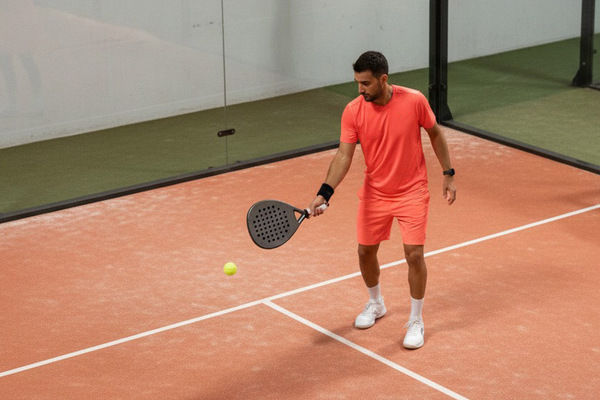
For most beginners, the glass is the strangest part of padel: a transparent wall that sends the ball back at you when you least expect it. For experienced players, it's a tool. Learning to play off the glass is less about any single shot and more about building a progression, from reading the first bounce, to handling single-wall and double-wall balls, to using the glass to attack. This guide gives you that progression, and explains how glass differs from the mesh fence that sits above and beside it. For detailed technique on specific walls, see our guides on playing off the back wall and the side wall.
Glass and Mesh: What's the Difference?
A padel court is enclosed by a combination of glass and metal mesh. The back walls typically have panels of glass about three meters high with a one-meter metal fence above, for a total height of four meters, while the side walls commonly combine glass near the back of the court with mesh further forward. The exact layout varies from court to court, so it's worth checking yours before you play.
The rules treat the two surfaces differently. After the ball has bounced on the ground, it may hit the glass and stay in play. A serve may touch the glass after its first bounce, but never the mesh directly, and a ball that hits the mesh without bouncing first is a fault.
Note
Glass is the surface that gives a clean, uniform rebound. Mesh is the surface that tends to kill the ball. Learning to tell them apart quickly, from the height and position of the ball, is a skill in itself.

Why Glass Is Predictable
Glass produces a fairly uniform rebound, which is why it can be learned. The ball comes off at an angle and speed related to the angle and speed it arrived with, and spin changes the path slightly. The beginner's mistake is treating each rebound as a surprise. Once you've seen the same pattern repeatedly, the glass becomes a source of time rather than trouble.
Read the First Bounce
The most useful information comes before the ball reaches the glass. Watch the height of the first bounce on the ground, because a high first bounce tends to reach the wall higher and come off with more height, while a low, skidding ball comes off lower. Combine that with the speed and the direction of the shot to predict where the ball will go after the rebound, and decide early whether to let it bounce or cut it off.
A Learning Sequence for Glass Play
Trying to learn everything at once is the fastest way to get frustrated. A more effective approach is to work through a sequence, making each step reliable before moving on.
Put it to the test with our free padel quiz — quick questions, instant results.
| Stage | Skill | Goal |
|---|---|---|
| 1 | Single glass from a slow feed | Read the rebound and hit it in front of you |
| 2 | Single glass at match pace | Choose depth and direction under pressure |
| 3 | Double glass | Wait for the full rebound, then play it compactly |
| 4 | Taking the ball before the glass | Decide when to cut it off rather than let it bounce |
| 5 | Attacking off the glass | Turn a good rebound into a bajada or an attacking lob |
Using Your Own Glass for Defense
The most common use of the glass is defensive. When a deep ball passes you, let it hit the glass, step into the rebound, and play a controlled reply, usually a deep drive cross-court or a high lob that resets the point. Standing too close to the glass leaves no room for the shot, so keep some distance. The glass is a source of time, but only if you let it be.
Using Your Opponents' Glass for Attack
The glass isn't only a defensive tool. Overheads such as the bandeja and the vibora can be aimed deep into corners or toward the side glass so the ball rebounds low, which makes it difficult for opponents to counterattack. Aiming for the junction between glass and mesh can also produce awkward, unpredictable bounces that are hard to read.
Important
Don't treat mesh like glass. A ball off the mesh loses much of its energy and often drops almost vertically, so the adjustments you'd make for a clean glass rebound will leave you late or off balance.

The Fence: Why the Bounce Dies
When the ball goes from the glass into the mesh, it tends to lose much of the energy the glass gave it. A common example is a deep ball that comes off the back glass and carries into the side mesh, dropping close to vertical and often finishing low, tight to the fence. Sometimes the best option is to leave it, and when you do play it, expect it to die quickly. Seeing the fence coming early, from the height of the ball, helps you adjust.
Positioning and Footwork Around the Glass
Good glass play is mostly footwork. Stand far enough from the glass that you can step into the rebound, about a racket length is a useful starting point in drills, and move back with the ball as it travels toward the wall, then forward after it rebounds so you can take a full swing. Keep your shoulders turned and your balance on the balls of your feet, so you can adjust if the ball bounces differently from what you expected.
Tracking Your Progress
Choose one simple measure for each stage of the sequence, for example how many of ten single-glass balls you return deep and under control, then how many double-glass balls, then how many balls you chose correctly to cut off. When a stage feels reliable, move to the next. A steady rise over a few weeks is a better sign of progress than one spectacular rebound shot.
Drills to Build Glass Confidence
Drop-Feed Rebounds
Drop the ball and let it bounce into the glass, then step in and play it. Repeat until the timing feels natural.
Call the Rebound
Have a partner hit balls toward the glass at varied angles, and call out where each will go before it rebounds. It sharpens your reading.
Sequence Practice
Work through single glass, double glass, and taking the ball early in that order, spending a few minutes on each.
Glass and Mesh Awareness
Throw balls by hand at different heights against both surfaces so you learn how each behaves.
Common Mistakes
Crowding the Glass
With no space, you can't step into the shot. Keep a little distance.
Rushing the Rebound
Hitting before the ball has completed its path leads to mistimed contact. Give it time.
Treating Mesh Like Glass
Mesh kills the bounce. Learn to spot it early.
Skipping the Sequence
Jumping to attacking glass shots before single-glass play is reliable creates more errors than winners.
Advice
Spend a few minutes of warm-up each session simply watching and playing balls off the glass at easy pace. Familiarity is what turns a chaotic rebound into a predictable one.

Playing off the glass comes down to knowing the difference between glass and mesh, reading the first bounce, working through a sensible learning sequence, and then using the glass for both defense and attack. Build it step by step and the walls stop being an obstacle and become one of padel's biggest advantages.