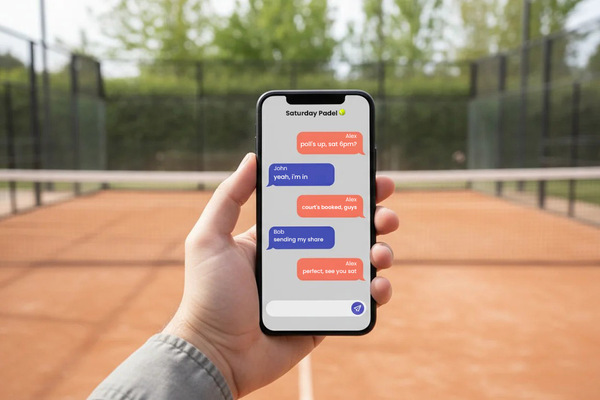
Tired of group chats where nobody ever confirms a game?
A padel group chat that actually works is the difference between a friend group that plays every week for years and one that fizzles out after a few enthusiastic months. Most groups don't fall apart because people stop liking padel, they fall apart because organizing a game became more annoying than actually playing one. This guide covers the practical habits that keep a padel group chat useful instead of a source of friction.

Why the Group Chat Matters More Than You'd Think
For most recreational groups, the chat is the entire organizational backbone of the hobby, there's no club membership or automated system handling scheduling for you. A chat that's clear, low-friction, and fair tends to keep a group playing consistently, while a chat plagued by confusion, unanswered messages, or unresolved disputes over who owes court fees quietly drives people to stop responding altogether.
Most groups don't consciously decide to let their chat fall apart, it happens gradually: one unanswered poll, one unresolved cancellation dispute, one week where nobody quite knows who's supposed to book the court. None of these individually ends a group, but they compound over months into exactly the kind of low-grade friction that makes people quietly stop responding to the next scheduling message.
Keep the Purpose Clear From the Start
Decide early whether the chat is purely for scheduling matches or also a general social space for banter, memes, and off-topic conversation. Neither approach is wrong, but a chat that drifts unintentionally between the two often buries important scheduling messages under unrelated chatter, leading to missed games or last-minute confusion about who's actually playing.
Note
If your group wants both social chat and reliable scheduling, consider a pinned message or a separate thread specifically for confirming who's playing each week, so it doesn't get lost in general conversation.

Scheduling: Polls Beat Endless Back-and-Forth
A simple poll with a few date and time options, using a messaging app's built-in poll feature, gets a group to a decision far faster than an open-ended "when's everyone free" message that inevitably produces ten separate replies to sort through manually. Set a clear deadline for responses too, so the poll doesn't stay open indefinitely while the actual court booking window closes.
Free tournament generator — Americano, Mexicano and more. Set it up in minutes.
Posting the same poll on a consistent day each week, say every Sunday evening for the following week's games, also builds a predictable rhythm that members start to anticipate rather than needing a fresh reminder every single time. That small bit of routine does a lot to keep response rates high over the long run.
Handling Cancellations and No-Shows Fairly
Nothing kills a padel group chat's goodwill faster than unclear expectations around late cancellations or no-shows, especially once real money for a booked court is involved. Agree on a simple, explicit rule early: a cancellation inside a certain window, say 24 hours, means that player still owes their share of the court fee unless they find a replacement themselves. Having this rule stated once, rather than negotiated fresh every time someone bails, avoids a lot of awkward conversations later.
Important
Set cancellation expectations before a dispute happens, not after. Trying to establish a fair rule in the middle of an argument about a specific missed payment rarely goes well for group morale.

Rotating the Organizer Role
Many padel groups quietly rely on one person to book courts, chase payments, and post the weekly poll, and that person often burns out or drifts away eventually, taking the group's momentum with them. Rotating who takes on organizing duties, even informally, month to month spreads the effort more evenly and makes the group's survival less dependent on a single person staying enthusiastic and available indefinitely.
A simple rotation, whoever hosted last month passes the job on, works well enough for most groups without needing a formal schedule. The goal isn't perfect fairness in who organizes how often, it's just making sure the responsibility doesn't quietly calcify onto one increasingly resentful person.
Keeping the Chat Fun Without Losing Focus
A group chat that's purely transactional, booking confirmations and nothing else, tends to feel less like a community and more like an obligation. A bit of banter, sharing a good rally clip, or celebrating a win keeps the social glue that makes people actually want to show up. The key is balance: enough personality to keep it enjoyable, without letting genuinely important logistics get lost in the noise.
| Do | Don't |
|---|---|
| Use a poll with a clear deadline | Ask an open-ended "when's everyone free" |
| Agree on cancellation rules upfront | Negotiate fairness mid-argument |
| Rotate who organizes each month | Let one person carry the whole group indefinitely |
| Pin important scheduling messages | Let logistics get buried in banter |
| Confirm numbers before booking | Book a court hoping enough people show up |
Using Booking Apps Alongside the Chat
Many groups combine a messaging app for social coordination with a padel booking app for the actual court reservation, since booking platforms often handle payment splitting and confirmations more smoothly than a plain group chat. Sharing the booking link directly in the chat once numbers are confirmed, rather than leaving one person to sort out payments manually afterward, removes another common source of friction.
Welcoming New Members Without Disrupting the Group
Adding a new player to an established group chat works best with a bit of intentional introduction rather than just dropping them in silently. A short message explaining who they are, how they know the group, and a quick note pointing them to the pinned rules helps a newcomer feel welcome and understand expectations immediately, rather than guessing at unwritten norms the existing members have long since taken for granted.
Setting Simple Ground Rules
A handful of explicit, agreed-upon rules prevents most of the friction that slowly kills group chats: how far in advance people need to confirm, what happens with late cancellations, who's responsible for booking each week, and how payment gets split and collected. Writing these down once, even informally in a pinned message, saves the group from repeatedly re-litigating the same small disagreements.
When to Split Into Multiple Chats
Once a group grows beyond roughly eight to twelve regular players, a single chat often becomes noisy and hard to follow, with multiple sub-groups trying to schedule different sessions in the same thread. At that point, splitting into smaller chats organized by day, skill level, or specific playing pod, while keeping one larger group for general announcements, usually keeps things more manageable than trying to coordinate everyone in a single sprawling conversation.
Resist splitting too early, though. A chat with only five or six people rarely needs this kind of structure, and adding it prematurely can make a small, tight-knit group feel unnecessarily formal.
Advice
Pin a short "how this group works" message covering scheduling, payment, and cancellation rules. New members who join later can read it in seconds instead of learning the unwritten rules the hard way.

A padel group chat that actually works usually isn't the one with the most jokes or the fastest replies, it's the one with clear, low-friction habits around scheduling, payment, and expectations. A little upfront structure, a scheduling poll, a stated cancellation policy, a rotating organizer, does more to keep a group playing together for years than any amount of enthusiasm in the first few weeks.
Most of these habits take only a few minutes to set up once, whether that's pinning a rules message or creating a recurring poll template, but they save the group from repeating the same small frustrations every single week. That upfront investment is almost always worth it for a group hoping to still be booking courts together a year or two down the line.