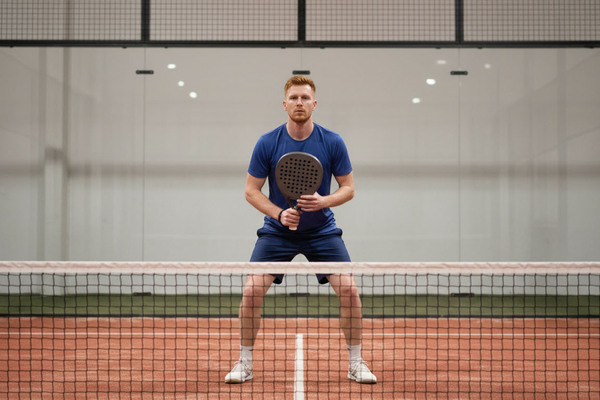
Your first volley in padel is a short, compact shot hit before the ball bounces, usually from a position close to the net. Getting comfortable with it early matters more in padel than in most racket sports, since so much of the game is decided near the net rather than from the baseline. This guide covers the basic technique, where to stand, and the most common mistakes beginners make while learning it.
What Is a Volley in Padel?
A volley is any shot hit in the air, before the ball has a chance to bounce on the court. In padel, volleys are usually hit from a position near the net rather than from deep in the court, which is a big part of why the shot looks and feels so different from a groundstroke.
Unlike a full groundstroke swing, a volley is short and controlled, closer to a firm block or punch than a full stroke. That difference in technique is the first thing most beginners need to unlearn if they're coming from tennis or another baseline-heavy sport.
Why the Volley Matters So Much in Padel
Padel is fundamentally a net-oriented game. Points are frequently decided at the net rather than from the back of the court, and stronger pairs actively look for chances to move forward and take control there. A reliable volley is what lets you hold that position once you've earned it, rather than getting passed or lobbed the moment you arrive.
Because the court is smaller and the ball travels faster at close range, you also have far less time to react at the net than you do from the baseline. That's exactly why volley technique needs to be simple and repeatable rather than elaborate.
Note
A volley isn't a mini groundstroke. Thinking of it as a completely different shot, rather than a smaller version of your forehand or backhand, makes the technique click faster for most beginners.

Volley Technique Basics
Grip: Continental Is King
Almost every volley in padel is hit with a continental grip, the same grip used for serving. This grip lets you handle balls on both your forehand and backhand side at the net without needing to change your hand position between shots, which matters when you have very little time to react.
Put it to the test with our free padel quiz — quick questions, instant results.
The Compact "Block" Swing
Instead of a full backswing, a good volley uses a short, controlled motion, more like blocking or punching the ball than swinging at it. Take the racket back only slightly, then push forward through contact. This shorter motion is what gives you the control and reaction time the net position demands.
Contact Point: In Front of Your Body
Try to make contact with the ball out in front of you, rather than letting it get too close to your body. Hitting the ball late, when it's already beside or behind you, is one of the most common technical breakdowns for beginners learning to volley, and it usually leads to a weak, floating shot that's easy for opponents to attack.
Important
Keep your wrist firm through contact. A loose or flicking wrist is the single biggest cause of inconsistent volleys for beginners, since it removes the stability the shot depends on.

Footwork and Positioning for Volleys
Where to Stand at the Net
A good starting position for beginners is roughly one to two steps back from the net itself, close enough to cut off angles but with enough room to react to a ball hit at your feet or above your head. Standing too tight against the net leaves you vulnerable to lobs and fast balls you simply won't have time to handle.
Split Step Before Reacting
Just as the ball is about to be hit by your opponent, a small hop, known as a split step, lands you in a balanced, ready position that lets you push off quickly in any direction. Skipping this step is a common reason beginners feel a half-second late to every volley, even when their technique is otherwise fine.
Weight Transfer and Recovery
Step slightly toward the ball as you make contact, transferring your weight forward rather than volleying from a flat-footed, stationary position. After the shot, recover back to a balanced ready position instead of watching the ball, since the next shot at the net often arrives quickly.
| Aspect | Groundstroke | Volley |
|---|---|---|
| Swing Length | Full backswing and follow-through | Short, compact block motion |
| Court Position | Baseline or mid-court | Near the net |
| Reaction Time | More time to prepare | Very little time to react |
| Main Goal | Build the point, generate depth | Control the net, cut off angles |
Forehand vs Backhand Volley Differences
The forehand volley usually feels more natural early on, since it's closer to a punching motion in front of your dominant side. The backhand volley takes a bit more deliberate practice, since beginners often let their elbow drop or bend too much, which weakens the shot. Keeping a firmer arm and a slightly more compact motion on the backhand side helps close that gap in consistency.
Volleying High Balls vs Low Balls
A volley above net height gives you the chance to be more aggressive, angling the ball down toward your opponents' feet or into open space. A volley below net height calls for a more conservative approach: opening the racket face slightly and prioritizing control over power, since trying to attack a low ball aggressively usually just sends it into the net. Learning to recognize which situation you're in, before you even start your swing, is a skill that develops with repetition.
When to Move In and Take the Net
Beginners don't need to rush the net on every point, but recognizing an easy opportunity, a short, weak ball from an opponent, is worth practicing early. Moving in behind a solid approach shot, rather than staying back out of habit, is often the difference between controlling a point and simply reacting to one.
Common Mistakes When Learning to Volley
Taking Too Big a Swing
A full swing at the net rarely works, since there isn't enough time to complete it before the ball arrives. Shortening the motion, even if it feels like you're barely swinging at all, usually produces a cleaner, more controlled result.
Free tournament generator — Americano, Mexicano and more. Set it up in minutes.
Standing Flat-Footed
Waiting for the ball without any movement leaves you a step behind on faster shots. A small split step and a readiness to move in any direction closes that gap.
Letting the Ball Get Too Close
Contact made too close to the body usually results in a cramped, weak shot. Reaching slightly forward to meet the ball earlier gives you more control over where it goes.
Aiming Instead of Directing
Beginners often try to steer the ball with an exaggerated racket angle rather than simply presenting a stable face at contact. A firm, well-angled racket face does most of the directional work on its own, without needing extra manipulation mid-swing.
Advice
Practice volleys from a shorter distance before moving back to a full net position. Working close to the net first builds the compact swing and firm contact you'll need once you add real pace and distance.

Volley Drills for Beginners
Start with a simple feed-and-volley drill: have a partner feed easy, controlled balls straight to you at the net while you focus purely on a compact swing and clean contact. Once that feels comfortable, add movement, side-to-side volleys that require a small step before contact, so you get used to combining footwork with the shot rather than volleying only from a fixed spot.
A reliable first volley comes down to a few repeatable habits: a continental grip, a short block-style swing, contact out in front of your body, and solid positioning with a split step before every shot. None of it requires much power, just consistency, and that consistency is exactly what turns the net from an intimidating position into one of the strongest parts of your game.