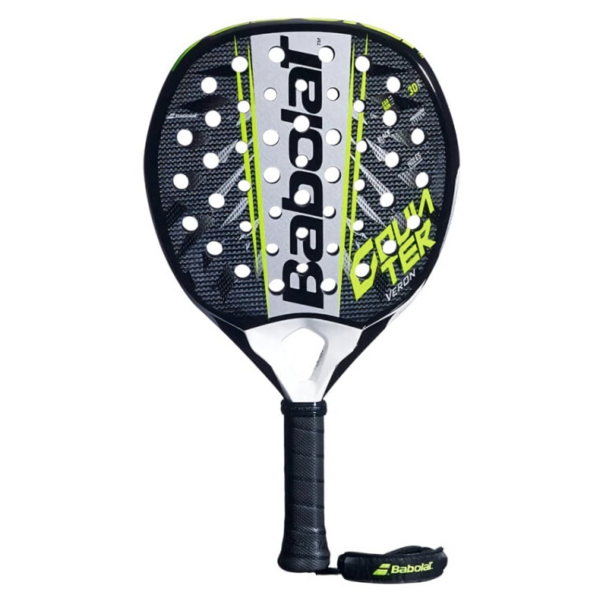
Babolat Counter Veron 2.6 2026 vs Babolat Counter Viper 2.6 2026
Trouvez la raquette idéale. Comparez les caractéristiques et les notes côte à côte.

Notes
Caractéristiques
The Babolat Counter Veron 2.6 trades outright attacking power for depth, direction, and comfort on defensive and counterattacking shots, built around a Carbon Flex surface, a Black EVA core, and a 270 mm balance point. Intermediate to advanced players who build points from the back of the court gain a wide margin on off centre contact and low vibration through long exchanges, while giving up the flat finishing power of the stiffer Counter Viper 2.6 in the same range.
- Consistent depth on defensive shots without needing an aggressive swing.
- Holds direction reliably on off centre contact.
- Vibration stays low through extended baseline rallies.
- Quick transition from defense to net despite the frame's weight.
- Flat power on the smash falls behind the stiffer Counter Viper 2.6 in the same range.
- The softer Carbon Flex surface asks for a fuller swing to generate pace on attacking shots.
- Net authority on a committed volley is modest rather than commanding.
- Building genuine pace from the baseline takes deliberate technique rather than raw swing speed.
The Counter Viper 2.6 2026 gives back-court players a stable frame with a wide sweet spot and the most precise directional control in Babolat's 2026 Viper range, built around a 3K Carbon face over a three-layer X-EVA core. It keeps usable pace on the bandeja and víbora for a round frame while staying oriented toward a patient, positional game based on redirecting pace. Players chasing maximum overhead power should look to the diamond-shaped models instead; players who want a control shape they can still finish points with will find little to argue with.
- Wide sweet spot for a round, control-oriented racket.
- Direction holds under pressure; the ball goes where it is aimed.
- Stable under heavy pace; resists twisting on hard blocks.
- Textured surface adds bite on sliced shots.
- More free-moving through defense-to-attack transitions than the previous Counter Viper generation.
- Mass in the head becomes the limiting factor in the fastest hand exchanges at the net.
- Smash and overhead pace sit behind diamond-shaped attacking models.
- Rewards early preparation; does not forgive late, rushed defensive swings.
- Comfort rests on the damping rather than on a soft core, and cold conditions make the face read harder.


Abonnez-vous aux nouveautés Padelmesh
Actus, tests de matériel et guides écrits par des joueurs et des coachs, directement dans votre boîte mail.
Recherches fréquentes
Les tests de matériel de padel sur Padelmesh sont réalisés raquette en main : chaque modèle est évalué selon les mêmes paramètres, ce qui permet de comparer puissance, contrôle, équilibre et confort côte à côte plutôt que de se fier aux arguments marketing.
Une fois la raquette choisie, il reste à trouver un terrain pour l’essayer. Padelmesh recense les clubs de padel, les coachs et les réseaux de clubs dans des dizaines de pays.
Trouver un club de padel
Trouvez le terrain idéal dans le club qui correspond à votre jeu, sélectionné pour son confort, la qualité de ses services et une expérience de match parfaite
Trouver un club