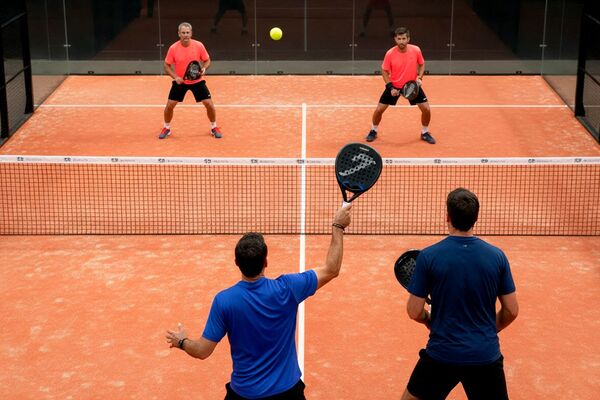
Bandeja vs smash is one of the most common in-the-moment decisions in padel, and picking the wrong one is a quiet but constant source of lost points at every level. Both are overhead shots hit against a lob, but they serve very different purposes — one protects your net position, the other tries to end the point outright. Learning to read the situation and choose correctly is often more valuable than perfecting either shot's technique in isolation.
This guide focuses purely on the decision-making side: when each shot makes sense, the risk and reward of each, and the situational cues that should guide your choice mid-point.
The Core Difference in One Sentence
A bandeja is a controlled, lower-risk shot meant to keep your team at the net, while a smash is an aggressive, higher-risk shot meant to finish the point immediately. Every decision between the two comes back to that basic tradeoff between control and risk.
Why This Decision Comes Up So Often
Lobs are one of the most common shots in padel precisely because the sport's enclosed court makes them a reliable way to disrupt a team holding the net. That means the bandeja-versus-smash decision isn't a rare, occasional judgment call — it's something that comes up repeatedly in nearly every match, which is exactly why building a fast, reliable decision process matters as much as the shots' individual technique.
Risk and Reward Compared
A smash offers a higher reward — a genuine chance to end the point on the spot — but carries real risk, since a mishit or poorly placed smash can go out, hit the net, or set up an easy counter for your opponents. A bandeja offers a lower, more modest reward — usually just maintaining your position and forcing another shot — but comes with far less risk of an outright unforced error.
| Factor | Bandeja | Smash |
|---|---|---|
| Primary goal | Hold net position, stay consistent | End the point immediately |
| Risk of unforced error | Lower | Higher |
| Best against | Deep, well-placed lobs | Short, high, or weak lobs |
| Swing style | Short, controlled | Full, aggressive |
| Typical outcome | Point continues, position maintained | Point often ends, one way or another |
Situational Cues for Choosing a Bandeja
A bandeja is usually the right call when the lob is deep, landing close to the back wall, or when you're stretched, off-balance, or not in an ideal position to generate power. It's also the safer default any time you're uncertain — a controlled bandeja that keeps the point alive is almost always better than a forced, low-percentage smash attempt.
Situational Cues for Choosing a Smash
A smash makes sense when the lob is short, sits up at a comfortable height, and you have solid footing and a clear path to an open part of the court. If your opponents are poorly positioned or clearly out of position, the reward of ending the point on the spot usually outweighs the added risk.
A Simple Decision Framework
Before committing to either shot, quickly check three things: how deep is the lob, how much time and balance do you have, and where are your opponents standing. A deep lob, limited time, or opponents already well-positioned all point toward a bandeja. A short lob, good balance, and a clear opening all point toward a smash.
When in Doubt, Default to the Bandeja
If you're not fully confident in the read, choosing the bandeja is generally the safer habit to build, since a missed smash costs you both the point and, often, your net position — while a modest bandeja at worst just continues the rally.
Common Mistakes in This Decision
Even players who understand this decision in theory often fall into a few recurring traps once they're in the heat of a point — starting with the most common one: reaching for the smash out of habit rather than judgment.
Smashing Everything Out of Habit
Some players treat every lob as a smash opportunity regardless of depth or positioning, which leads to a high rate of unforced errors against well-placed lobs. Reading the specific situation matters more than defaulting to the most aggressive option available.
Playing It Too Safe on Easy Opportunities
On the other end, some players default to a bandeja even on short, easy lobs that call for a smash, leaving free points on the table. Recognizing a genuine attacking opportunity and committing to it is just as important as knowing when to hold back.
Ignoring Opponent Positioning
Choosing between a bandeja and a smash without factoring in where your opponents are standing means missing chances to exploit open space, whether through an aggressive smash into a gap or a well-placed bandeja that pins them deep.
A Note on Doubles Strategy
Since padel is played in pairs, communicate quickly with your partner if there's any ambiguity about which shot to attempt, especially if you're both moving toward the same ball. A brief, clear signal about your intention — attacking or resetting — helps your partner position correctly for whatever happens next.
How Skill Level Changes This Decision
Beginners are usually better off leaning heavily toward the bandeja, since the smash's technical demands and higher error rate tend to cost more points than they win at that stage. As technique and consistency improve, the smash becomes a more reliable weapon, and more experienced players can afford to take it on borderline lobs where a beginner would be better off resetting with a bandeja instead. Recognizing your own current skill level honestly, rather than trying to play like a pro from the start, leads to fewer wasted points overall.
Bandeja vs Smash Quick Checklist
- Deep lob or limited time and balance? Choose a bandeja.
- Short lob, good footing, and a clear opening? Consider a smash.
- When uncertain, default to the safer bandeja rather than forcing a smash.
- Check opponent positioning before committing to either shot's target.
- Avoid smashing purely out of habit on lobs that don't call for it.
- Don't play it too safe on genuinely easy attacking opportunities.
The bandeja vs smash decision comes down to reading the lob and your own position honestly, rather than defaulting to whichever shot feels more exciting in the moment. Get comfortable making that quick read, and you'll waste far fewer points on the wrong choice.