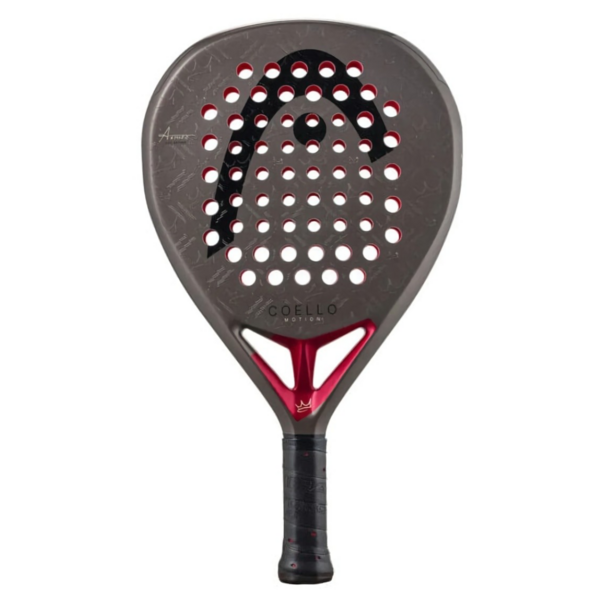

Best for advanced players who attack early and already know diamond rackets
Advanced and tournament players who take the initiative in the point and look to close it above their head. It suits a player who already hits through the ball on the volley, and it suits a Coello Pro owner whose racket starts arriving late in the third set. It does not suit a player who wins points by absorbing pace and stretching rallies out, and it should not be anyone's first diamond: at 268 mm the head still leads the swing, and the best response on the face sits in a fairly small part of those 475 cm².

Specifications
- Shape
- Diamond
- Weight
- 360 g (± 10 g)
- Touch
- Medium-hard
- Balance
- 268 mm
- Core
- Power Foam
- Faces
- Carbon Hybrid
- Frame
- 100 % Carbon
- Level
- Advanced
Overview of the HEAD Coello Motion 2026
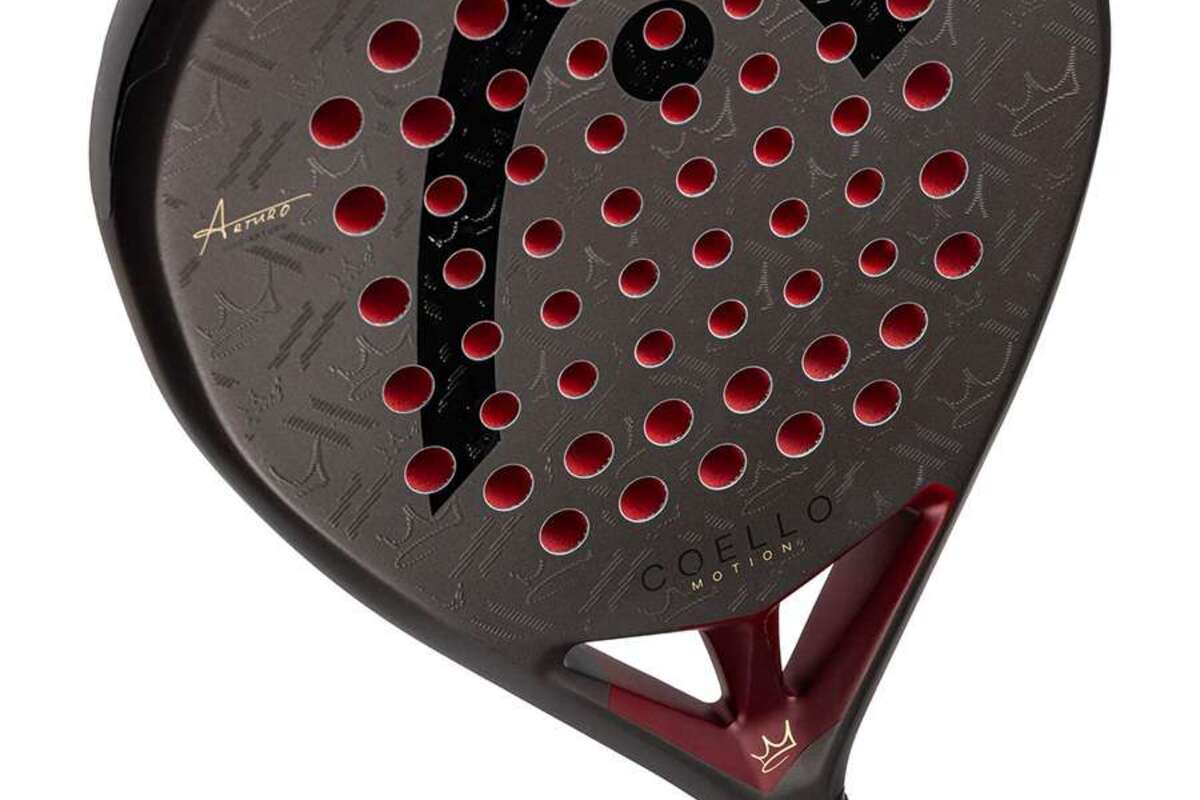
The HEAD Coello Motion 2026 is the lighter of the two top frames in HEAD's Arturo Coello 2026 collection, sitting directly under the Coello Pro 2026. The two rackets are built the same way: one diamond mould, one 475 cm² Carbon Hybrid face, one Power Foam core, a 38 mm profile and an identical list of technologies. What separates them is 10 grams and 4 millimetres of balance, 360 g at 268 mm against 370 g at 272 mm. That is a narrow gap on paper and a clear one in the hand, and it is the whole reason the Motion exists: the Pro's attacking behaviour at a swing a wider group of players can hold together over three sets.
Pros & Cons
Pros
- The Coello Pro's attacking output at ten grams less.
- Heavy first volley that can be taken early in fast exchanges.
- Víbora bites hard off a short backswing.
- Stable through a firm block against a hard smash.
- Rough face takes hold of the ball on overheads.
Cons
- The best response sits in a small part of a 475 cm² face.
- Low contact costs depth badly on the lob.
- Fine volley angles have to be aimed deliberately.
- Firm impact reaching the wrist and forearm.
- Less mass behind the ball than the Pro when the swing is passive.
Technologies & Materials
- Carbon Hybrid HS — a weave of carbon fibre and fiberglass with the carbon share dominant, for a more explosive response without losing ball feel;
- Carbon Frame — full carbon frame construction, for rigidity and stability;
- Power Foam — the fastest and most reactive foam in HEAD's padel line, built to push power into attacking shots;
- Auxetic 2.0 — construction placed in the carbon bridge and in the central bar inside the handle, widening as it compresses at impact to sharpen the feedback that reaches the hand;
- Extreme Spin — a rough 3D decal on the face that raises grip and traction on the ball;
- Optimized Sweet Spot — a drilling pattern adjusted to this frame's own characteristics rather than a pattern shared across models;
- Power Stabilizer — reinforced construction that keeps the frame steady while it generates power;
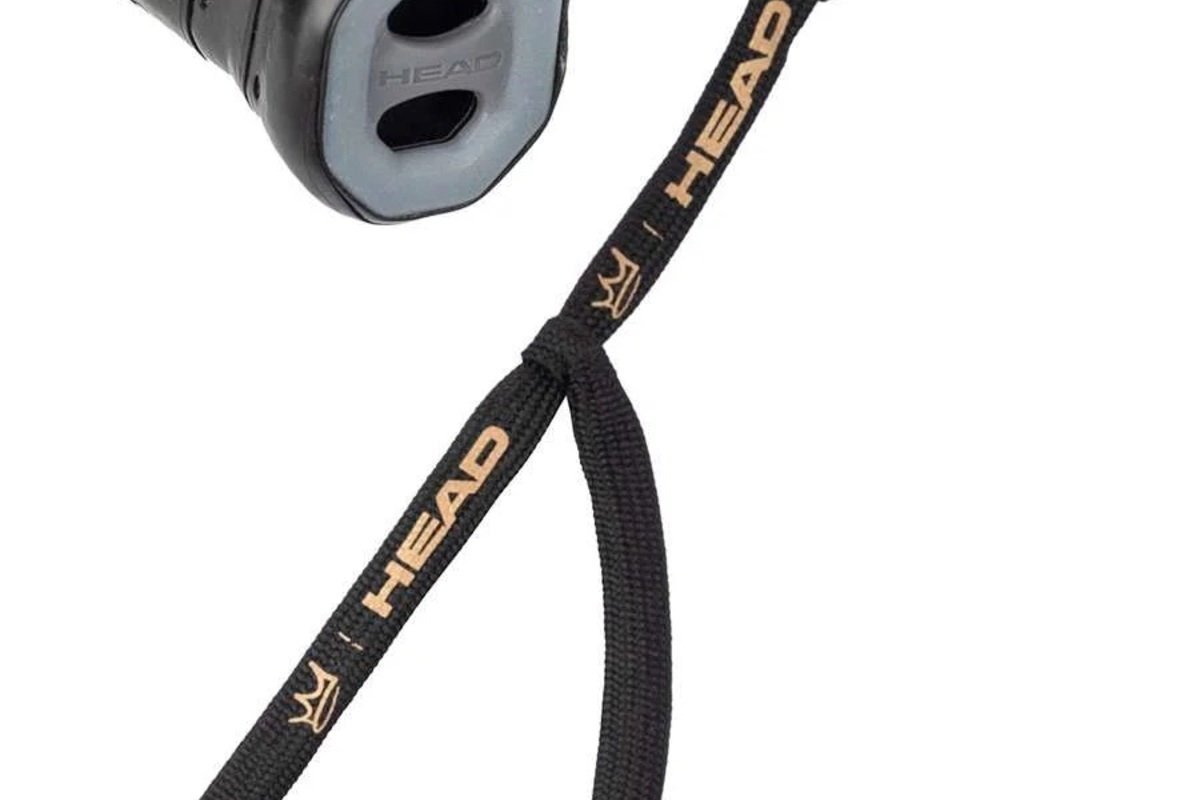
- Soft Cap + — butt cap in softer material with an exchangeable cord system;
- Anti Shock Skin Padel — polymer film protecting the frame from knocks and scratches.
What Makes the HEAD Coello Motion 2026 Special
The Motion is not a softened Pro. It is the same racket with mass taken out. HEAD kept the Carbon Hybrid face, the Power Foam core and all nine technologies of the heavier model, and changed only the weight and the balance point. On court the consequence is specific rather than general: ball speed on a full swing stays close to the Pro's, but the frame reaches the contact point earlier, which shows up on reflex volleys and on the second overhead of a rally rather than on the first. Auxetic 2.0 sits in the carbon bridge and in the central bar inside the handle, where the structure widens laterally as impact compresses it, so information about the strike reaches the hand instead of being flattened out by damping.
Gallery
How it Feels on the Court
Defense
From the back of the court the racket is workable rather than generous.
Important
At 268 mm the head still leads the swing, so a lob has to be started early: take it late and the ball leaves flat and lands around the service line.

With time, depth is straightforward and the height comes from the legs more than from the frame. Off the back glass the Carbon Hybrid face holds the ball a fraction longer than a full carbon face would, which helps on the low ball that has to be dug out and sent cross court. Blocks against a hard smash keep their shape, since stability is one of this frame's better traits and the face does not turn on firm contact.
Net Play
Volleys are where the ten grams pay for themselves. The frame arrives at the ball earlier than the Pro does, so a fast first volley can be taken in front of the body instead of beside it, and a hands battle at the net stays under control. Pace comes without a big action: a short punch travels deep enough to keep opponents behind the service line. The trade is precision on the finer volley. Angles have to be aimed deliberately, because the frame supplies ball speed more readily than it supplies placement.
Bandeja & Víbora
The bandeja is comfortable and repeatable, dropping before the glass as long as the swing stays long and the face stays open. The víbora is the better of the two: the rough surface takes hold of the ball and the head weight adds bite without a long backswing, so the ball leaves low and kicks off the side wall. Both shots need watching for length, because exit speed is high for a frame at this weight.
Advice
A player coming across from the Pro will need a slightly fuller swing to find the same depth, since there is less mass behind the ball.

Smash
Flat smashes finish points, and the ball comes down heavy when the swing is committed. Pace here is generated by swing speed rather than by mass, so a lazy overhead gives up more than it would on the Pro.
Maneuverability
For a 360 g diamond the frame comes round quickly, and the 4 mm drop in balance from the Pro is felt most in the switch from a defensive position into an attacking one.
Forgiveness
The face measures the same 475 cm² as the Pro's, and its best response is concentrated fairly high and fairly central. Low contact is the expensive one: the ball comes off short and without height rather than off line, and on a lob it barely clears the net. Towards the tip the reinforced construction keeps the frame from twisting, but the ball still leaves slower. The behaviour is honest rather than punishing. A clean strike is rewarded clearly, and a scrappy one produces a playable ball with nothing behind it.
Comfort
The response is firm, and repeated contact away from the middle sends a fair amount of impact into the wrist and forearm.
Note
Soft Cap + takes some of the edge off at the handle, but this is a direct frame rather than a plush one, and a player managing elbow trouble will feel it.

Conclusion
The Coello Motion 2026 is the Coello Pro made swingable. Nothing in the construction changes: the same Carbon Hybrid face, the same Power Foam, the same nine technologies, with ten grams and four millimetres of balance taken out. That buys earlier arrival at the ball and an easier third set, and it costs a slice of the mass that makes the Pro's smash land as heavily as it does. For an advanced player who attacks and wants the Coello frame without carrying 370 grams through a tournament, this is the version that makes sense. For a player who resets, absorbs and waits, neither Coello sits in the right part of the range.
Where to buy HEAD Coello Motion 2026
- Racket
- HEAD
- 7 minutes
- John Macallan