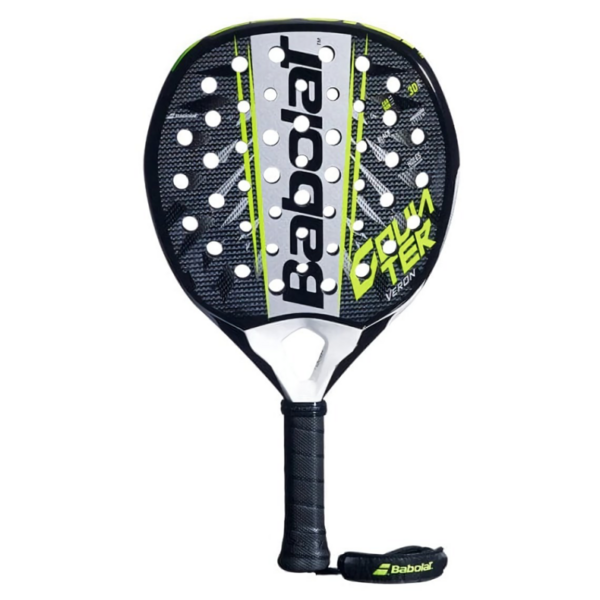
Babolat Counter Veron 2.6 2026 vs Babolat Counter Viper 2.6 2026
Find your perfect match. Compare specs and ratings side by side.

Ratings
Specifications
The Babolat Counter Veron 2.6 trades outright attacking power for depth, direction, and comfort on defensive and counterattacking shots, built around a Carbon Flex surface, a Black EVA core, and a 270 mm balance point. Intermediate to advanced players who build points from the back of the court gain a wide margin on off centre contact and low vibration through long exchanges, while giving up the flat finishing power of the stiffer Counter Viper 2.6 in the same range.
- Consistent depth on defensive shots without needing an aggressive swing.
- Holds direction reliably on off centre contact.
- Vibration stays low through extended baseline rallies.
- Quick transition from defense to net despite the frame's weight.
- Flat power on the smash falls behind the stiffer Counter Viper 2.6 in the same range.
- The softer Carbon Flex surface asks for a fuller swing to generate pace on attacking shots.
- Net authority on a committed volley is modest rather than commanding.
- Building genuine pace from the baseline takes deliberate technique rather than raw swing speed.
The Counter Viper 2.6 2026 gives back-court players a stable frame with a wide sweet spot and the most precise directional control in Babolat's 2026 Viper range, built around a 3K Carbon face over a three-layer X-EVA core. It keeps usable pace on the bandeja and víbora for a round frame while staying oriented toward a patient, positional game based on redirecting pace. Players chasing maximum overhead power should look to the diamond-shaped models instead; players who want a control shape they can still finish points with will find little to argue with.
- Wide sweet spot for a round, control-oriented racket.
- Direction holds under pressure; the ball goes where it is aimed.
- Stable under heavy pace; resists twisting on hard blocks.
- Textured surface adds bite on sliced shots.
- More free-moving through defense-to-attack transitions than the previous Counter Viper generation.
- Mass in the head becomes the limiting factor in the fastest hand exchanges at the net.
- Smash and overhead pace sit behind diamond-shaped attacking models.
- Rewards early preparation; does not forgive late, rushed defensive swings.
- Comfort rests on the damping rather than on a soft core, and cold conditions make the face read harder.


Subscribe to Padelmesh updates
News, gear reviews and guides from players and coaches — straight to your inbox.
Often search
Padel product overviews on Padelmesh are hands-on: every racket is tested across the same set of parameters, so you can compare power, control, balance and comfort side by side instead of relying on marketing claims.
Once you have picked a racket, find a court to try it on. Padelmesh covers padel clubs, coaches and club chains in dozens of countries.
Find a padel club
Find the right court in the club that suits your game, curated for comfort, convenience, and the perfect match experience
Find a Club