Adidas Metalbone HRD+ 2026 vs Babolat Technical Viper 3.0 2026
Find your perfect match. Compare specs and ratings side by side.

Ratings
Specifications
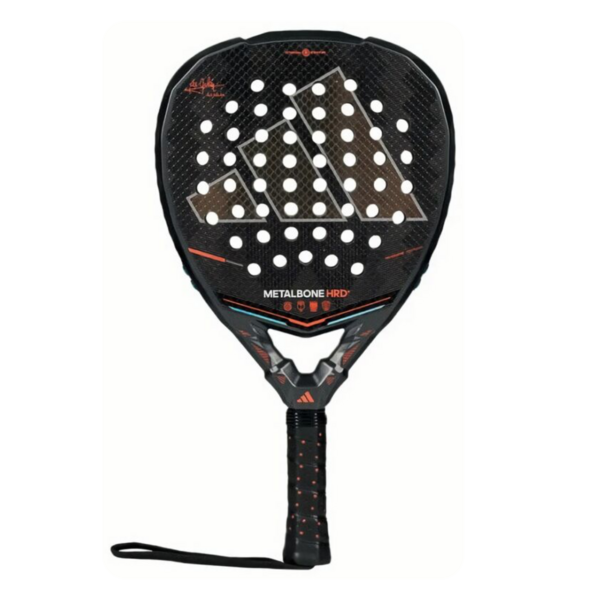
The Adidas Metalbone HRD+ 2026 delivers an attacking diamond identity built on a Carbon Aluminized 16K face, a carbon fiber frame with an Octagonal Structure and Low Poly geometry, and a High Memory EVA core. It rewards advanced and tournament players who generate their own pace at the net and on the smash, while asking for clean technique and offering little help in defense or on off centre contact. The Weight and Balance System adds fine tuning between power and control, but players seeking comfort or forgiveness over a long session are better served elsewhere in Adidas's range.
- Explosive smash and volleys backed by the head-heavy balance and stiff frame.
- Stable blocks against pace thanks to the Octagonal Structure and Power Groove rail.
- Clean bandeja and víbora with real bite from the Spin Blade Decal texture.
- Weight and Balance System allows up to 11.2 g of tuning between head and handle.
- Defense demands active footwork and early preparation; it is the racket's weakest zone.
- Only average maneuverability in fast defensive exchanges.
- Off centre contact loses quality quickly and can feel harsh through the stiff frame.
- Stiffness can tire the arm and shoulder over long sessions.
The Babolat Technical Viper 3.0 delivers an attacking diamond identity built on 3K Carbon faces, a carbon frame, and a Hard EVA core with an integrated Carbon Power Layer. It rewards advanced attackers who finish points at the net, on the bandeja and víbora, and on the smash, while asking for clean technique and offering little help in defense or on off centre contact. Players who want serious pace and accept a firm, demanding response are the clearest fit.
- Strong output on aggressive shots and clean contact.
- Stable on heavy impacts, resists twisting at the net.
- Heavy, fast volleys and a strong smash.
- Carbon Power Layer adds reactivity at higher swing speeds.
- Sweet spot is not generous; off centre contact loses quality quickly.
- Defense demands extra work and clean preparation.
- Hard feel loads the arm over long sessions.


Subscribe to Padelmesh updates
News, gear reviews and guides from players and coaches — straight to your inbox.
Often search
Padel product overviews on Padelmesh are hands-on: every racket is tested across the same set of parameters, so you can compare power, control, balance and comfort side by side instead of relying on marketing claims.
Once you have picked a racket, find a court to try it on. Padelmesh covers padel clubs, coaches and club chains in dozens of countries.
Find a padel club
Find the right court in the club that suits your game, curated for comfort, convenience, and the perfect match experience
Find a Club