Adidas Adipower Multiweight CTRL 3.4 2025 vs NOX ML10 Ventus Control 3K 2026
Find your perfect match. Compare specs and ratings side by side.

Ratings
Specifications
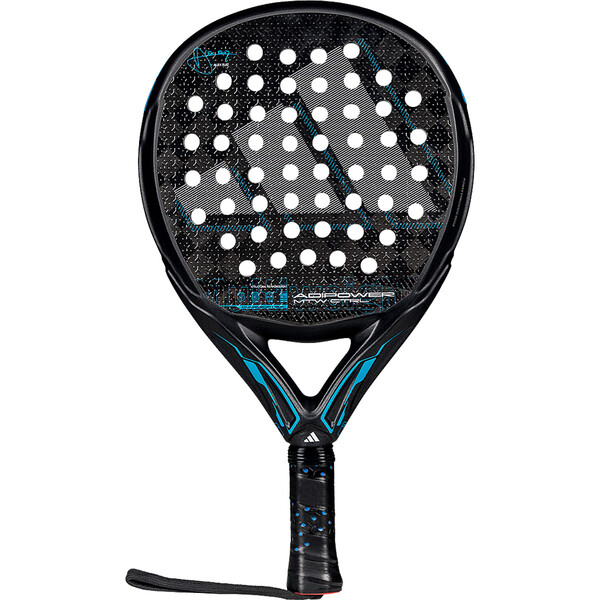
Carrying Carbon Aluminized 18K faces, an EVA High Memory core, and an adjustable Weight & Balance System on a round, even balanced build, the adidas Adipower Multiweight CTRL 3.4 2025 leans into control rather than raw power despite its attacking grade materials. Net play and forgiveness show the clearest returns, backed by a Dual Exoskeleton frame that resists twisting, while the smash still carries real weight when a player commits to the swing. It suits advanced to professional players who value placement and consistency and are willing to fine tune the racket to their own setup, while a player chasing maximum power without adjustment is better served by a diamond shaped, head heavy racket further up adidas's Adipower range.
- Round shape and even balance give genuinely controlled, predictable placement.
- Weight & Balance System lets a player tune the setup toward control or power rather than accepting one fixed feel.
- Wide sweet spot forgives off center contact well for a racket carrying 18K carbon faces.
- Smash still carries real weight despite the control first balance.
- Even, control leaning stock balance responds best once tuned, so a player unwilling to adjust the weights gets less from the racket.
- Medium hard touch sits firmer than a dedicated soft control racket.
- Not built for a player chasing maximum smash power without adjustment.
- Advanced to professional construction, not suited to a player still building consistent technique.
The ML10 Ventus Control 3K 2026 is a control-first round racket built around comfort, a wide sweet spot, and consistent ball output. Defense, bandeja and víbora are its strongest zones, while smash and aggressive flat volleys are where the racket asks the most from the player. For players who build points through placement, patient defense and structured net work – and for players who spend long hours on court – the racket is suitable. For players chasing explosive overhead dominance or finishing through pure pace, firmer attacking models will be more aligned with that brief.
- Wide, forgiving sweet spot driven by the round shape and low-density HR3 core.
- Comfortable across long sessions; arm tolerates extended play.
- Stable handling at the net on flat volleys and chancletazos.
- Repeatable bandeja with good depth and direction control.
- Strong víbora performance with bite from the Dual Spin surface.
- Low balance and Carbon Fiber 3K faces keep maneuverability high.
- Limited finishing punch on flat smashes.
- Volleys are quick but not aggressive when the player wants to end the point with pace.
- Slightly unstable on heavy incoming blocks at high pace and on hard body contacts.
- Lacks inertia on the por tres and on forward attack patterns.


Subscribe to Padelmesh updates
News, gear reviews and guides from players and coaches — straight to your inbox.
Often search
Padel product overviews on Padelmesh are hands-on: every racket is tested across the same set of parameters, so you can compare power, control, balance and comfort side by side instead of relying on marketing claims.
Once you have picked a racket, find a court to try it on. Padelmesh covers padel clubs, coaches and club chains in dozens of countries.
Find a padel club
Find the right court in the club that suits your game, curated for comfort, convenience, and the perfect match experience
Find a Club