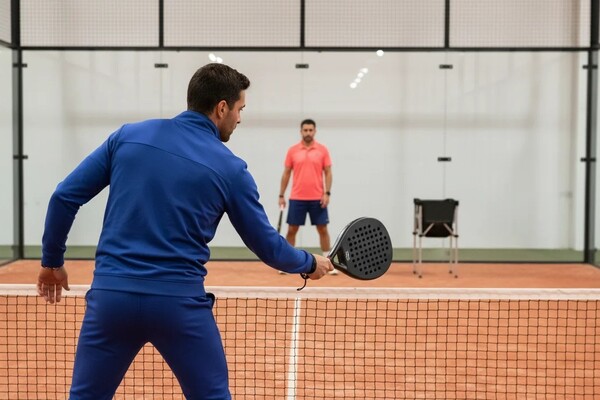
Cross-court shots drifting wide when it matters most?
Padel cross court drills are some of the most useful practice time you can spend on court, yet they're often skipped in favor of flashy overheads or smash practice. Cross-court play is the backbone of most padel points, especially in doubles, where the diagonal shot gives you the biggest margin for error and keeps your team in control of the rally.
This guide explains why cross-court shots matter so much in padel, walks through several drills you can use with a partner or alone, and points out the mistakes that keep players from getting the full benefit of this kind of practice. By the end, you'll have a simple routine you can add to your next session.

What Are Cross-Court Shots in Padel?
A cross-court shot travels diagonally across the court, from one side to the opposite side, rather than straight ahead down the same line. On a padel court, that diagonal path is longer than a straight line to the same depth, which means you get more room over the net and more court to land the ball in.
Because padel is almost always played in doubles, cross-court shots also tend to travel toward the gap between two opponents standing at different depths, which is often the hardest area for a team to cover cleanly.
Why Cross-Court Play Matters So Much in Padel
Coaches push cross-court drills early for a reason. The pattern shows up constantly in real matches, and building comfort with it pays off far more than working on riskier shots first.
Bigger Margin for Error
The net is at its lowest in the middle and rises slightly toward the sides, but the diagonal path of a cross-court shot is longer than a straight line of the same depth. That extra length gives you more room for the ball to drop in without going long, which is exactly why cross-court shots carry less risk than trying to thread a shot down the line.
Better Court Coverage With Your Partner
In doubles, cross-court shots naturally keep the rally moving between the two players on the opposite side, which mirrors how you and your partner should be covering the court. Down-the-line shots, by contrast, tend to isolate one opponent and can open up the court awkwardly if the shot doesn't land as planned.
Setting Up the Point
Teste es mit unserem kostenlosen Padel-Quiz — schnelle Fragen, sofortiges Ergebnis.
A consistent cross-court rally lets your team dictate the pace and wait for a short ball or a weak reply before attacking. Most winning net approaches in padel come after a string of solid cross-court shots that pushed the opponents into a defensive position first.
Note
Cross-court doesn't mean passive. Plenty of aggressive, well-placed shots are still hit cross-court — the direction is about safety margin, not about power or intent.

Cross-Court vs Down-the-Line
Both directions have their place, but they serve different purposes in a rally.
| Aspect | Cross-Court | Down-the-Line |
|---|---|---|
| Margin for error | Higher, longer diagonal path | Lower, shorter and tighter |
| Typical use | Building and controlling the rally | Surprise attack or finishing shot |
| Risk level | Lower | Higher |
| Effect on opponents | Keeps both under pressure evenly | Isolates one player |
| Best for beginners | Yes, main shot to practice first | Later, once control is solid |
Best Cross-Court Drills to Practice
These drills range from simple two-player rallies to a solo option, so you can practice regardless of whether you have a partner available.
Cross-Court Rally Drill (Two Players)
Stand diagonally from your partner, each on opposite sides of the court, and rally the ball back and forth using only cross-court shots. Count how many consecutive shots you can land before missing, and try to beat that number each round. This builds the timing and consistency that make cross-court shots feel automatic.
Cross-Court Target Drill
Place a cone or a towel in the back corner of the diagonal side of the court. Take turns feeding balls and try to land your cross-court shot as close to the target as possible. This adds a precision element on top of basic consistency.
Cross-Court Volley Exchange
Both players move to the net and volley the ball cross-court only, keeping the exchange going as long as possible. This trains the same diagonal pattern at a faster pace, which is closer to how points actually unfold once both teams reach the net.
Solo Wall Cross-Court Drill
If you don't have a partner, stand at an angle to a practice wall and hit the ball so it returns on a diagonal path, aiming to control the angle rather than the power. It's not a perfect substitute for a real rally, but it builds the same feel for angle and contact point.
Advice
Start every cross-court drill slower than feels necessary. Speed and power are easy to add later, but sloppy footwork and rushed contact points are hard habits to undo once they set in.

Common Mistakes in Cross-Court Drills
Even players who understand the value of cross-court shots run into a few recurring issues during practice.
Aiming Too Close to the Middle
Hitting toward the center of the court reduces the angle advantage that makes cross-court shots safer in the first place. Aim for the outer half of the diagonal side rather than splitting the difference toward the middle.
Rushing the Shot
Cross-court drills are meant to build rhythm, but players often speed up too quickly, sacrificing accuracy for pace. Slow the drill down whenever consistency starts slipping, rather than pushing through with sloppy shots.
Ignoring Depth
A cross-court shot that lands short gives your opponents an easy attacking opportunity, even if the angle is correct. Depth and direction need to be practiced together, not treated as separate skills.
Important
Don't skip footwork just because the drill feels repetitive. Getting your feet set before each cross-court shot is what makes the pattern reliable under real match pressure.

How to Build Cross-Court Drills Into Your Practice Routine
A short, focused block of cross-court work at the start of a session builds a strong foundation for everything else you practice afterward. Try this simple structure:
- Warm up with five minutes of easy cross-court rallying at low pace, focusing on footwork and contact point
- Run the cross-court target drill for ten minutes, tracking how consistently you hit the target zone
- Move to the cross-court volley exchange for five to ten minutes to bring the pattern up to net speed
- Finish with a live cross-court rally where the first player to miss or hit down the line loses the point, adding light competitive pressure
Repeating this structure two or three times a week builds the kind of reliable cross-court game that holds up once real points start.
When to Break the Cross-Court Pattern
Cross-court shots are the default, not a rule you follow every single time. Once you and your partner have built pressure with a few solid cross-court exchanges, a well-timed down-the-line shot can catch opponents who've settled into a comfortable cross-court rhythm. The key is treating that shot as a deliberate choice rather than a default option, which only works once your cross-court game is consistent enough to create that pressure in the first place.
Padel cross court drills aren't the most exciting part of practice, but they're one of the fastest ways to lower your unforced errors and build the kind of rally control that wins points in doubles. Spend time on them regularly, and the rest of your game has a much steadier platform to build on.