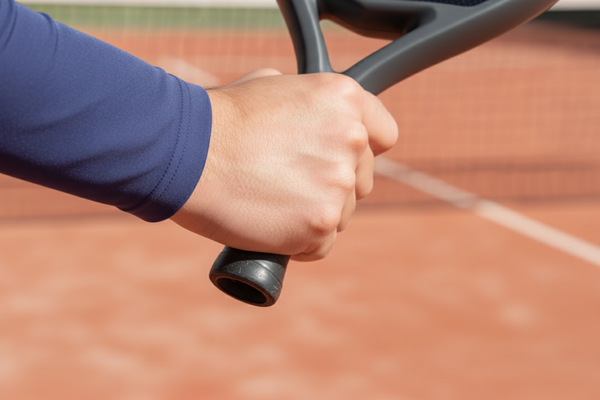
Not sure how you're actually supposed to hold the racket?
The continental grip in padel is the one technical detail that shapes almost everything else you do on court. Most beginners spend their first few sessions worrying about footwork or where to stand, but the way you hold the racket decides how quickly you can react, how clean your volleys look, and how much you'll have to relearn later on. Learning the continental grip early saves you from breaking habits down the road.
This guide explains what the continental grip actually is, how to find it on your own racket, and why so many coaches insist beginners learn it before anything else. You'll also see the most common mistakes new players make with it and a simple way to practice until it feels automatic.

What Is the Continental Grip in Padel?
The continental grip is a neutral hand position on the racket handle, borrowed directly from tennis. It sits between a full forehand grip and a full backhand grip, which is exactly why it works so well in padel: you don't need to change your hand position between shots the way you might in other racket sports.
With this grip, the racket face stays roughly vertical at contact, neither closed nor overly open. That neutral angle is what makes it so flexible. It gives you a stable base for volleys, serves, smashes, and defensive shots off the wall, all without shifting your fingers around mid-point.
In padel specifically, points move fast and there's rarely time to adjust your grip between shots. The continental grip solves that problem by being "good enough" for almost every situation, even if it isn't always the absolute optimal grip for one specific shot.
How to Find the Continental Grip on Your Racket
A simple way to find it: hold the racket like you're about to shake hands with someone. Let the handle rest diagonally across your palm rather than flat against it, with the base knuckle of your index finger sitting roughly on the top-right bevel of the handle if you're right-handed (top-left if you're left-handed).
Many coaches call this the "hammer grip" or "handshake grip," because the hand position looks similar to gripping a hammer to knock in a nail. If you swing an imaginary hammer, your palm naturally lands in almost the same spot the continental grip asks for.
Note
Padel rackets don't have the same bevel edges as a tennis racket handle, since they're solid rather than octagonal. Use the rough hand position as your guide instead of trying to line up with a specific edge.

Why Beginners Should Learn It Early
New players sometimes copy whatever grip feels comfortable in the moment, usually something closer to a tennis forehand grip. It feels natural for groundstrokes, but it quickly falls apart once volleys, smashes, and wall shots enter the picture. Here's why starting with the continental grip pays off.
Teste es mit unserem kostenlosen Padel-Quiz — schnelle Fragen, sofortiges Ergebnis.
One Grip for (Almost) Every Shot
Padel rallies move quickly, and the ball comes from unpredictable angles off the walls and glass. Switching grips between shots costs time you don't have. The continental grip lets you hit forehands, backhands, volleys, and overheads without changing your hand position, which keeps your reactions fast and your technique consistent.
Faster Reactions at the Net
Most points in padel are decided at the net, where volleys happen in a split second. A neutral grip means your racket face is already in a workable position no matter which side the ball comes from. Players using a forehand-style grip often get caught out on quick backhand volleys because there's no time to adjust.
Better Wall and Defensive Play
Padel's walls send the ball back at strange heights and angles. Defending off the back or side glass requires a grip that adapts instantly, and the continental grip's neutral face angle handles those awkward bounces far better than a grip built around one specific stroke.
Continental Grip vs Other Grips
Here's how the continental grip compares to the two alternatives beginners sometimes drift toward.
| Grip | Racket Face at Contact | Best For | Downside in Padel |
|---|---|---|---|
| Continental | Neutral, roughly vertical | Volleys, serves, smashes, defense | Slightly less topspin on groundstrokes |
| Eastern forehand | Slightly closed | Powerful topspin forehands | Slow to adjust for volleys and backhands |
| Semi-western | Closed | Heavy topspin, common in tennis baseline play | Poor for low volleys and defensive shots |
Notice that the continental grip trades some raw power on groundstrokes for consistency everywhere else. In padel, where net play and wall defense decide most points, that trade-off almost always works in your favor.
Common Mistakes with the Continental Grip
Even players who understand the theory often slip into bad habits once real points start. These are the three mistakes that show up most.
Holding Too Tight
A death grip on the handle stiffens your wrist and kills the small adjustments the continental grip is supposed to allow. Hold the racket firmly enough that it won't twist in your hand, but loose enough that your wrist can still move freely.
Slipping Into an Eastern-Style Grip on Forehands
It's common to rotate the hand slightly toward a forehand grip without noticing, especially when trying to hit harder groundstrokes. This feels more powerful in the moment but leaves you out of position for the next volley. Check your hand position between points if you notice your volleys getting shaky.
Not Adjusting Grip Pressure for Volleys
The continental grip stays the same for volleys, but the pressure should tighten slightly right before contact to absorb the ball's pace without the racket face wobbling. Beginners who keep a loose grip through contact often send volleys off-target.
Important
Don't try to fix your grip and your footwork at the same time during a match. Isolate the grip in practice sessions first, then bring it into live points once it feels automatic.

How to Practice the Continental Grip
Kostenloser Turnierplan-Generator — Americano, Mexicano und mehr. In wenigen Minuten startklar.
The fastest way to make the grip feel natural is repetition without the pressure of a real point. Try this simple progression:
- Practice finding the grip with your eyes closed, using the handshake method, until you can do it instantly every time
- Shadow-swing forehands and backhands slowly, checking that your hand hasn't drifted before each swing
- Have a partner feed you easy volleys from both sides without letting you reset your grip between them
- Add gentle overheads into the same feed sequence to build comfort switching from volley to smash without adjusting your hand
- Finish with light, low-pressure rallies where your only goal is keeping the grip consistent, not winning the point
Ten to fifteen minutes of this before regular practice sessions is usually enough to build the habit within a few weeks.
Advice
Tape a small mark on the handle where your index knuckle should sit while you're learning. It's a quick visual check between points until the position becomes automatic.

When You Might Adjust Your Grip
The continental grip covers almost every situation you'll face as a beginner or intermediate player, but it isn't an absolute rule. Some advanced players make tiny adjustments toward an eastern grip for specific heavy topspin forehands, especially from the back of the court where there's time to prepare. Even then, they return to a continental base for everything else.
If you're still building your fundamentals, there's no need to think about these exceptions yet. Learning one reliable grip well beats juggling multiple grips badly, and the continental grip gives you the most coverage for the least complexity.
Building a Solid Foundation
The continental grip in padel isn't flashy, and it won't show up in highlight reels the way a big smash does. But it's the quiet foundation underneath every clean volley, controlled defensive shot, and consistent serve you'll ever hit. Beginners who take the time to learn it properly, rather than picking it up by accident later, tend to progress faster once they start working on the shots themselves.
Spend your first few weeks on this grip before worrying about anything more advanced. Everything else in padel technique builds on top of it.