Losing your balance the moment a rally gets awkward?
Core exercises for padel don't get nearly as much attention as footwork drills or shot technique, but they quietly decide how stable your shots are and how well you hold up over a long match. Every twist to hit a backhand, every lunge to reach a low volley, and every quick change of direction runs through your core first. If it's weak, everything built on top of it — balance, power, control — suffers.
This guide walks through why core training matters specifically for padel, the exercises that transfer best to the shots you actually hit, and a simple routine you can start using this week. You'll also see the mistakes that keep people training their core without seeing much benefit on court.

Why Core Strength Matters in Padel
Padel is a rotational sport. Almost every shot involves turning your torso, whether it's a forehand from the baseline, a bandeja overhead, or a quick backhand volley at the net. That rotation has to come from somewhere, and a strong core is what generates it without putting all the strain on your shoulder or lower back.
Beyond power, the core is also your balance center. Padel courts are small, and points often involve sudden stops, lunges toward the glass, and fast recovery steps back toward the net. A stable core keeps you from wobbling through these movements, which means cleaner contact on the ball and fewer mishits from being off-balance.
There's also an injury angle worth mentioning. A lot of lower back and hip strain in padel comes from players using their arms and shoulders to generate power that should be coming from a rotating, stable core. Strengthening it properly takes pressure off joints that weren't designed to do that work alone.
What "Core" Actually Means for Padel Players
"Core" is often treated as a synonym for abs, but that's only part of the picture. For padel, your core includes your obliques, lower back, hips, and deep stabilizing muscles around your spine. These muscles work together to resist rotation, control rotation, and transfer force between your legs and your arms during a shot.
This matters because training only your front abs with crunches builds very little that transfers to padel. The shots you hit need rotational strength and anti-rotation stability far more than they need a six-pack. That distinction shapes which exercises are actually worth your time.
Note
You don't need a gym membership to train any of the exercises below. A resistance band, a light medicine ball, or just your bodyweight covers almost everything a padel player needs.

The Best Core Exercises for Padel
Проверьте себя в бесплатном тесте по паделу — короткие вопросы, результат сразу.
These four categories cover the type of core strength padel actually demands: resisting rotation, creating rotation, holding stability, and balancing on one leg mid-shot.
Anti-Rotation: Pallof Press
Attach a resistance band to something at chest height, hold the handle with both hands at your sternum, and press it straight out in front of you while resisting the pull that tries to rotate your torso. This trains the exact muscles that keep your body stable when an opponent's shot forces you into an awkward, off-balance position.
Rotational Power: Medicine Ball Rotational Throws
Stand side-on to a wall, hold a light medicine ball at your hip, and rotate through your torso to throw it against the wall, catching it on the rebound. This mimics the rotational snap of a forehand or a smash far more closely than a standard sit-up ever will.
Stability: Plank Variations
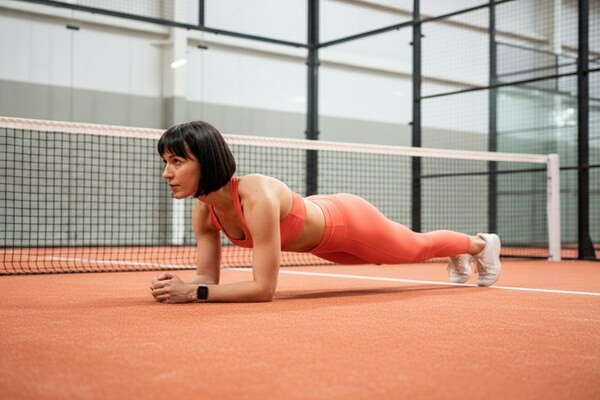
A standard front plank builds baseline stability, but side planks and plank-with-shoulder-taps add the anti-rotation element that padel demands. Hold each position with a straight line from shoulders to ankles, without letting your hips sag or rise.
Single-Leg Balance with Core Engagement
Stand on one leg and slowly reach the opposite hand toward your foot, or hold a light weight and rotate your torso while balancing. Padel rarely happens on two stable feet, so training your core to stabilize on one leg carries over directly to lunges and stretches during a rally.
Which Exercise Trains Which Shot
Here's a quick reference for connecting these exercises to the shots and situations they help most.
| Exercise | Core Function | Helps Most With |
|---|---|---|
| Pallof press | Anti-rotation stability | Defending off-balance shots, resisting body twist |
| Medicine ball rotational throw | Rotational power | Forehand power, smash, bandeja |
| Plank variations | Static core stability | Overall balance, posture during long rallies |
| Single-leg balance work | Dynamic stability | Lunges to the glass, recovery footwork |
How to Build a Simple Core Routine
You don't need an hour-long session to see results. A focused fifteen-minute routine, done consistently, beats an occasional long workout. Try this structure:
- Warm up with two minutes of light movement — jumping jacks, high knees, or a short jog in place
- Two sets of Pallof press, 12 reps per side, resting 30 seconds between sets
- Two sets of medicine ball rotational throws, 10 reps per side
- One 30-45 second front plank, followed by 20-30 seconds per side of side plank
- Two sets of single-leg balance reaches, 8-10 reps per leg
- Finish with light stretching, focusing on the hips and lower back
This whole sequence takes around fifteen minutes and can slot easily into a warm-up before you play, or stand alone as a short off-court session two or three times a week.
Advice
Do the rotational exercises on both sides evenly, even though one side probably feels more natural. Padel players who only train their dominant rotation direction often end up with muscle imbalances that show up as nagging lower back tightness.

Common Mistakes When Training Core for Padel
Plenty of players do put in core work, but a few habits keep that effort from actually showing up on court.
Бесплатный генератор турнирной сетки — Americano, Mexicano и другие форматы. Готово за пару минут.
Only Doing Crunches
Crunches train forward flexion, which almost never happens during a padel shot. Time spent on crunches alone is time not spent on the rotational and anti-rotation work that actually transfers to your game.
Ignoring Rotational Movement
Static holds like planks are useful, but padel needs a core that can generate and control rotation under speed. Skipping rotational throws or twists means missing the exercise category that maps most directly onto your shots.
Overtraining Without Recovery
Core muscles recover slower than people expect, especially with rotational work. Training the same muscles hard every single day without rest tends to lead to fatigue that shows up as sloppier technique, not stronger shots.
Important
Stop any core exercise immediately if you feel sharp pain in your lower back, as opposed to normal muscle fatigue. Sharp pain is a sign to check your form or scale back the exercise, not to push through it.

How Often Should You Train Your Core?
Two to three sessions a week is enough for most recreational and intermediate padel players. That gives your muscles time to recover between sessions while still building strength consistently. If you play padel several times a week already, a shorter version of the routine as part of your warm-up on playing days works well alongside one or two dedicated sessions.
Core training for padel isn't about building visible abs. It's about giving every shot a stable, powerful base to work from, and giving your body the resilience to handle a long match without breaking down. A few focused sessions each week, built around rotation and stability rather than endless crunches, is enough to feel the difference in your control and your recovery on court.