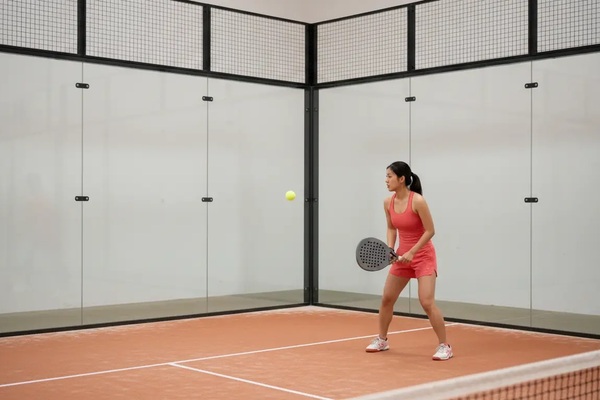
Freezing up when the ball comes off two walls?
A double wall shot in padel happens when the ball touches two walls, usually the back wall and a side wall, after it bounces on the court. It's completely legal and one of the most common sources of confusion for beginners, since the ball can come off the corner at a sharp, unexpected angle instead of the straight rebound most new players expect.
This guide explains exactly what a double wall shot is, why it's allowed under the rules, how to read and return it, and how more advanced players eventually turn it into an attacking weapon instead of just a defensive scramble.

What Is a Double Wall Shot in Padel?
A double wall shot is any rally ball that contacts two walls in sequence, most often when it lands near a back corner and touches both the back glass and the side glass before a player hits it. Because the two walls meet at roughly a right angle, the ball's direction changes twice in quick succession, which is very different from the simple, predictable bounce you get off a single wall.
Some players and coaches call this a "corner shot," since it almost always happens where the back wall and a side wall meet. You'll also hear the Spanish term "doble pared" used, especially by players who learned the game in Spain or Latin America.
These shots usually happen after a smash, a bandeja, or a hard lob that lands deep and close to a corner. The ball bounces on the court first, then clips one wall, then the other, before it's played back into the rally.
Is a Double Wall Shot Allowed in Padel?
Yes. According to the rules, once the ball has bounced once on the court, it can touch the back wall, a side wall, or both, any number of times, as long as it's returned before it bounces a second time on the ground. There's no limit on how many walls the ball can hit after that first bounce.
The only version of this that isn't allowed is a ball touching a wall before it bounces on the court at all. If the ball hits a wall first and the ground second, it's out. Once the ground contact happens first, the walls become fair game, whether the ball touches one of them or both.
Important
Order matters more than count. One wall touch or five, it doesn't matter, as long as the ball bounced on the ground first and hasn't bounced twice by the time you hit it.

Why Double Wall Shots Confuse Beginners
Most beginners get comfortable reading a single wall bounce fairly quickly. A ball that hits the back glass comes straight back out at a predictable angle. A double wall shot breaks that pattern completely, since the second wall contact redirects the ball sideways, often sending it toward the middle of the court instead of continuing along its original path.
Coloque à prova com nosso questionário de padel gratuito — perguntas rápidas, resultado instantâneo.
The confusion usually isn't about the rules, it's about timing and positioning. New players often move to intercept where they expect the ball to go after one wall, then watch it bounce away from them after the second contact.
Where Double Wall Shots Happen Most Often
Off a Deep Smash
When an opponent hits a hard, flat smash that lands close to a back corner, the ball often has enough pace to reach both walls before losing much speed. These are usually the fastest, most demanding double wall shots to defend, since there's very little time between the first and second wall contact.
Off a Defensive Lob
A high, deep lob that drops into a corner produces a slower, more manageable double wall bounce. The ball has less pace by the time it reaches the walls, giving you more time to read the direction and adjust your position before playing your shot.
How to Read a Double Wall Shot
The first clue is where the ball is heading before it lands. Shots aimed deep into a corner, especially smashes and bandejas hit with pace, are the most likely candidates for a double wall bounce. If you see the ball tracking toward a corner rather than the flat back wall, prepare for a sideways deflection rather than a straight one.
Watch the first wall contact closely. Whichever wall the ball hits first tells you roughly where the second contact will send it: a ball that hits the back wall first and then the side wall will usually come out toward the center of the court, while the reverse order tends to send it back along the side.
Note
Every court is a little different. Glass thickness, temperature, and even how worn the ball is can all change exactly how a double wall bounce behaves, so treat these patterns as a general guide rather than an exact science.

How to Play a Double Wall Return
Give the ball extra time. Rushing in to hit a double wall shot before it's finished bouncing is one of the most common ways to mishit it. Stay slightly further back than you would for a single wall ball, and let the second contact happen before you commit to your swing.
Keep your racket ready in a neutral position rather than committing early to one side. Since the exact angle depends on precisely where and how the ball strikes each wall, small changes in your read can matter more than they would on a simpler shot. A short, controlled swing gives you more room to adjust at the last moment than a big, committed stroke.
Footwork matters too. Small, adjustable steps let you shift at the last second once the ball's true direction is clear, while a big committed run toward a guessed spot leaves you stuck if the read turns out wrong.
| Aspect | Single Wall Shot | Double Wall Shot |
|---|---|---|
| Walls Touched | One (back or side) | Two (back and side) |
| Predictability | High, straightforward rebound | Lower, sharp change of direction |
| Common Cause | A ball landing near the middle of the back wall | A ball landing deep, close to a corner |
| Best Response | Normal positioning and timing | Extra time, neutral racket position, wait for the second contact |
Turning a Double Wall Bounce into an Attack
More experienced players don't just survive double wall shots, they use them. Once you can reliably read how the ball comes off a corner, you can set up an attacking shot like a bajada, using the extra height and slightly slower pace the double bounce often creates to step in and drive the ball forward instead of simply blocking it back.
This takes time, since it depends on reading the bounce pattern fast enough to adjust your whole body, not just your racket. Beginners should focus on consistently getting the ball back in play first, and look for attacking chances once defending the corner feels comfortable.
Common Mistakes with Double Wall Shots
Committing Too Early
Moving toward where the ball "should" go after the first wall contact, before the second contact happens, is the most common error. Wait until both wall touches are done before deciding your positioning.
Gerador de chaveamento gratuito — Americano, Mexicano e mais. Pronto em minutos.
Standing Too Close to the Corner
Crowding the corner leaves you almost no time to react once the ball changes direction a second time. Give yourself a step or two of extra space compared to how you'd position for a single wall shot.
Swinging Too Hard on the Return
Because double wall shots often lose pace through the two contacts, players sometimes overcompensate with a big swing. A controlled, shorter stroke usually gives a more reliable result than trying to generate extra power.
Ignoring Your Partner's Position
A double wall shot is often better covered by whichever player has a clearer angle, not necessarily whoever is closest. Failing to communicate can leave both players hesitating, or worse, both going for the same ball.
Advice
Communicate early with your partner when a ball looks like it's heading for a corner. A quick call lets whoever is better positioned take the shot instead of both players hesitating.

Drills to Get Comfortable with Double Wall Shots
These drills work well with a coach or a practice partner feeding balls into the corners:
- Have a partner feed lobs and smashes deep into each back corner so you can practice reading the double bounce.
- Practice from both corners of the court, since the deflection direction reverses depending on which wall is hit first.
- Start with slower, higher feeds to build your read before adding pace.
- Add a live point after each fed ball, so you get used to defending and then continuing the rally rather than just blocking the return.
- Once returns feel consistent, try stepping in on the slower double wall bounces to practice turning defense into an attacking shot.
Double wall shots stop feeling chaotic once you've seen enough of them. With a bit of practice reading the corners, what looks like an unpredictable bounce becomes just another shot you know how to defend, and eventually one you can use yourself to put opponents in the same awkward position.