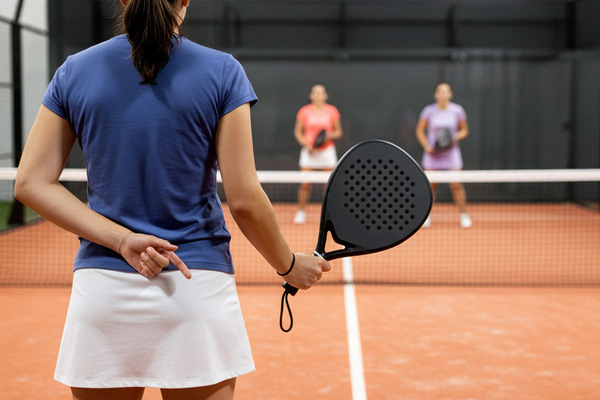
Losing easy points because you and your partner don't talk?
Padel is almost always played in doubles, and the partnership between two players is often the deciding factor in a match. Yet many pairs with perfectly good technique lose points for a very simple reason: they don't talk. Two players collide on an easy volley, a ball drops between them, or one retreats while the other stays at the net. The fix isn't more skill. It's a handful of short, clear calls and a few simple habits. This guide gives you the padel communication basics for doubles partners: the core calls, when to use them, hand signals, what to say between points, and how to practice.

Why Communication Wins Points
Verbal communication enables coordinated movement, prevents unforced errors, and helps you anticipate what the opponents will do. A simple "mine" or "yours" can prevent a collision and secure a valuable point. Great teams treat doubles as more than two singles players standing side by side. They use smart, simple signals, communicate at the right time, and share movement patterns. Talking too much or too little can both wreck the rhythm, so the goal is the right amount, delivered clearly.
Note
Staying silent is the single most common communication mistake. Even a basic "mine" on balls down the middle prevents most coordination errors, so start there.

The Core Calls
You don't need a long vocabulary. A small set of words, used consistently, covers nearly every situation.
| Call | Meaning | When to Use It |
|---|---|---|
| "Mine" | I'm taking this ball | Any ball you can reach, especially down the middle |
| "Yours" | You take it | When the ball is better placed for your partner |
| "Middle" | The ball is down the center | To clarify who covers the middle |
| "Lob" | A high ball is coming | When you see an opponent lob |
| "Switch" | We're swapping sides | When a lob passes over one player and the other covers |
| "Up" / "Go" | Move forward together | When you see a chance to take the net |
| "Back" | Drop back together | When you need to retreat as a pair |
| "Watch out" | Danger, such as a lob or an unusual bounce | To warn your partner early |
Rules for Good Calls
- Be early. The earlier the call, the more time your partner has to adjust. Calls should be proactive, not reactive, and speaking too late is a common mistake.
- Keep it short. One word is usually enough. Long chats between points rarely help.
- Give each word one meaning. Unclear messages cause confusion, so use short, concrete words such as "mine," "yours," or "switch."
- Be consistent. Use the same words every time, so your partner doesn't have to decode new commands in the middle of a match.
- Be loud enough to hear. Court noise and the glass can swallow quiet calls, but you don't need to shout.
Calls on Lobs
Lobs cause more misunderstandings than almost any other shot. A simple sequence helps: call "Lob!" to warn your partner that a high ball is coming, "Yours!" if the ball is on their side, and "Switch!" if it passes over you and you need to swap sides. Because lobs also lead to retreat and advance decisions, add "Back" when you both need to drop and "Up" when you can move forward to win back the net. These calls prevent the dangerous split position where one player is at the net and the other at the baseline.
Изпробвайте го с нашата безплатна викторина за падел — бързи въпроси, незабавни резултати.
Hand Signals Before the Serve
Words aren't the only tool. Before each serve, the net player of the serving pair can show a hand signal behind their back to tell their partner what they plan to do, for example which direction to serve or whether to cross. A common set covers a serve to the line, to the body, or to the glass. Agree the signals before the match, keep them simple, and use the same ones every time. A raised arm can also be used with the call "switch," and the same signal can switch you back.
Important
Consistency matters more than complexity. Three or four signals you both remember under pressure are worth far more than ten you have to think about.

Between Points: Talk Briefly, Look at Each Other
The time between points is when real strategy happens. A quick glance at your partner confirms you're both ready, and a few words can adjust your plan. Use these moments to agree who covers the middle on certain patterns, share something you noticed about the opponents, or decide where to serve. Keep it brief, and give each other space. Some players want a tip in the middle of a match, and others prefer a fist bump, so it helps to ask your partner what they like before you start.
What Not to Say
- Blame. "You should have had that" kills momentum. Encourage your partner after misses instead.
- Constant coaching. There is a difference between tactical discussion and constant instruction. Padel should be fun, so find the balance.
- Long speeches. If it can't be said in a sentence, save it for a break or after the match.
- Self-criticism out loud. Calling yourself the weak link before every point gets old quickly.
- Silence. Saying nothing is the number one mistake. Even a plain "mine" helps.
A Two-Minute Pre-Match Agreement
- Agree the core calls: "mine," "yours," "switch," "lob," "up," and "back."
- Decide who takes the middle ball in common situations.
- Choose two or three hand signals for the serve.
- Ask each other how you prefer to receive feedback during the match.
- Agree a quick reset phrase for when things go wrong, such as "next point."
Playing With a New Partner
Communication matters most when you don't know your partner's habits. Before your first match together, spend a minute agreeing the basics: the core calls, who takes the middle, and one or two signals. Use the same signals every time so your partner never has to decode something new in the middle of a match. A relaxed, friendly tone helps too, since a new partner who feels supported plays better than one who feels judged.
How to Practice Communication
Dedicated practice builds communication faster than playing matches alone. Try these simple ways:
- Call-every-ball sets. Play a practice set where every ball must be called "mine" or "yours."
- Signals before a match. Spend fifteen minutes practicing poaching with hand signals.
- Role swap. Play points where one player directs all tactical decisions, then switch roles.
- Review after games. When both of you went for the same ball, or neither did, talk through what the call should have been.
Levels of Communication
| Level | Focus |
|---|---|
| Beginner | "Mine," "yours," and a clear call on every middle ball |
| Improving | Add "lob," "switch," "up," and "back," and talk briefly between points |
| Experienced | Add hand signals, tactical patterns, and honest, short feedback |
Common Mistakes
Calling Too Late
A call after the swing has started creates the confusion it was meant to prevent. Call early.
Using Different Words Each Time
Changing your vocabulary forces your partner to decode it mid-rally. Stick to a few words.
Over-Explaining on Court
Keep calls short and tactical. Don't turn the court into a debate.
Going Quiet When Things Go Wrong
That's when partners need each other most. Use a simple reset phrase and play the next point.
Advice
Try one session where your only goal is to call every ball. It feels awkward for ten minutes, then it becomes automatic, and you'll notice far fewer collisions and dropped balls.

Good padel communication isn't complicated: a few short calls, used early and consistently, a couple of simple hand signals, and a kind, brief exchange between points. Agree them before you play, practice them until they're automatic, and your partnership will look sharper than the sum of your two games.